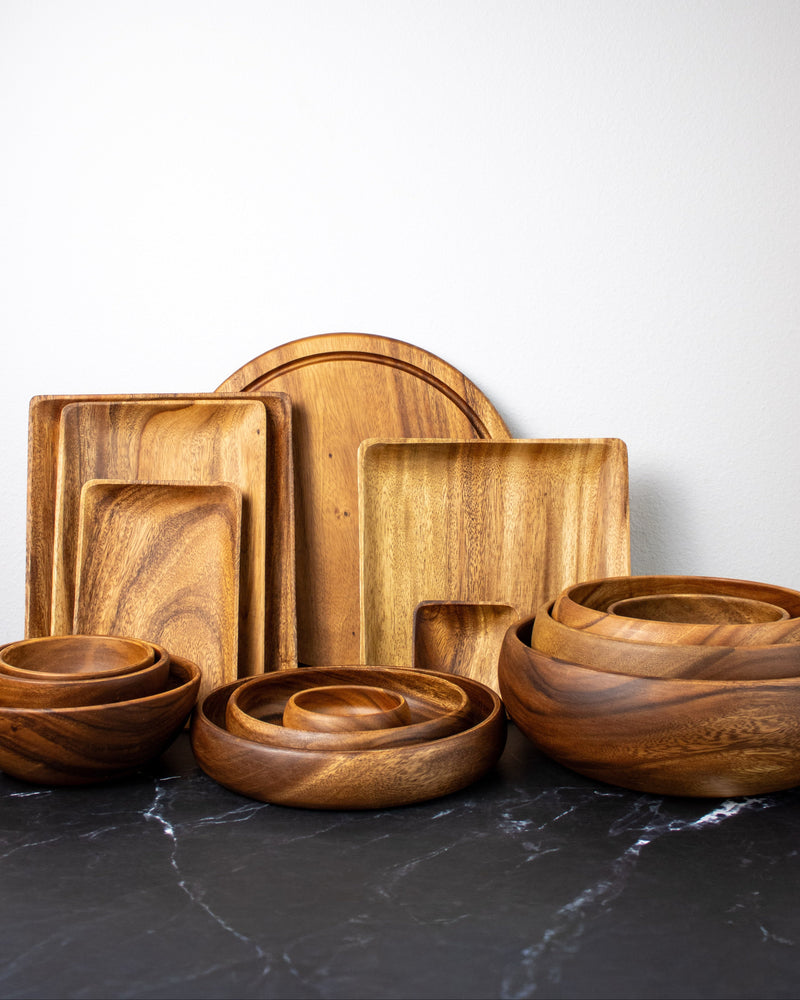
The bowl on your table might be labelled "acacia" and still have travelled through three countries before it reached you. Acacia mangium and the rain tree grow across Southeast Asia, so an acacia bowl carved in Vietnam, milled in Thailand, and finished in Indonesia can wear the same species name as a bowl carved in Pampanga from a tree that grew forty kilometres from the workshop. The word acacia does not tell you where the wood came from, who shaped it, or how far it travelled. For a Filipino household picking pieces for daily kanin, boodle fights, and pasalubong, that difference matters. It changes the price, the grain, the story, and the carbon behind the piece. This guide walks through what actually separates Philippine acacia from imported acacia, and how to read the difference on a product page.
Two acacias, one species name
The confusion starts with the label. Acacia is a huge genus with over a thousand species, but most tableware acacia is either Acacia mangium or the closely related rain tree, Samanea saman, which many workshops still market as acacia. Both grow across the tropical belt from the Philippines to Vietnam to Indonesia. A product page that says only "acacia wood" is telling you the material, not the origin. Two bowls with the same species name can have very different lives before they reach the table.
The species is common. The provenance is not.
Acacia mangium was introduced across Southeast Asia in the 1970s and 1980s as a fast-growing agroforestry species, and it took hold everywhere it was planted. Today it grows in commercial plantations in Vietnam, Thailand, Indonesia, Malaysia, and the Philippines. The rain tree grows even more widely and has been part of Filipino landscapes for centuries, planted along roads, in schoolyards, and beside rice fields. The species you buy in a Manila workshop and the species shipped in a container from Ho Chi Minh City are, botanically, cousins. What separates them is everything that happens after the tree is cut.
Why origin still matters even when the wood is the same
Origin changes four things you cannot see from a product photo. The distance the wood travelled before becoming a bowl. The number of hands that shaped it. The carbon burned to move it. And the traceability of the supply chain from tree to table. A bowl carved in a Pampanga workshop from acacia grown in a neighbouring province is a piece with a short, verifiable history. A bowl labelled "acacia" from a big-box import channel might be a fine piece, but the story behind it usually stops at a container manifest. Both can be well made. Only one carries the weight of place. Our guide on acacia and Philippine forestry covers the tree and its place in local agroforestry in more depth.
The quick-reference comparison
The differences between Philippine and imported acacia are not about the wood itself. They are about the chain behind the wood:
- Growing region: Philippine acacia is typically farm sourced in Luzon and the Visayas. Imported acacia commonly comes from Vietnam, Thailand, or Indonesia.
- Distance to workshop: Philippine wood is usually cut and carved within the same island group. Imported wood often crosses one to three international borders before finishing.
- Traceability: Philippine workshops can typically name the region and often the craftsman. Import channels rarely disclose either.
- Price: Imported acacia sold at scale is often cheaper per piece because volume plantations and container logistics drive unit costs down.
- Character: Both can be beautiful. Philippine pieces from smaller workshops tend to show more visible handwork.
How local sourcing actually works
The Philippine acacia supply chain is shorter than most shoppers realise. In many cases the tree grew, was cut, and was carved within a hundred-kilometre radius. This is not marketing language. It is the practical reality of how heritage workshops have operated for generations, long before "local" became a product-page virtue. Our piece on the tree to table journey follows the same route step by step.
From agroforestry plot to workshop
Acacia mangium and the rain tree grow in agroforestry systems across Pampanga, Pangasinan, Batangas, Bohol, and Cebu, often as shade trees on coconut and coffee farms or as boundary planting along rice fields. Farmers sell mature trees to local sawmills when the timber value peaks, typically at eight to twelve years of growth. From the sawmill the lumber moves to nearby carving workshops, some of them family run for three generations. In heritage carving centres like Betis in Pampanga, and in Cebu's woodcraft villages, the wood often changes hands only twice between the tree and the finished bowl.
Named regions, named craftsmen
The clearest sign of a genuinely local piece is disclosure. Ask a Philippine workshop where their wood comes from and you will usually get a province, sometimes a municipality, occasionally the name of the farmer who sold the tree. Ask which craftsman carved a specific bowl and, for heritage workshops, you will often get an answer. This is not romantic embellishment. It is a practical consequence of a supply chain that fits inside one country and often inside one region. The regions most commonly named across the Filipino tableware trade include Pampanga for its long carving tradition, Cebu for its woodcraft villages, and Batangas and Pangasinan for their agroforestry timber. These are not marketing claims. They are the places where the workshops actually are.
What "farm sourced" really means
Farm sourced is another phrase that does a lot of work on product pages. Translated honestly, it means the acacia was grown on managed agricultural land rather than harvested from a native or old-growth forest. For Philippine acacia this is nearly always true, because there is no meaningful old-growth acacia industry here. The trees are planted, grown, felled, and replanted on the same land. If a Philippine tableware brand claims farm sourced acacia, the claim is usually accurate. Verifying it takes one question: which province, which farm, and how long has that workshop been buying from them?

Locally carved bowls for daily kainan
The Gorosin bowl set is carved from Philippine acacia in the same island group where the tree grew, holding rice, sinigang, and lugaw with the calm presence of a piece that stayed home.
Shop the Gorosin Bowl Set →Imported acacia: where it comes from and what it costs
Most of the acacia tableware sold globally does not come from the Philippines. It comes from Vietnam, Thailand, and Indonesia, where large-scale acacia plantations and export-oriented woodware industries have grown steadily since the 1990s. This is a real industry making real pieces, and much of it is well made. It is also a different proposition from a piece carved down the road from where the tree grew.
Vietnam, Thailand, Indonesia: the export triangle
Vietnam is the world's largest exporter of acacia wood products, with plantations concentrated in the central and northern provinces. Thailand has a mature woodware industry centred in the north, with acacia products moving through Chiang Mai and Bangkok before shipping. Indonesia's acacia plantations, mostly on Sumatra and Java, feed both domestic markets and export lines. All three countries produce acacia tableware that gets sold under generic acacia labelling in North America, Europe, and increasingly in the Philippine retail market itself. This is the wood you are usually looking at when a big-box import piece says only "acacia wood" with no further disclosure.
The container-ship supply chain
Imported acacia usually reaches a Filipino kitchen via a longer chain than most shoppers picture. Wood is felled on the plantation, milled locally, sometimes shipped as rough lumber to a second country for finishing, then containerised and shipped again to the destination market. A bowl in a mall display can easily represent lumber cut in Vietnam, finished in Indonesia, and shipped through Manila. Each step is fine on its own. Stacked together they add distance, hands, and time between the tree and the table. For a piece that will be used for years, this is not a disqualifier. It is just a fact worth knowing.
Where the price comes from
Imported acacia sold at scale is often less expensive per piece than a Philippine workshop bowl, and the reason is straightforward. Plantation acacia at export scale is grown for volume, milled with industrial efficiency, and shipped in container quantities that lower per-unit logistics costs. A Philippine workshop working from local lumber, with named carvers and smaller batches, cannot match that unit cost, and does not try to. The trade-off is transparent: you pay less for imported acacia at scale, and you pay more for pieces you can trace to a workshop and a region. Neither is wrong. They are two different value propositions on the same species.
Carbon, craft, and what "locally made" means
Local sourcing is often framed as a carbon story, but it is really two stories at once. One is the actual embodied carbon of shipping and handling. The other is the craft economy of which workshops keep operating. Both matter, and neither is served by vague product-page slogans. Our broader look at whether acacia is sustainable sets out the plantation-side picture.
The distance a bowl travels
An acacia bowl carved in Betis and sold in Manila travels roughly a hundred kilometres by road. The same bowl carved in a Vietnamese workshop and sold in Manila travels roughly two thousand kilometres by road and sea, in a container that carries thousands of pieces alongside it. We are not going to quote a per-bowl carbon figure, because the honest answer depends on ship efficiency, container fill, and last-mile logistics that no product page can verify. What we will say is directional and easy to check on a map: shorter distance and fewer transfers mean lower embodied transport carbon per piece. This is not a certified footprint. It is basic geography applied to a wooden bowl.
The craft economy behind local pieces
The other side of local sourcing is the workshop economy. Philippine acacia carving is a living craft tradition with active workshops in Pampanga, Cebu, and elsewhere. Each piece sold through those workshops pays a specific set of hands: the farmer who grew the tree, the sawyer who milled it, the carver who shaped it, and often the finisher who oiled it. Import channels support their own workshops too, but from the perspective of a Filipino buyer, choosing local means paying workshops in your own country to keep operating. If you have ever visited a heritage carving village and watched a bowl take shape from a block of lumber, that decision starts to matter beyond spreadsheet economics.
Reading between "sustainable" and "responsibly sourced"
Product pages use "sustainable" and "responsibly sourced" almost interchangeably, and often neither term is defined. Here is the practical translation:
- "Sustainable" without provenance usually means fast-growing species. It is true and thin.
- "Responsibly sourced" without a named region is usually a statement of intent, not a verifiable claim.
- Named region plus named workshop is the strongest signal, because it can be checked.
- For plantation acacia, look for FSC certification if the brand claims one.
- For Philippine acacia, look for the workshop or carving village named directly.
None of this makes imported acacia bad. It just means the sustainability claim behind an unnamed import is thinner than the same claim behind a named workshop. Our comparison of acacia and teak covers a similar provenance question for the other main premium wood.

Plates carved close to the timber
The Ina plate set carries grain that no import container will duplicate, shaped in a Philippine workshop from wood grown within the same island group.
Shop the Ina Plate Set →Look, feel, and quality at the table
Origin does not determine whether a piece is well made. There are stunning imported acacia bowls and there are ordinary Philippine ones. But there are patterns worth knowing when you pick up a piece and look for the character behind it.
Grain and finish, workshop by workshop
Acacia grain is dramatic wherever it grows. Dark coffee-brown streaks across a paler background is the signature look, and it varies more by tree than by country. What does vary by workshop is finish. Volume-scale imported pieces often carry a machine-buffed, uniform finish that hides small variations. Handworked Philippine pieces tend to show softer tool marks, slight asymmetries at the rim, and a hand-oiled sheen that develops rather than sits on top. Neither is objectively better. If you want the character of the wood to show, look for pieces where the finish reveals the grain rather than glossing over it. This is closer to what you get with mango wood too, which we cover in our acacia vs mango wood comparison.
Weight, thickness, and edge quality
Volume-scale plates and bowls are often milled thinner and lighter to keep container weight and unit cost down. Workshop pieces from Philippine carvers tend to be a little heavier and thicker, because they are shaped from bigger blanks and finished by hand. Pick up an acacia bowl and feel the weight in your palm. If it feels substantial without being unwieldy, and if the rim is smoothed to a soft round rather than a sharp machined edge, you are usually holding a piece that has spent more time in a carver's hands than in a machine.
How each ages through years of kainan
The wood ages the same either way. Philippine acacia and imported acacia both darken evenly with regular oiling, both develop a soft patina from years of use, and both reward the same care routine. What changes is the story. A piece from a named Philippine workshop, carried through years of noche buena dinners and salu salo weekends, becomes a family object with a specific origin behind it. A piece from an unnamed import channel becomes a beloved bowl with no story attached to its beginning. Both can end up as heirlooms. Only one starts as a piece you can talk about when your apo asks where it came from.
How to tell what you are buying
Provenance is the whole game. If you want to know whether the acacia in front of you is Philippine or imported, and how far from the tree it was carved, the answer is on the product page or it is not. Here is how to read for it.
Questions a good brand can answer
A Philippine tableware brand selling local acacia should be able to answer, without evasion:
- Which region or province did the wood come from
- Which workshop or carving village shaped the piece
- What finish was applied and whether it is food safe
- How long the workshop has been operating
- Whether the wood is farm sourced or plantation sourced
These are not gotcha questions. They are the same questions any transparent supply chain expects. If the brand cannot answer, the piece may still be fine, but the "locally made" claim is thinner than it looks. Our guide on how to tell real acacia from fake covers the species-authentication side of the same instinct.
Red flags on a product page
The clearest red flags for an unclear origin claim:
- The word "acacia" appears with no country of origin listed anywhere on the page
- "Sustainably sourced" appears without a named forest, region, or certification
- The finish is described as "wood finish" or "natural finish" without specifying oil, wax, or lacquer
- The brand story references heritage without naming a specific workshop or village
- The price is dramatically lower than comparable named-provenance pieces
None of these are proof that the wood is imported. They are signals that the origin is not being disclosed. In the tableware trade, undisclosed usually means volume import.
When imported acacia is the right choice
Imported acacia is a genuine, useful category. If you need a large set at an entry-level price, if you are buying pieces for casual outdoor use, or if the story of a specific piece matters less to you than the function it will serve, imported acacia does the job. Where local acacia earns its price is in pieces that will sit on the table for years, that will hold food you cook for people you love, and that will eventually pass to the next kitchen in your family. For those pieces, the shorter supply chain and the named workshop are the difference between an object and an heirloom. If you are choosing across other wooden options too, our acacia vs bamboo tableware guide covers that side of the decision.

A full-table set with a short supply chain
The Pamilya board set anchors the whole spread, from boodle fight to weekday ulam, in Philippine acacia carved close to the timber and made to earn its place across years of kainan.
Shop the Pamilya Board Set →Frequently Asked Questions
Is Philippine acacia a different species from imported acacia?
Usually no. Most tableware acacia across the Philippines, Vietnam, Thailand, and Indonesia is Acacia mangium or the rain tree, Samanea saman, marketed as acacia. The species is the same. The origin, workshop, and supply chain are what differ.
Where does most imported acacia tableware come from?
Vietnam is the largest exporter of acacia wood products globally, with Thailand and Indonesia following. Acacia products labelled generically in retail channels most often originate in one of these three countries and may be milled, carved, or finished across more than one of them.
Is Philippine acacia higher quality than imported?
Not automatically. Quality varies by workshop more than by country. What Philippine sourcing offers is a shorter supply chain, named workshop provenance, and the ability to trace the wood back to a specific region. Well-made imported pieces can equal handmade Philippine ones on the surface.
Why is Philippine acacia often more expensive than imported?
Imported acacia at export volume benefits from plantation-scale milling and container-scale shipping economics that lower unit costs. Philippine workshop acacia is made in smaller batches, with more handwork per piece, and paid at named workshop rates rather than volume-plantation rates. The price gap reflects scale and craft, not raw material quality.
How can I tell if an acacia bowl was made in the Philippines?
Check the product page for a named region or province, a named workshop or carving village, and a specific finish disclosure. Ask the brand where the wood was grown and where it was carved. Transparent Philippine brands will name Pampanga, Cebu, Pangasinan, Batangas, or Bohol as the origin.
Is imported acacia less sustainable than Philippine acacia?
Sustainability depends on more than distance. Both can be grown on managed plantations, and both are fast-renewing species. Philippine acacia typically travels far shorter distances to reach a Filipino kitchen, which lowers transport carbon per piece. For a full sustainability picture, look for named provenance and, for plantation wood, FSC certification.