You bought a bowl labelled "acacia." Maybe it was a gift, maybe a marketplace find, maybe a department store buy. Now you are looking at it under the kitchen light and something feels off. The color is too even. The weight is too light. The seller never said where it came from. You are not paranoid. You are doing what most buyers should do but rarely think to.
The wood-tableware market has a fraud problem, and acacia sits at the center of it because acacia is desirable enough to fake but not so rare that the substitution feels absurd. Stained pine, stained rubberwood, and over-darkened mango get rebranded as acacia every day, in mall stores and online listings alike. The tests below are the ones our workshop uses on every batch, and the ones you can run at home in ten minutes with no tools beyond your hands, a glass of water, and a strong light.
Why fake acacia floods the market
Acacia is one of those woods that sits in a strange commercial sweet spot. It is well-known enough that buyers ask for it by name, premium enough to command a higher price than pine or rubberwood, but not so rare or regulated that substitution feels risky for the seller. That gap, the difference between what acacia commands at retail and what the substitute actually cost the maker, is where the fraud lives.
The price gap that makes fraud profitable
A genuine Philippine acacia bowl, sourced from a legitimate workshop, finished with food-safe oil, and shipped honestly, has a real floor price. The wood is dense, the trees take decades to mature, and the labor to hand-finish a bowl is not trivial. When you see a piece labelled "acacia" selling for a fraction of what a comparable real piece costs, the math has to come from somewhere. Usually it comes from the wood itself. Rubberwood, the throwaway by-product of expired rubber-tree plantations, costs almost nothing. Stained pine costs even less. A dark walnut-tinted lacquer on either of them passes a quick glance, and quick glances are most of what online shopping is.
What sellers usually substitute
The three most common substitutes are rubberwood (light, pale yellow, takes stain beautifully, the workhorse of cheap kitchenware), pine (very light, very soft, dents under a fingernail), and mango wood stained darker than its natural color. Mango is actually a respectable wood in its own right, and a piece sold honestly as mango is fine. The deception is when mango gets over-stained and rebranded to fetch acacia prices. Each of these substitutes has tells that the next chapters will help you read.
Why "acacia-style" and "acacia finish" are red flags
Read product titles like a lawyer. "Acacia wood bowl" is a claim about the material. "Acacia-style bowl," "acacia finish wood bowl," "acacia-look serving board," and "in the style of acacia" are not claims about the material at all. They are claims about the appearance. Sellers who use these phrases are protecting themselves legally while letting you assume the wood is real. If the listing describes the look instead of the species, the wood is almost certainly not acacia. For the broader context on what real acacia is and how it grows, the full acacia wood guide walks through species, sourcing, and what to expect from a genuine piece.
Read the grain, the single most reliable tell
If you only run one test, run this one. Wood grain is the fingerprint of a species, and acacia has a fingerprint that is genuinely hard to fake convincingly. Stain can mimic a color. It cannot manufacture a grain pattern that grew through forty years of tree life. Once you know what to look for, the eye becomes faster than any chemical test.
What real acacia grain actually looks like
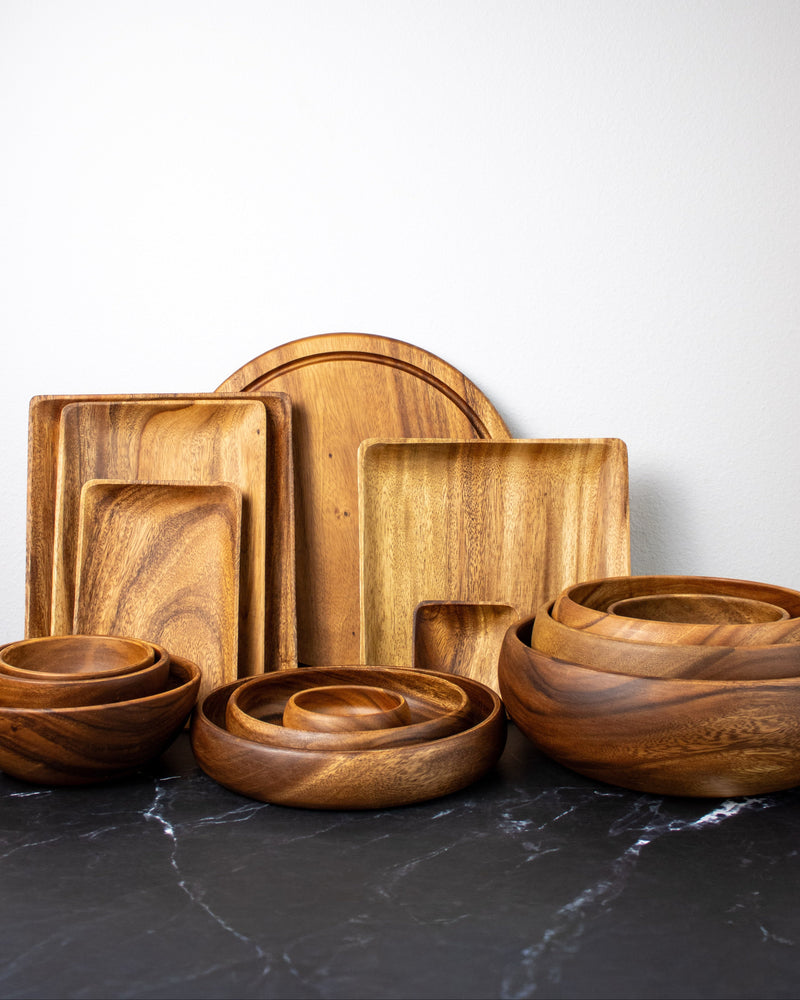
Real acacia carries dark streaks, often near-black or deep chocolate, running through a base that ranges from honey blonde to warm gold to reddish brown. The streaks are irregular. They flow with the wood, sometimes thick and sometimes thin, sometimes branching, sometimes running clean across the piece in a single sweep. There is contrast within a single board, and contrast between boards from the same tree. The base color is rarely uniform. You will see lighter passages and darker passages within the same bowl. This variation is the wood telling you its history, where the heartwood ended and the sapwood began, where a branch joined, where the tree grew faster or slower one year. A piece of real acacia looks alive. A stained imitation looks printed.
The "painted on" look of stained pine or rubberwood
Hold a suspect piece under a strong light. Stained pine and stained rubberwood almost always show a flat, even brown wash over the surface, with the original wood's faint, soft grain barely visible through the color. The grain is not dark streaking through a lighter base. It is a single tone of brown with subtle lighter lines underneath, the opposite pattern from acacia. If you tilt the bowl and the color looks like a coat sitting on top of the wood instead of a feature of the wood itself, you are looking at finish, not species.
How to check the underside and inside edges
The most diagnostic surfaces on any wooden piece are the ones nobody styled. Flip the bowl upside down. Look at the foot ring, the very edge where it meets the table. Look at the inside lip just under the rim. Look at any spot the manufacturer might have missed with the spray gun. On stained fakes, these areas often show the original pale wood color peeking through, or a thin sanded patch where the stain barely covered. On real acacia, the grain runs continuously from the visible top into the hidden underside, with the same streak pattern carrying through. Dark on top, pale on the bottom, is a near-certain sign of staining.
Why uniform color across a whole bowl is suspicious
This is the rule that catches most fakes. Real acacia almost never produces a finished bowl in which every square inch is the same shade of brown. The wood itself does not work that way. If your bowl is one consistent color, edge to edge, top to bottom, with no light streaks, no dark streaks, no variation, it has either been dyed to a uniformity that acacia simply does not produce, or it is a different wood entirely. Some buyers are conditioned to think uniformity equals quality. With acacia, uniformity equals a lie.

See what real acacia grain looks like
Every bowl in the Gorosin set carries the streaked, irregular grain that staining cannot replicate, sourced from a single workshop and finished with food-safe oil.
Shop the Gorosin Bowl Set →
The weight test, the smell test, and the water test
Grain reads the past of the wood. The next set of tests reads the wood itself, its density, its chemistry, and how it interacts with the world. Each of these takes under a minute, and together they are nearly impossible for a fake to pass cleanly.
Weight: acacia is dense, lift it and feel
Acacia is a hardwood with a specific gravity around 0.65 to 0.75, meaning a bowl of it weighs substantially more than the same shape made of pine (around 0.4) or rubberwood (around 0.55). You do not need a scale. Pick up the bowl with one hand and pick up any other wooden bowl of similar size with the other. A real acacia salad bowl feels noticeably solid, the kind of weight that makes you set it down carefully. A pine bowl in the same dimensions feels almost hollow by comparison, and a rubberwood bowl sits somewhere in between, closer to pine than to acacia. If the bowl labelled acacia feels lighter than you expected, trust the hand.
Smell: faint sweet-woody scent versus chemical varnish
Bring the inside of the bowl close to your nose. Real acacia finished with a food-safe oil has a faint, warm, slightly sweet woody scent, sometimes barely there, sometimes more pronounced on a newer piece. It smells like wood. A heavily lacquered fake smells like the lacquer, a sharp chemical note, almost solventy, with no wood scent underneath at all. The reason is simple. A thick lacquer seal traps everything below it. There is no wood to smell because the wood is wrapped in plastic. If your "wooden" bowl smells more like a freshly painted wall than like a tree, the seal is doing the talking.
Water test: a drop on raw wood versus a sealed fake
Find an unfinished or lightly finished spot on the bowl, typically the underside or inside the foot ring. Place a single drop of water on it and wait sixty seconds. On real acacia finished with oil, the drop will sit briefly and then begin to soak in slowly, darkening the wood around it. The darkening fades as the wood dries. On a piece sealed with heavy lacquer, the drop beads up perfectly, sits on the surface like it would on a plastic plate, and rolls off if you tilt the bowl. Beading on the underside, where stain and seal are usually thinnest, is a strong sign that the wood underneath is hidden by a coating thick enough to be doing more than just protecting the wood. It is hiding what wood it actually is.
The scratch test, only on a hidden spot
This one damages the piece, so use it as a last resort and only somewhere invisible, usually the underside near the foot ring. Take a coin or the back of a butter knife and scratch firmly across a small patch. On real acacia, you see wood. The scratch reveals the same kind of grain, the same color family, sometimes a little lighter where the oil has not penetrated as deeply, but unmistakably wood of the same species. On a stained fake, the scratch reveals the original pale wood underneath. Light yellow rubberwood under a dark brown scratch is conclusive. If you do not want to scratch the piece, skip this test and rely on the others. The grain, weight, smell, and water tests together are usually enough.
Checking construction and joinery
Beyond the wood itself, how the piece is built carries information. Construction does not tell you the species directly, but it tells you about the maker, and a maker who lies about wood often cuts corners in other places too.
One-piece versus glued-up pieces
Both can be real acacia, but they tell different stories. A bowl carved from a single block of wood is harder to make, requires a larger piece of timber, and is usually more expensive. A glued-up bowl, where strips of wood are joined edge to edge to form the blank, is more efficient and lets the maker use smaller offcuts. Neither is dishonest. What matters is whether the joinery is clean and whether the wood across the seams is consistent in grain and color. Glued-up real acacia will show streak patterns flowing across the joints, with the grain on either side of each seam still reading as acacia. A suspect piece will show grain that suddenly stops at a glue line and resumes as something different on the other side, or a uniform stain that masks the joints entirely.
End-grain inspection, the cross-section never lies
The end grain, the cross-section of the wood that shows the rings, is the most species-specific surface on any piece. Find an exposed end grain edge, often on the handle of a board or the rim of a board piece. Real acacia end grain shows large, open pores in an irregular pattern, with growth rings that ripple rather than march in neat concentric circles. Pine end grain shows tight, regular rings and very small pores. Rubberwood end grain shows a uniform pattern of small pores with little contrast. If you can see the end grain on your piece, it is the single most diagnostic surface available. A maker who knows their wood will often leave end grain visible. A maker who is hiding something usually sands and seals it until it disappears.
How factory-stained pieces hide seams under heavy lacquer
Heavy lacquer is the universal cover-up. It hides joint lines, masks color differences between glued strips, and creates a glossy, even appearance that reads as "finished" to buyers who do not know what to look for. Run your finger across the surface. A naturally oiled real acacia piece feels like wood, with a subtle texture you can feel through the finish. A heavily lacquered piece feels like glass or plastic, completely sealed, no texture, no breathing. The trade-off matters at the table too. A thick lacquer can chip, and once it does, water gets underneath and the wood you cannot see starts to rot. For more on which finishes are safe to eat from and which are not, see our guide to food-safe finishes.
What a properly finished acacia edge looks and feels like
A well-made acacia piece, finished honestly, has soft edges that have been sanded by hand, a finish you can feel as wood rather than as a plastic skin, and visible grain even where the maker has rounded the rim. The wood looks like the wood looks, with all its variation. The finish protects without disguising. If you put your fingernail against the rim and gently drag it, you should feel a very subtle texture, the way the grain runs into and out of the edge. A piece that feels suspiciously smooth, like a finished ceramic, has been over-sealed for a reason.

Plates from a workshop we can name
The Ina plates are turned in a Pampanga workshop we visit by name, with end grain left visible and oil finishing only.
Shop the Ina Plate Set →Questions to ask before you buy
The tests above let you verify a piece you already have in your hands. For something you are about to buy, especially online, the wood is not in your hands yet. The substitute test is to interrogate the seller. A legitimate seller can answer all four of the questions below without scrambling. A reseller who bought a container of mystery brown bowls from a wholesaler cannot answer any of them honestly.
Where was the tree grown and harvested
This is the first question and the one that filters out most fraud. Acacia grown in the Philippines, in Vietnam, in Thailand, and in India all exist and are all sold globally, but each origin has different practices, different species, and different reputations. A seller who can answer "the Philippines, Bulacan province" or "Vietnam, central highlands" is telling you something verifiable. A seller who says only "Asia" or "imported" or pivots to talking about the design is buying time. If you want to understand why provenance matters, the piece on where Philippine acacia is harvested walks through how the supply chain actually works.
Is it Philippine acacia or imported
Philippine acacia, specifically the rain tree (Samanea saman), grows in mature plantations and homestead lots across Luzon, the Visayas, and Mindanao, and has a grain pattern and density profile that long-time buyers learn to recognize. Imported acacia from continental Asia is often a different species and often grown in faster-rotation plantations, which produces lighter, less streaked wood. Neither is automatically better, but they are different, and a piece marketed as one when it is actually the other is misrepresented. Our Philippine acacia vs imported piece breaks down the practical differences you can see and feel.
What finish is on it
"Food-safe oil," ideally named (mineral oil, walnut oil, a beeswax blend), is the right answer for anything you eat off. "Lacquer" is fine for decor and for boards that will never touch wet food, but it is not what you want under a salad. "Sealed" or "protected" with no further detail is a non-answer that should make you ask a follow-up. If the seller cannot or will not name the finish, you do not know what your hands and your food are touching.
Can the seller name the workshop or village
This is the question that separates a brand from a reseller. A brand that works with a specific workshop can name the workshop, often the town, sometimes the lead craftsman. A reseller buying off a wholesale platform has no idea where the pieces came from beyond the name of the importer. You do not need every brand to give you a craftsman's name to trust them, but a seller who has no answer at all to "where was this made and by whom" is a seller who cannot verify their own supply chain. That alone is not proof of fraud, but it is proof that the seller cannot disprove fraud either.
What to do if you already own a suspect piece
Maybe you have read this far with a growing certainty that the bowl on your kitchen shelf is not what the box said. That is uncomfortable. It does not have to be expensive. Here is the practical sequence.
A simple home audit using the tests above
Take the piece into the brightest room in your house. Run the grain test, the weight test (compared against any other wooden piece you trust), the smell test, and the water test on the underside. Write down what you find. If three of the four tests fail, the piece is almost certainly not what was sold to you. If two of the four fail, it could be a real piece with an aggressive finish, or it could be a borderline fake. If only one fails, especially the weight test on a small piece, it is likely genuine and you can stop worrying.
When stained rubberwood is fine for decor but not for food
Be honest about what the piece is actually good for. A stained rubberwood bowl is not dangerous in itself. As a fruit display on a sideboard, as a catch-all for keys by the door, as a decorative piece on an open shelf, it functions perfectly well. What it should not do is hold food that has any moisture, especially anything acidic like vinegar-dressed salads or citrus. The lacquer that is hiding the cheaper wood can leach or chip, and the wood underneath, once exposed to moisture, can harbor bacteria in ways that real acacia, properly oiled, does not. Demote the piece, do not destroy it.
How to replace one suspect piece without redoing your whole set
You do not have to rebuy everything. The most-used piece, usually the family salad bowl or the everyday serving plate, is the one to replace first. Pick the piece that actually touches food every week and start there. The decorative pieces, the fruit bowls and shelf items, can wait or stay where they are in their new role as decor. Building a real set one piece at a time is also how most Filipino households have done it for generations. You are not falling behind. You are doing it the way it was always done.
When to ask for a refund and what evidence to gather
If the seller advertised the piece as acacia and your tests strongly suggest it is not, you have grounds to ask for a refund or replacement. Photograph the piece under good light, showing the uniform color and the lack of streaked grain. Photograph the underside, especially any spots where stain looks thin. Photograph the water test in progress, with the droplet beading. Save the original listing or receipt that named the wood as acacia. Send a calm, factual message naming your tests and the listing claim. Reputable sellers refund. Dodgy ones go silent, which is itself an answer about who you bought from.

A replacement piece you can verify
If you are replacing one suspect piece, the Pamilya board is hand-finished, with grain you can read across the entire surface.
Shop the Pamilya Board Set →Frequently Asked Questions
How can I tell if my acacia bowl is real at home, without tools?
Use your eyes, your hands, and a glass of water. Look for dark streaks running through a honey-blonde base, with visible variation across the piece. Lift it next to another wooden bowl and feel the weight. Place a drop of water on the underside and watch whether it soaks in slowly or beads up. Three honest tests, no equipment required.
What is the most common fake acacia wood substitute?
Stained rubberwood is the most common substitute by a wide margin. Rubberwood is cheap, takes stain evenly, and finishes smoothly, which is exactly what a factory wants when it needs to produce uniform brown bowls at scale. Stained pine is second, usually in lower-end products where weight is also obviously wrong.
Does real acacia wood always have dark streaks?
Almost always, yes, though the intensity varies. Some pieces show dramatic black streaks across a pale base. Others show subtler streaking, more chocolate than black. What real acacia rarely shows is a single uniform color from edge to edge. If your piece is one flat shade with no variation, it is not behaving like acacia behaves.
Will the water test damage my bowl?
No, if you do it on the underside and dry the spot afterward. A single drop of water on any wooden bowl is well within what the wood handles every time it gets washed. Wipe it dry within a minute or two, and there will be no lasting mark, whether the piece is real or fake.
Is stained rubberwood safe for food?
Rubberwood itself is food-safe and is used legitimately in many cutting boards. The issue is the finish on a stained piece, which is usually a thick lacquer rather than a food-safe oil. That lacquer can chip, and the seal that hid the cheaper wood can fail. Use stained rubberwood pieces as decor or for dry foods, not as everyday salad bowls.
Why is some "acacia" so much cheaper than others?
Sometimes because it is from a faster-rotation plantation with thinner-walled wood. More often because it is not acacia at all. The difference between real acacia at a fair price and a stained fake at a too-good-to-be-true price is usually the wood itself, not the markup. Match the price to the wood, not to the label.
Can two real acacia pieces look completely different?
Yes, and this is one of the more confusing parts for new buyers. Acacia grain varies dramatically between trees, between parts of the same tree, and between boards cut from the same log. Two genuine acacia bowls can read as almost different species at a glance. Uniformity within a piece is the red flag. Variation between pieces is normal and expected.