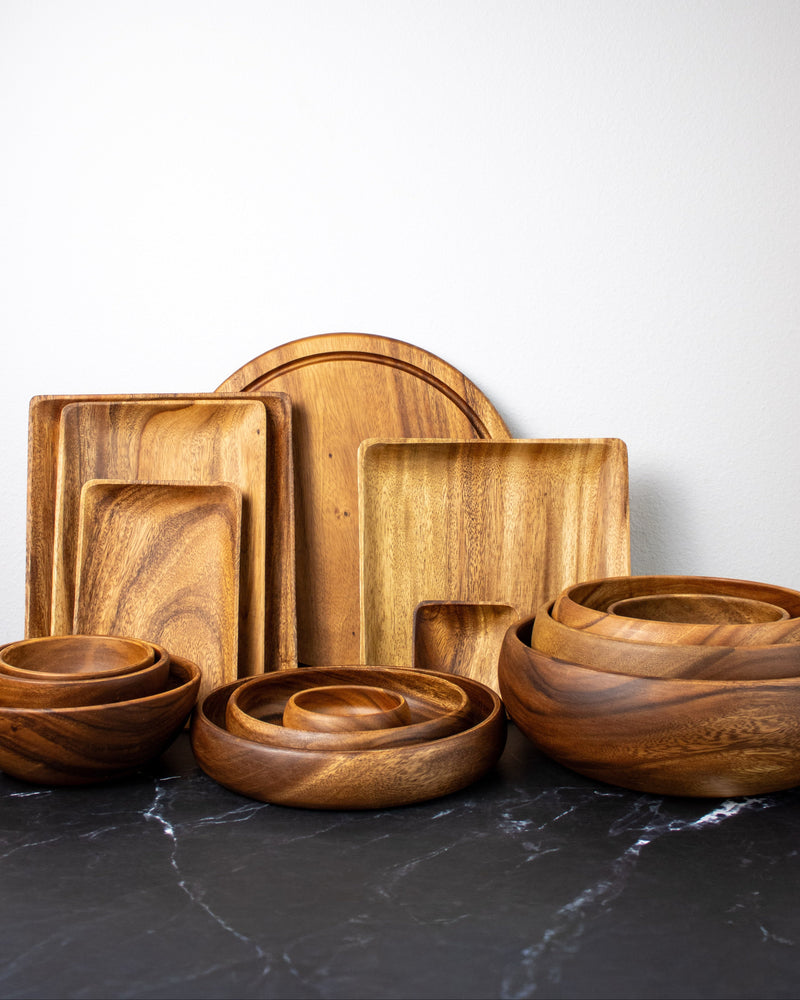
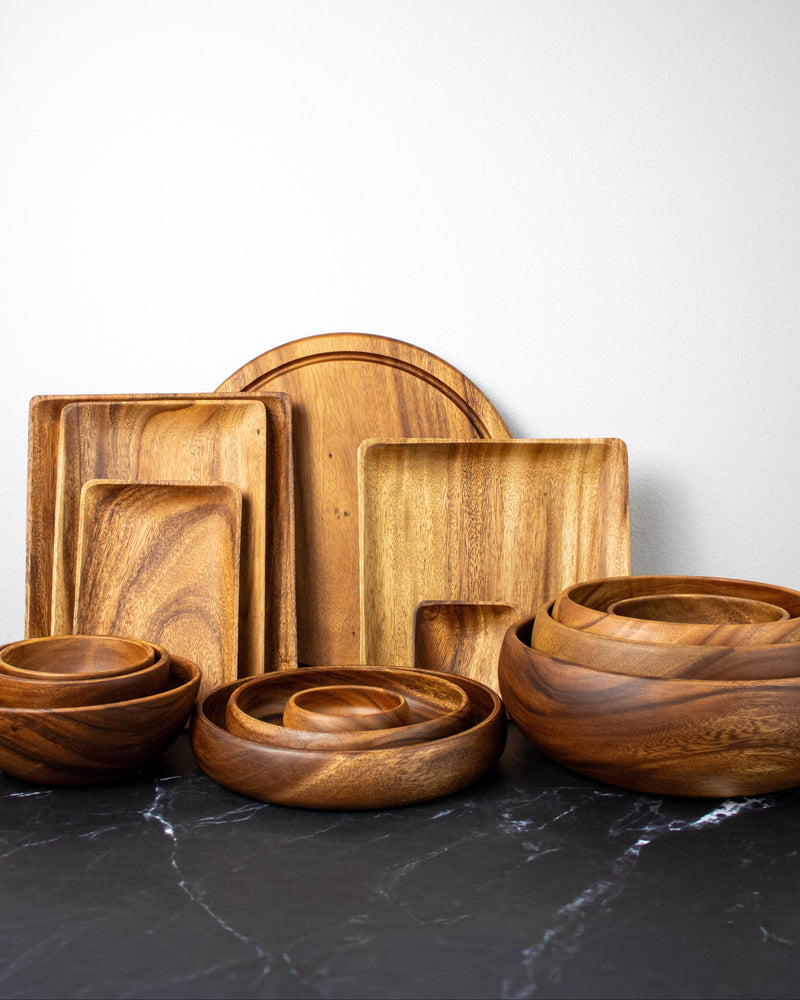
An acacia tree grows outside the plaza in almost every provincial town in the Philippines. It shades the tricycle stand. It drops pods that kids pry open in October. It has been there since before the oldest tita you know was born. If you have grown up here, or spent enough time here, that shape is home. It is one of the first trees you learned to draw. When you pick up a bowl in our workshop, or a serving board on your dining table, this is the tree in your hand.
But the story is more complicated than that, and the story matters, because it decides what "acacia tableware" honestly means and what it does not. What follows is the long version, in six beats: how the tree arrived, how it grew into the landscape, what the paperwork around it looks like, when we can actually harvest it, which of its neighbors we leave alone, and what all of that adds up to when the piece finally reaches your table.
The tree that came here and stayed
The acacia most Filipinos know, the wide-canopied giant that shades the church patio and the elementary school, is not native. It is Samanea saman, sometimes called the rain tree or monkeypod, originally from Central and South America. It arrived in the Philippines in the late 1800s, brought in during the Spanish period and planted heavily during the American colonial years for its shade and its speed of growth. If you look at old photographs of Manila and provincial capitals from the 1920s and 1930s, the same broad crown is already there, already established, already the tree everyone stood under to wait out an afternoon shower.
The species stayed because it thrives here. It handles the wet season and the dry season with equal indifference. It grows fast enough that a tree planted for a wedding can shade the grandchildren of that couple. It fixes nitrogen in the soil around it, which is one of the reasons it took so easily to Philippine ground that had been worked hard by agriculture. Within two generations of its introduction, it had spread from official plantings into schoolyards, private lots, plaza edges, roadsides, hospital grounds. By the time our grandparents were young, no one thought of it as foreign anymore.
What Filipinos call acacia
In everyday Filipino usage, "acacia" almost always means Samanea saman. There are native acacias in the botanical sense, and there are also introduced plantation acacias (Acacia mangium, Acacia auriculiformis) grown for pulp in industrial forestry across Southeast Asia, but neither is what people mean when they say the word. The rain tree is what we mean. It is the tree in the barangay. It is also, almost always, the tree in the bowl.
Why it stayed and multiplied
Saman is generous in the way that trees people plant near their homes need to be. It gives shade in weeks and shelter in years. It drops sweet pods that livestock will eat. Its wood, when it eventually comes down, is workable and beautiful. A colonial-era planter looking for a shade tree for a school compound could not have picked more shrewdly. A century later, the tree is embedded in the landscape and, quietly, in the material culture of Filipino homes.
"The acacia in a Filipino plaza is not the acacia a European furniture buyer imagines. Ours is a shade tree that lived a long life first and became lumber second. That order matters."
Not a plantation, not exactly a forest
When a global furniture brand advertises an "acacia" cheeseboard for 15 dollars, that wood almost certainly came from an industrial plantation somewhere in Vietnam, Indonesia, or East Malaysia. It is likely Acacia mangium or a hybrid, grown in monoculture rows on a rotation of 7 to 12 years, harvested young for pulp and low-cost lumber. The rows are planted, sprayed, thinned, and cut on a schedule the mill controls. That is one thing.
The acacia our workshop uses is another thing entirely. A saman tree in the Philippines does not grow in a row. It grows next to a house, in a school lot, along the edge of a rice field, in front of a chapel. It grows on its own timetable, in soil no one prepared for it, and it might stand for 30 or 60 or 80 years before it comes down. When it does come down, it is not because a plantation manager decided it was time. It is because a typhoon took it, because a road project pushed through, because the family that owns the lot has finally decided to clear it. If you want the deeper mechanics of how we actually get from that fallen trunk to a finished piece, we walk through it in our piece on how acacia becomes tableware, and if you want the sourcing side specifically, we cover where acacia wood comes from in more depth.
The difference you can see in the wood
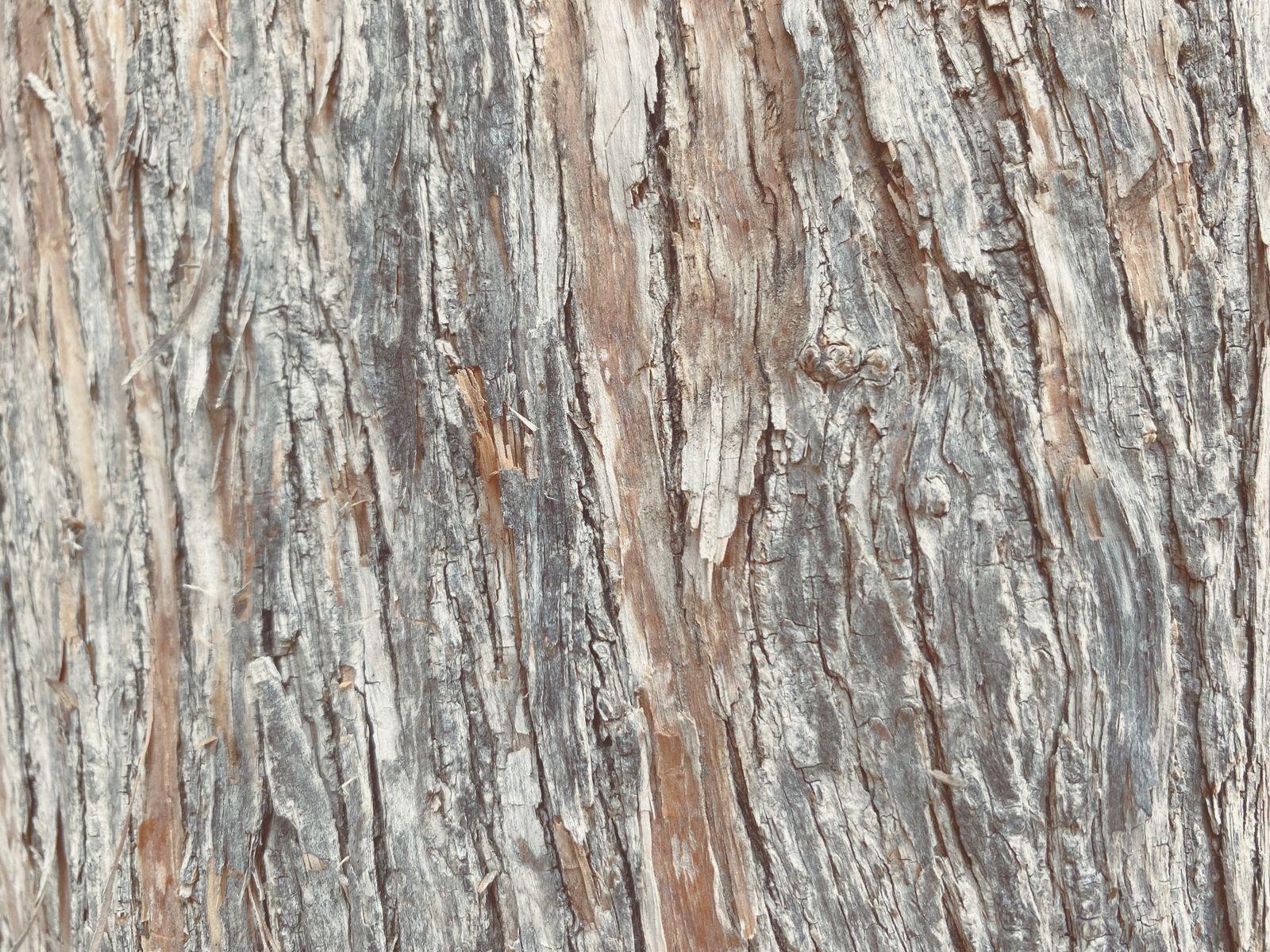
Plantation acacia is pale, uniform, and often finger-jointed together from small pieces because the trees never got old enough to yield wide boards. It looks fine, but it looks the same board to board. The trunk of a 40-year-old saman gives you something else: dark heartwood streaked with lighter sap, wide continuous boards, the swirled figure that grows around old branch joints. That is not a design choice. It is the price of time. A tree that lived a life gives wood that shows it. If you set a plantation-acacia board next to one of our Pamilya boards, you can read the difference across the room.
Why our supply looks nothing like a supply chain
A plantation supplies on schedule. Our sourcing works the opposite way. There is no order form we can send to a saman farm, because there are no saman farms at any meaningful scale. What we have is a network of people across Luzon who know us and who call when a tree has come down in their sitio, their subdivision, their lolo's lot. The logs arrive when they arrive. This is inconvenient for planning. It is also the point.
DENR paperwork, and what it actually protects
Nothing moves in Philippine forestry without paperwork, and the paperwork exists for reasons anyone who lived through the last century of Philippine logging understands. The Department of Environment and Natural Resources, DENR for short, is the agency that governs it. If you are cutting or moving wood in this country, you are dealing with DENR.
The relevant permits, at the workshop level, are a small stack. A chainsaw itself must be registered under Republic Act 9175 (the Chainsaw Act of 2002), which is why a legitimate cutter cannot just show up with a saw and start work. A tree that comes down on private land, even a dead one, generally needs a tree cutting permit issued by the local DENR office before it can be legally removed and moved off the property. Once the wood is cut into logs or lumber, moving it requires a Certificate of Transport Agreement (CTA) or its current equivalent, which travels with the load. A workshop that processes the lumber into finished pieces holds a Wood Processing Plant Permit (WPPP). None of this is exotic. It is the ordinary bureaucracy of a country that lost most of its old-growth forest to unregulated logging in the mid-twentieth century and does not intend to lose the rest.
Why saman is workable and other species are not
The reason we can build a workshop around Samanea saman, and not around narra or molave, is exactly this regulatory reality. Saman is an introduced species that grows abundantly and reproduces easily. It is not on the threatened or restricted lists. With the right permits, a fallen or end-of-life saman can be legally cut, transported, milled, and turned. The native premium hardwoods, most of which we will come back to shortly, are governed under much tighter rules, with some species outright banned from commercial cutting. That is as it should be. It also means the honest working material for a Filipino wood tableware company, if the goal is legal, traceable, and non-destructive supply, is saman.
The paperwork is not a nuisance
It is fashionable in some circles to complain about DENR requirements as red tape. Inside the industry, the honest view is different. The permits are the reason there is still forest to speak of on parts of Luzon and Mindanao. They are the reason a buyer of a piece of Philippine wood tableware can ask, reasonably, where the wood came from and expect a defensible answer. Where the paperwork slips is where the abuses happen. We would rather work slower and cleaner than faster and vague.
When acacia actually comes down
There is no harvest season for saman in the way there is a harvest season for mango or coconut. The tree comes down when it comes down. In practice, the workshop pace is set by four rhythms.
The first is typhoon season. From roughly June through November, storms move across the country and take trees with them. A wide-canopied saman is exactly the shape that catches wind and comes down in a bad one. Most of our largest single-log arrivals happen in the weeks after a strong typhoon. We are on the phone with suppliers during those weeks the way farmers are on the phone about a rice harvest.
The second is end-of-life clearance from family land. A tree that has stood for 60 years on a family lot eventually loses the top, or splits at the crotch, or starts dropping heavy limbs onto the roof of the house it was planted to shade. At some point the family decides. The tree comes down, gets sectioned, and the family calls the wood buyer they know. This happens quietly, all year, one tree at a time.
The third is public works. Road widening, drainage projects, a school compound being rebuilt. These projects generate a small but steady flow of felled trees that the local government arranges to have removed. Some of that wood reaches workshops like ours. Some goes to firewood or gets buried. Which fate a given tree meets depends heavily on whether anyone with a permit and a truck is paying attention.
The fourth is subdivision clearing. As agricultural land turns into housing, the mature saman that shaded the barrio disappears. This is a bittersweet source. We would rather the tree stay standing. If it is coming down anyway, we would rather see it become something that keeps a Filipino family gathered around a table for another 40 years than see it burned.
What "sustainable" honestly means here
"Sustainable" is a word that gets bent in tableware marketing until it means nothing. For our material, the honest version is narrower. It means: the tree was not felled to make the bowl. It means: the wood was going to leave its site regardless of whether a workshop wanted it. It means: no native forest was cleared, no protected species was cut, no permit was faked. That is the whole claim. It is smaller than "carbon neutral" or "reforested." It is what we can defend.
The species we do not cut
Any conversation about Philippine wood has to reckon with the species that make saman look ordinary. Narra, molave, kamagong, yakal, ipil, guijo, mangkono. These are the hardwoods that built the old churches, the ancestral houses, the antique furniture that gets passed down as inheritance. They are also the reason Philippine forestry regulation exists at the intensity it does.
Narra (Pterocarpus indicus) is the national tree of the Philippines. Its wood is one of the most beautiful in Southeast Asia, a deep rose that darkens with age, and it has been logged so heavily that it is now listed as endangered on the IUCN Red List. Commercial cutting of narra is banned or heavily restricted under Philippine law, and only very controlled harvesting of naturally fallen or plantation-grown trees is permitted. A workshop that offers "narra" tableware today is almost certainly working with old salvaged stock, with material of questionable provenance, or with wood mis-labelled from another species. We do not make narra tableware. We would rather send our customers to the antique market for a piece of narra than pretend we can source it responsibly at production scale.
Molave (Vitex parviflora) is another premium hardwood, historically used for shipbuilding and heavy construction, still restricted. Kamagong, the Philippine ebony (Diospyros blancoi and related species), is protected. Yakal, ipil, and guijo are all managed under tight rules for the same reasons. These are the trees the country is trying to keep. They are not the trees to build a modern tableware line around.
The mislabeling problem
Walk through any tourist market in Manila or Cebu and you will find "narra" carvings, "kamagong" chopsticks, "molave" spoons. Some of these are the real thing, worked from old stock. Many are stained saman, or mango wood, or unidentified tropical hardwood painted up to look premium. This is not a small issue. It muddies the market for every honest workshop and makes it harder for buyers to know what they own. When we say a piece is acacia, we mean saman. When we describe the color, we mean the natural color of the wood. If you want the broader honesty check on this, our note on acacia vs mango wood and the piece on acacia vs teak may be useful, because those are the two comparisons where the labeling gets loosest.
Why we do not chase the fancy species
Every year someone in our workshop, usually a new visitor rather than someone who has been on the floor for a while, asks whether we would ever add a narra line or a kamagong series. The answer is no, and the reason is not aesthetic. It is that the country cannot afford it. Saman is the tree that can carry a workshop responsibly at the scale a working brand needs. The rest belongs to the forest, to the antique inheritance, and to a slower recovery that we do not have any interest in interrupting.
What honest wood looks like on the table
All of this backstory ends in the same place: the piece in your hand, on a Sunday, with rice in it. So what should honest wood look like there?
It looks varied. Two bowls in a pair share a family resemblance, not a match. The heartwood streak that ran through the center of the trunk shows up in one but not the other. One reads a shade warmer. The grain figure sweeps differently. This is not a flaw. It is the tree, showing you where it grew and how. A finish that erases this variation, whether by stain or by film, is the finish of a company that would rather sell a uniform product than a truthful one.
"You are not paying for a bowl. You are paying for the decades the tree stood, the paperwork that let it move, and the hours the workshop spent finishing it by hand."
It looks like it will age. Wood that is truly finished with oil rather than plastic keeps living on your table. The color deepens in the first year. The grain reads more sharply with use. Small marks from serving knives, from citrus, from a hot pan of chicken adobo set down carelessly one evening, become part of the piece rather than damage to it. A bowl from our Gorosin bowl set that has spent five years on a family table looks different from the day it arrived, and that difference is the piece earning its place. The Ina plates do the same thing under everyday use, the way well-fed wood is supposed to.
It looks traceable. If you asked us, of any given piece we sold this quarter, what province the wood came from and roughly what year it left its site, we could get you close. Not to the tree, because saman logs come to us as logs, not with birth certificates. But to the region and the season and the supplier, and often to the neighborhood. That is a smaller claim than the one every brand makes on Instagram. It is a bigger claim than most of them can back up.
And it looks unhurried. A saman tree stood for 40 years. It fell in a typhoon. It waited on the ground for a week and in the yard for months. It rested through drying, rested again between rough and final turning, rested again between oil coats. By the time it arrived at your kainan and someone spooned garlic rice into it, the piece had already lived a longer life than most of what you own. That is the wood the country has to give. That is the wood we work. That is what the story of acacia and Philippine forestry actually amounts to when it reaches the table.