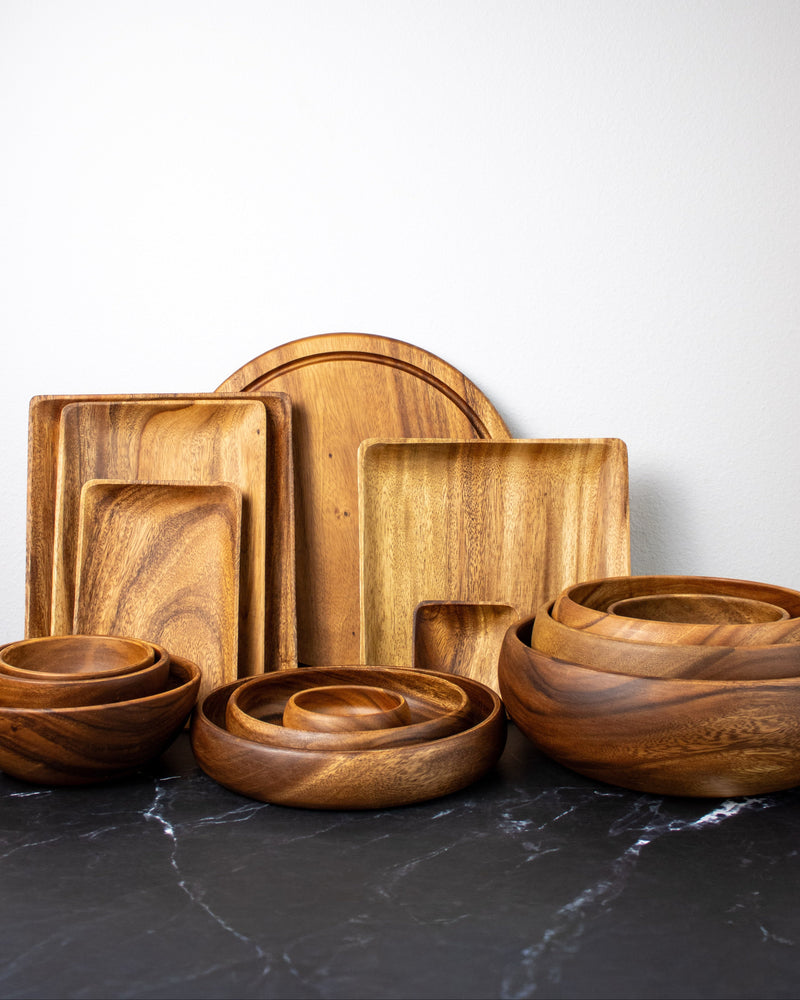
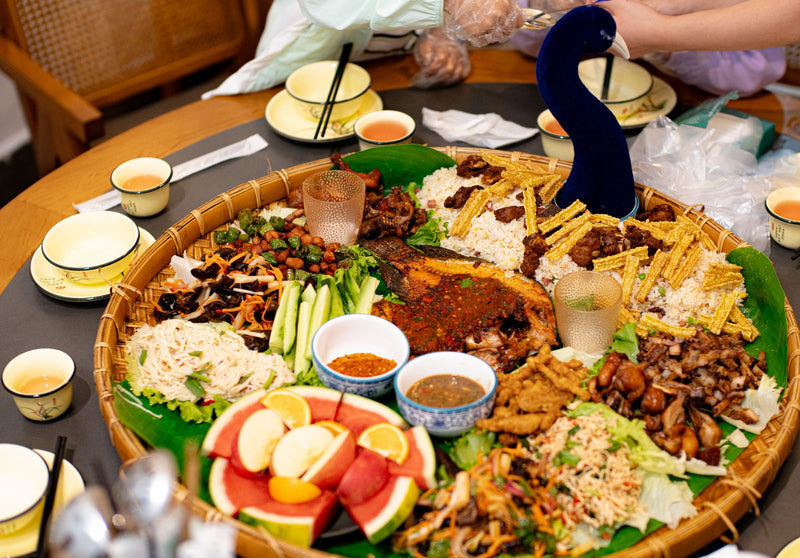
Teak is the name almost everyone knows when they think of wooden tableware. It built its reputation on shipyards, danish modern furniture, and the dinnerware aisles of luxury department stores. Acacia is the name that quietly shows up on most Filipino tables, in pasalubong markets across Pampanga and Cebu, and in heritage workshops where bowls and boards have been carved by hand for generations. If you are deciding between the two for the plates that will hold your daily kanin or the bowls that will carry your next salu salo of sinigang, the choice is not obvious from a product photo alone. This guide compares them honestly, side by side, on the things that matter at the table: food safety, durability, care, look, and price.
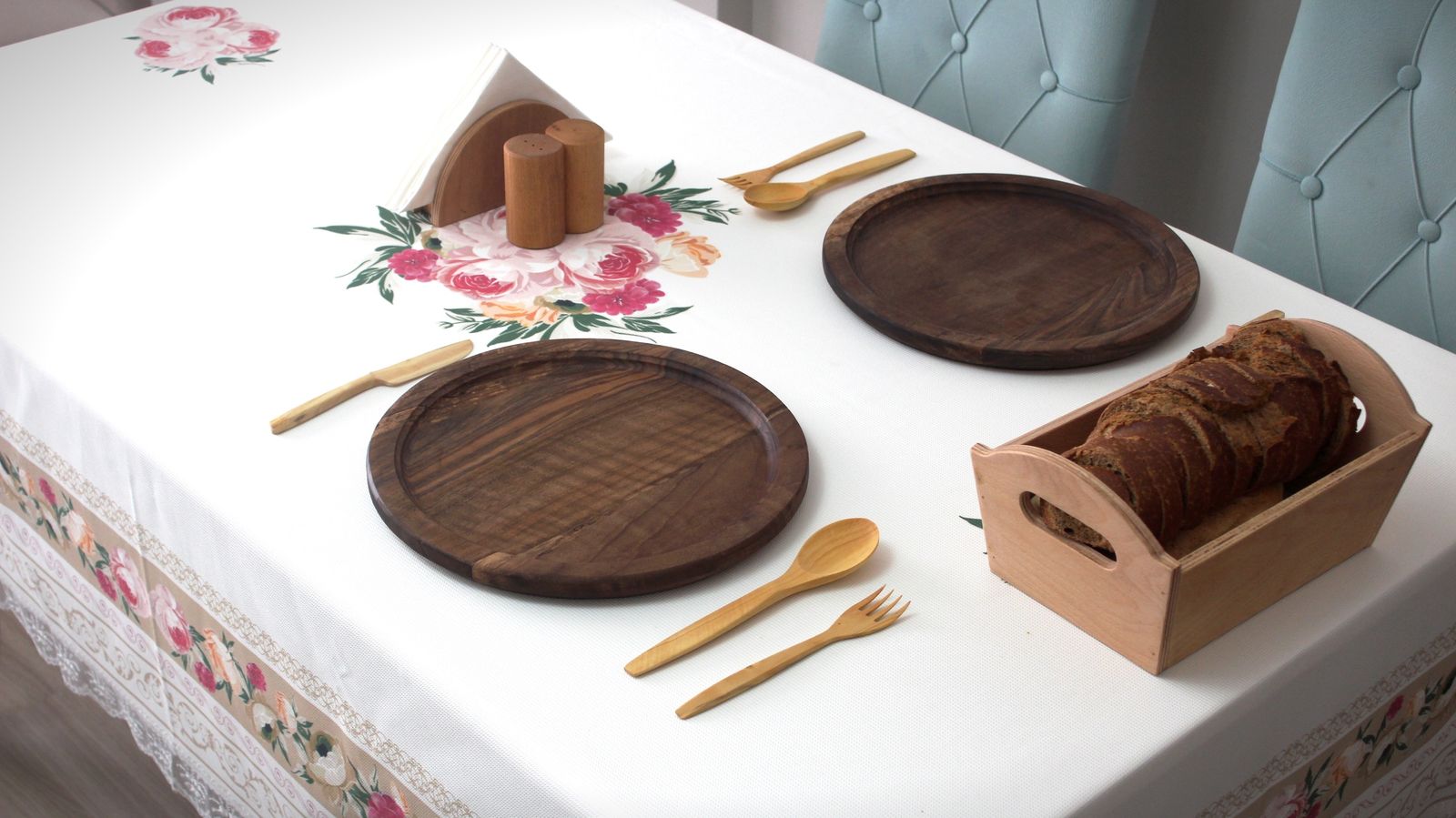
Teak vs acacia at a glance
Teak has been the default wood for serving pieces in the West for almost a century. Acacia has been the default at the Filipino lamesa for far longer. The two woods occupy similar roles but reach the table through very different histories.
Why teak became the global benchmark for wooden tableware
Teak first earned its reputation in shipbuilding. Old-growth Burmese teak resisted seawater so well that the British Royal Navy specified it for decking, and the wood carried that prestige into mid-century furniture, marine joinery, and eventually salad bowls. Three properties built the reputation:
- A tight, straight grain that resists splitting
- High natural oil content, which repels water and slows rot
- Dimensional stability across humidity swings
Premium pricing reinforced the perception of a higher-tier wood, and most boutique tableware brands still lead with teak because the global market recognises the name on a hangtag.
Where acacia fits, and why it is the heritage wood of the Filipino table
Acacia mangium and the related rain tree species grow widely across the Philippines, in agroforestry plots alongside coconut and coffee, and along the edges of rice fields in Pangasinan and Pampanga. Generations of Filipino artisans have carved bowls, scoops, and boards from acacia by hand. It is the wood under the lugaw bowl at your lola's house. It is the wood in the boodle fight platter at the family reunion. It is not an import substitute for teak. It is a parallel tradition that predates the global tableware market by centuries. Our complete acacia wood guide covers this heritage in depth.
The quick-reference comparison
The two woods look similar at a glance but differ in measurable ways. Here is the short version:
- Janka hardness: acacia mangium runs about 1,100 to 1,200 lbf, plantation teak about 1,000 to 1,070 lbf. Acacia is slightly harder.
- Natural oil content: teak is higher, which gives it a slight edge on water repellency before oiling.
- Grain pattern: teak is uniform gold-brown, acacia has dramatic dark streaks across a lighter background.
- Origin: teak comes mostly from plantations in Indonesia, Thailand, India, or Costa Rica. Acacia for Filipino tableware is grown and carved in the Philippines.
- Price: for the same size and finish, acacia typically costs 30 to 50 percent less.
How they grow: sourcing and sustainability
The story of any wooden bowl starts in the forest or plantation that grew the tree. Sustainability is not just about whether the species is endangered. It is also about how long the tree took to mature, how far the wood travelled, and how much of the tree became the finished piece.
Teak's slow growth and the plantation question
Teak takes 25 to 30 years to reach harvest size for furniture-grade lumber. Old-growth Burmese teak, the wood that built the original reputation, is largely exhausted and tightly trade restricted under CITES. Most teak in tableware today is plantation teak from Indonesia, Thailand, India, or Central America. Plantation teak is younger than old growth, with wider grain rings and slightly less natural oil. It is still a fine wood. It is not the wood your grandfather's teak salad bowl was made from.
Acacia's fast renewal and the offcut story
Acacia mangium reaches harvest size in 8 to 12 years, less than half the time teak needs. In the Philippines it is often grown as part of agroforestry systems, providing nitrogen fixation for adjacent crops and shade for younger plants. Many of the acacia bowls and plates in heritage workshops are made from offcuts of furniture-grade lumber, which means a single tree yields a higher proportion of usable product. Shorter supply chain, faster regrowth, less travel before the wood becomes a bowl. If you want a deeper comparison with another fast-growing alternative, our piece on acacia vs bamboo tableware covers that side of the conversation.
What "sustainable" actually means on a product page
The word sustainable does a lot of heavy lifting on tableware product pages. Translate it before you trust it:
- Look for fast growth and traceable origin. A named workshop or region beats a generic "ethically sourced" claim.
- Offcut sourcing means the bowl came from leftover lumber, not a tree felled specifically for kitchenware.
- For teak, look for FSC certification or plantation origin disclosed by country.
- For acacia, the cleanest provenance is direct from workshop with a named craftsman, the kind of supply chain Filipino brands can actually verify.

Acacia bowls for the everyday kainan
The Gorosin set is the bowl that holds rice, sinigang, and lugaw with the same calm presence acacia has carried on Filipino tables for generations.
Shop the Gorosin Bowl Set →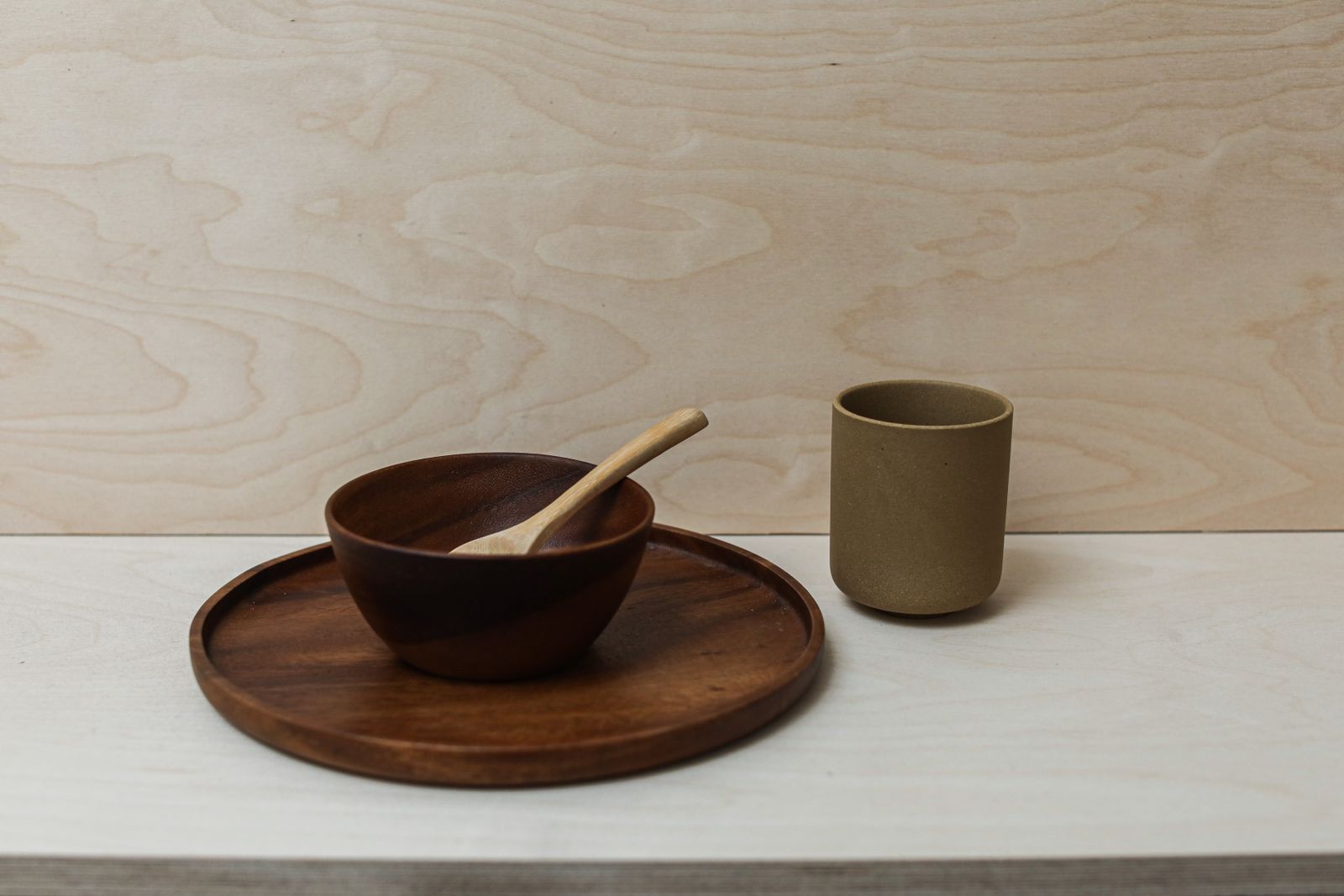
Food safety and everyday use
This is the chapter most shoppers want to read first. Both woods are food safe when properly finished and cared for. The differences are subtle but worth knowing if you cook with the strong flavours of Filipino cuisine.
Natural oils, density, and why both resist bacteria
The clearest research on wood and food safety came from Dr Dean Cliver at the University of California, Davis, who tested wooden cutting boards against plastic ones for bacterial survival. Wood, including hardwoods like teak and acacia, inherently resists bacteria. Pathogens introduced to a wood surface are drawn into the pores, where they dry out and die. Plastic boards, by contrast, can harbour bacteria in knife grooves. Density matters here. Both teak and acacia are dense hardwoods with closed-pore structures that close further when wet and re-seal as the natural oils stabilise. Neither needs an antimicrobial coating.
Are either treated or finished? What actually touches your food
Most teak and acacia tableware is finished with food-grade mineral oil, beeswax, or a carnauba blend. These finishes are FDA recognised for food contact and they soak into the wood rather than sitting on top. What you want to avoid:
- Polyurethane or varnish on a food-contact surface (look for "lacquered" warnings)
- Unspecified "wood finish" without disclosure of what it contains
- Painted or stained interiors
If a brand cannot tell you what touches your food, choose a different brand. This is not a teak-vs-acacia question. It is a brand-trust question.
Acidic foods, suka, and patis: how each wood holds up
Filipino food is full of acid. Suka, kalamansi, the patis in nearly every dipping sauce, the tomato in sinigang, the vinegar in kinilaw and paksiw. Both teak and acacia handle this without warping or pitting. What can happen, on either wood, is a slight darkening where suka pools for hours. The fix is simple: wipe the surface down after the meal, dry it with a soft towel, and re-oil if you see the grain lift. A well-oiled acacia bowl that has held a thousand servings of kinilaw will darken evenly across years, which is the patina, not damage.
Durability, water, and care
Wooden tableware lives or dies by how it gets washed. Both woods can last decades. Both can also be ruined in a single dishwasher cycle. Here is the practical side.
Janka hardness and dent resistance, head to head
The Janka hardness test, developed by Gabriel Janka and standardised through the USDA Forest Products Laboratory, measures the force needed to embed a steel ball into wood. It is the standard reference for how easily a wood will dent.
- Plantation teak: roughly 1,000 to 1,070 lbf
- Acacia mangium: roughly 1,100 to 1,200 lbf
- Acacia koa (rarer, mostly Hawaiian): roughly 1,170 lbf
Acacia is slightly harder than plantation teak. In practice this means an acacia plate is marginally more dent resistant against a dropped fork, and an acacia board takes knife pressure a little better. The difference is small enough that you will not notice it in everyday use, but the data answers the common assumption that teak must be harder because it costs more. It is not.
Water tolerance and the no-dishwasher rule
Neither wood survives a dishwasher. The combination of sustained heat, prolonged immersion, and harsh detergent strips the natural and applied oils, dries the wood, and eventually causes cracking. This is the single rule that matters most for either wood:
- Hand wash in warm water with mild dish soap
- Towel dry immediately, do not air dry face down
- Never soak, even for "just a few minutes"
- Store dry, with airflow on all sides
Teak handles brief water exposure slightly better because of its higher oil content, but the difference is marginal. Treat both woods like you would treat a good knife: wash by hand, dry, put away.
The oiling routine: effort and frequency
Both woods benefit from a light re-oil every 2 to 3 months, more often if the wood starts to look dry or pale. The routine is identical:
- Wash the piece and let it dry overnight.
- Apply a small amount of food-grade mineral oil or a specialised wood conditioner with a soft cloth.
- Work the oil into the grain in a circular motion.
- Let it sit for several hours, ideally overnight.
- Buff off any excess with a clean cloth.
One bottle of food-grade oil will care for a full set of plates and bowls for a year or more. The effort is genuinely small once you are in the habit.

Acacia plates with grain you can read
The Ina plate set carries the dark-streak character that no two teak plates will ever match, with the heft to handle a full ulam spread.
Shop the Ina Plate Set →Look, feel, and the table
Numbers and certifications aside, you live with these pieces every day. How they look on the table, how they feel in the hand, how they age over years of kainan, these matter as much as the hardness ratings.
Teak's even gold-brown vs acacia's dramatic grain variation
If you put a teak plate next to an acacia plate, the difference is immediate. Teak is uniform: a fine, straight grain in shades of honey and chocolate, with the kind of even tone that photographs beautifully and matches itself across a full set. Acacia is the opposite. Dark coffee-brown streaks run across a pale background, and no two pieces are alike. A set of six acacia plates will have six different grain patterns. Some people prefer the uniformity of teak. Others prefer the character of acacia, which mirrors the variation you see in mango wood (we cover that comparison in acacia vs mango wood). This is a taste question, not a quality question.
Weight in the hand and presence on the table
Teak feels slightly denser in the hand, the higher oil content showing through. Acacia feels substantial without being heavy, with a warmth that comes through immediately when you pick it up. Both stack the same way, store the same way, and occupy the same footprint on a table. If you have an existing teak board and want to add acacia bowls, the visual mix works because both woods carry the same warm undertone.
How each ages over years of kainan
This is where heritage pieces earn their value. Teak ages by deepening to a richer amber-brown across the whole surface, slowly and uniformly. Acacia ages differently. The dark grain streaks darken further while the pale background warms, and the contrast deepens. Both develop a soft patina from hand contact, the polished sheen you see on serving boards in an old Cebu kitchen. Treat either wood with regular oiling and gentle washing and you are looking at decades of service. Treat them well and you have heirlooms, the kind of pieces that get handed down, the kind your apo will inherit.
Which wood should you choose?
The honest answer is that there is no universally better wood. There is the wood that fits how you eat, how you cook, what you value in a hangtag, and what you have budgeted. Here is the decision broken down.
Choose teak if, choose acacia if
Choose teak if:
- You want the global benchmark name on the hangtag
- You prefer uniform grain across a full set
- You are matching existing teak furniture or serveware
- Marginally higher water resistance matters more than price
Choose acacia if:
- You want the heritage wood of the Filipino table
- You like grain that is alive with variation
- You eat Filipino food at home and want the wood that has held that food for generations
- You want to support Philippine workshops and shorter supply chains
- You want comparable durability at a lower price
Price-to-value: what you pay for and what you keep
For the same size, finish, and craftsmanship, acacia tableware typically costs 30 to 50 percent less than comparable teak. The reason is not lower quality. The reasons are faster tree growth, shorter supply chain, and the fact that acacia has not been priced into the luxury market the way teak has. For the same budget, acacia gives you bigger pieces, a fuller set, or both. Over a ten-year ownership horizon, both woods will look better the longer you have them, provided you oil and hand wash.
Mixing both on one table
You do not have to choose one. A teak serving board with acacia bowls and plates is a beautiful combination, and the contrast between teak's uniform tone and acacia's dramatic grain reads as intentional rather than mismatched. Use the same food-grade oil on both woods so the care routine stays simple. If you are starting from scratch, building a full acacia set first and adding a teak accent piece later is the path most Filipino households actually take, because it matches how kitchens grow over time.

The full-table close in acacia
The Pamilya board set anchors the whole table, from boodle fight spread to weekday ulam, in acacia that earns its place over years of kainan.
Shop the Pamilya Board Set →Frequently asked questions
Is acacia or teak better for bowls and plates?
Neither is universally better. Acacia is slightly harder on the Janka scale, more dramatically grained, and usually less expensive. Teak has more natural oil and uniform grain, and carries a more widely recognised global brand. For Filipino food and Filipino tables, acacia is the heritage wood and a fair match on durability.
Is acacia wood food safe?
Yes. Acacia is a dense hardwood that, like teak, resists bacteria through its closed-pore structure. Standard acacia tableware finishes use food-grade mineral oil, beeswax, or carnauba, all FDA recognised for food contact. Avoid pieces finished with polyurethane or unspecified varnish on the food-contact side.
Which lasts longer, acacia or teak?
Both can last decades with proper care. Teak edges out marginally on water resistance because of its higher natural oil content, while acacia edges out on hardness. In practice the lifespan is set by how you wash and oil the piece, not by which wood you bought.
Is acacia cheaper than teak, and why?
Yes, usually 30 to 50 percent less for comparable pieces. Acacia grows in 8 to 12 years against teak's 25 to 30, the supply chain to Philippine workshops is short, and acacia has not been priced into the luxury market the way teak has. The price gap reflects sourcing, not quality.
Can you put acacia or teak tableware in the dishwasher?
No. Neither wood survives dishwasher heat, prolonged immersion, or harsh detergent. The natural oils strip out, the wood dries, and cracking follows. Hand wash in warm water with mild soap, towel dry, and store with airflow on all sides.
Does acacia stain from acidic foods like suka and patis?
It can darken slightly where vinegar or patis pools for hours, but it does not pit, warp, or stain in the way porous untreated wood would. Wipe down the piece after each meal, dry it, and re-oil every few months. Slight darkening over years is part of the patina, not damage.