The tree that will not be a tree
It begins in a paddock somewhere in Central Luzon, on land that used to be sugarcane before the family gave up on sugarcane. The tree is acacia, Samanea saman, the kind farmers here call rain tree because the leaves fold shut before a downpour. It is about thirty years old. It was never planted for furniture, or for bowls, or for anything really. It was planted because a farmer needed shade over his carabao pen and heard that acacia grows fast and drops leaves that fertilize the grass underneath.
By the time we meet it, the tree has outlived the carabao. The pen is gone. The paddock has been divided among three grown children. The acacia is now sitting in the middle of a plot the youngest daughter uses for pechay and okra, and the shade that once cooled the animals is now shading the vegetables into stunted, pale versions of themselves. She wants it down. Her neighbor tells her a man from Pampanga sometimes drives around looking for exactly this. She calls him. He comes on a Tuesday.
This is the honest beginning of most Filipino acacia. Not a plantation, not a forestry concession, not anything grand. It is a tree that has done its work and is finally, gently, in the way. The story of acacia in the Philippines is really the story of these farm trees, planted for shade or windbreak, felled when the reason for planting them has moved on.
The cut
The felling itself takes twenty minutes. The chainsaw man is careful. He clears a fall path, notches the trunk on the side he wants it to drop toward, then makes the back cut. The tree comes down with the soft, dry crack of a big thing surrendering to gravity. It lies in the pechay bed and the daughter stares at it for a long time, because for thirty years the sky above her vegetables looked one way, and now it looks another.
The trunk is cross-cut into rounds about a meter long. These are the billets. They are heavy, wet, and streaked with the two colors that acacia is famous for: a pale, buttery sapwood ring around the outside, and a dark, chocolate heartwood core in the middle. The line between them is not clean. It wanders. Sometimes it swirls back on itself where a branch used to be. This wandering is what will eventually make each finished bowl look like a small aerial photograph of a river system.
The billets are loaded onto a jeepney flatbed and trucked to a small yard outside San Fernando where the miller works. Nothing about this leg of the journey looks like a supply chain. It looks like a favor between neighbors, which is essentially what it is.
The long silence
Wet acacia cannot be turned into a bowl. If you tried, the blank would warp and split as it dried around the finished shape, and you would end up with an oval instead of a circle, or worse, a bowl with a crack running from rim to base. So the billets go into the drying shed.
The shed is a roof on four posts, open on the sides. The billets sit on stickers, small square battens that keep air moving between them. They will sit like this for a long time. How long depends on the size of the billet and the season. A big round from the base of the trunk, sixty centimeters across, might need eighteen months. A smaller one from higher up, maybe eight. The miller checks them with a moisture meter every few weeks, waiting for the reading to drop from the mid-forties (soaking) down to the low teens (workable).
"You cannot rush this part. The wood is losing water the way a person loses a habit. Slowly, and only if you leave it alone."
The miller says this while pointing at a stack of billets that came in during the last rainy season and still are not ready. He has thirty years of stacks. Some of the oldest are from trees he cut when his sons were small, and his sons are now the ones who deliver the finished blanks to the workshop.
This is the part of the process that no customer ever sees, and no marketing photograph ever captures. It is a shed. It is quiet. Nothing is happening, and everything is happening.
Choosing the blank
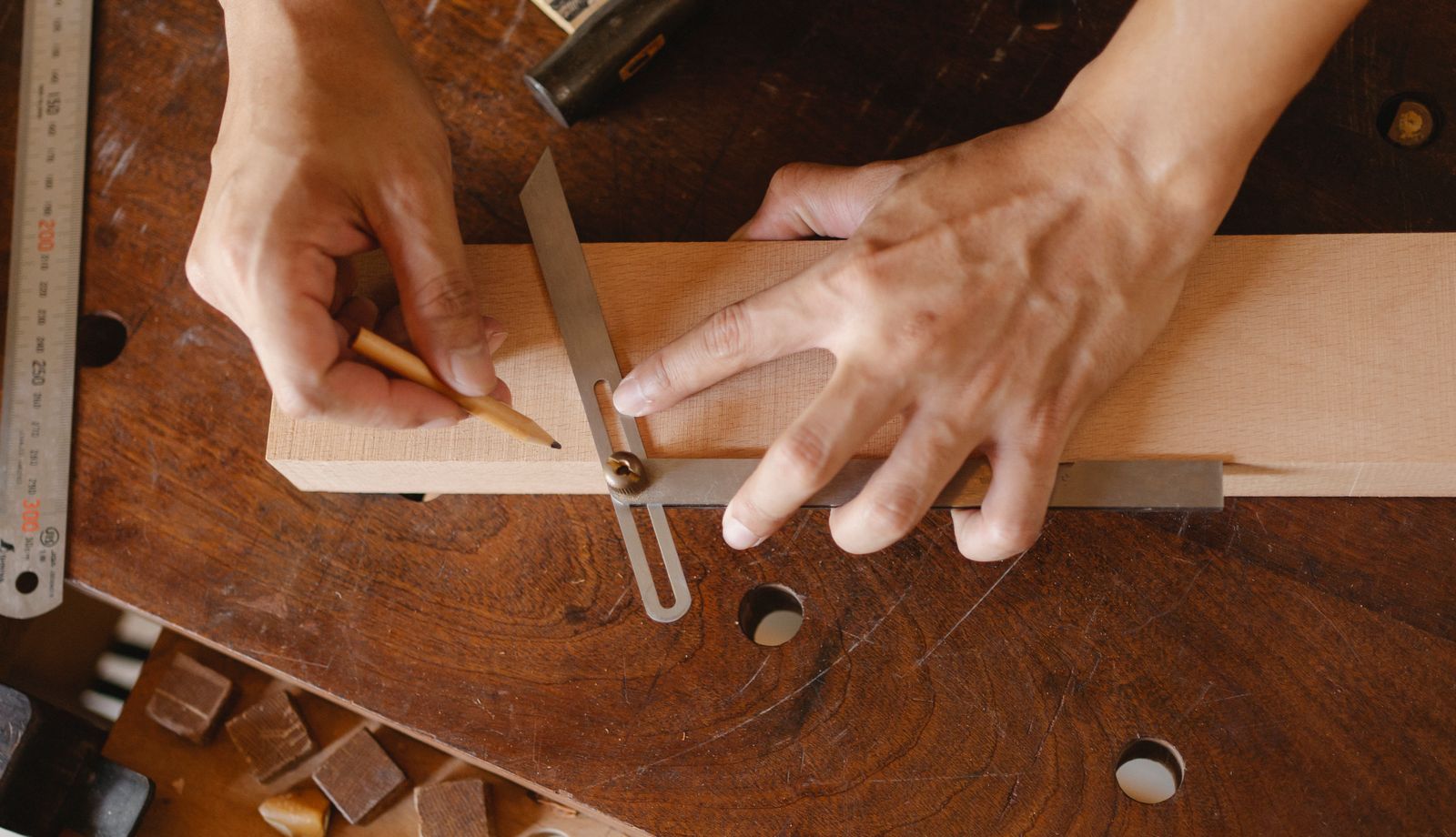
Eventually the billet is dry. The miller cross-cuts it into slabs about the thickness of the future bowl, plus a generous margin. Then he stands over each slab with a piece of chalk and draws circles. This is where the artist part begins.
He is looking for a few things. He wants the heartwood-sapwood line to run through the bowl in a way that flatters it, not fights it. A line that circles the bowl like a horizon is beautiful. A line that runs straight across the base looks accidental. He also avoids knots that go all the way through, because those will chip on the lathe, and cracks that reach into the interior, because those will only get worse. He wants the grain to spiral, not stripe.
Each chalk circle is a bet. He cuts the circles out on the bandsaw, and the offcuts, curved crescents and irregular chunks, go into a bin. Nothing here is wasted. The offcuts become smaller pieces: the shallow saucers and coasters in the bowl range, and the flat cutting surfaces we cover in the guide to boards. A single farm acacia will produce maybe a dozen serving pieces, thirty smaller bowls, and a bucket of coasters. When you buy a set that matches, it usually means all those pieces came from the same tree.
Under the lathe
The blank arrives at the workshop mounted on nothing. It is just a disc of wood with a chalk mark showing the center. The turner, a man in his fifties who apprenticed under his uncle and now trains two younger men, screws it onto the lathe faceplate and starts the motor.
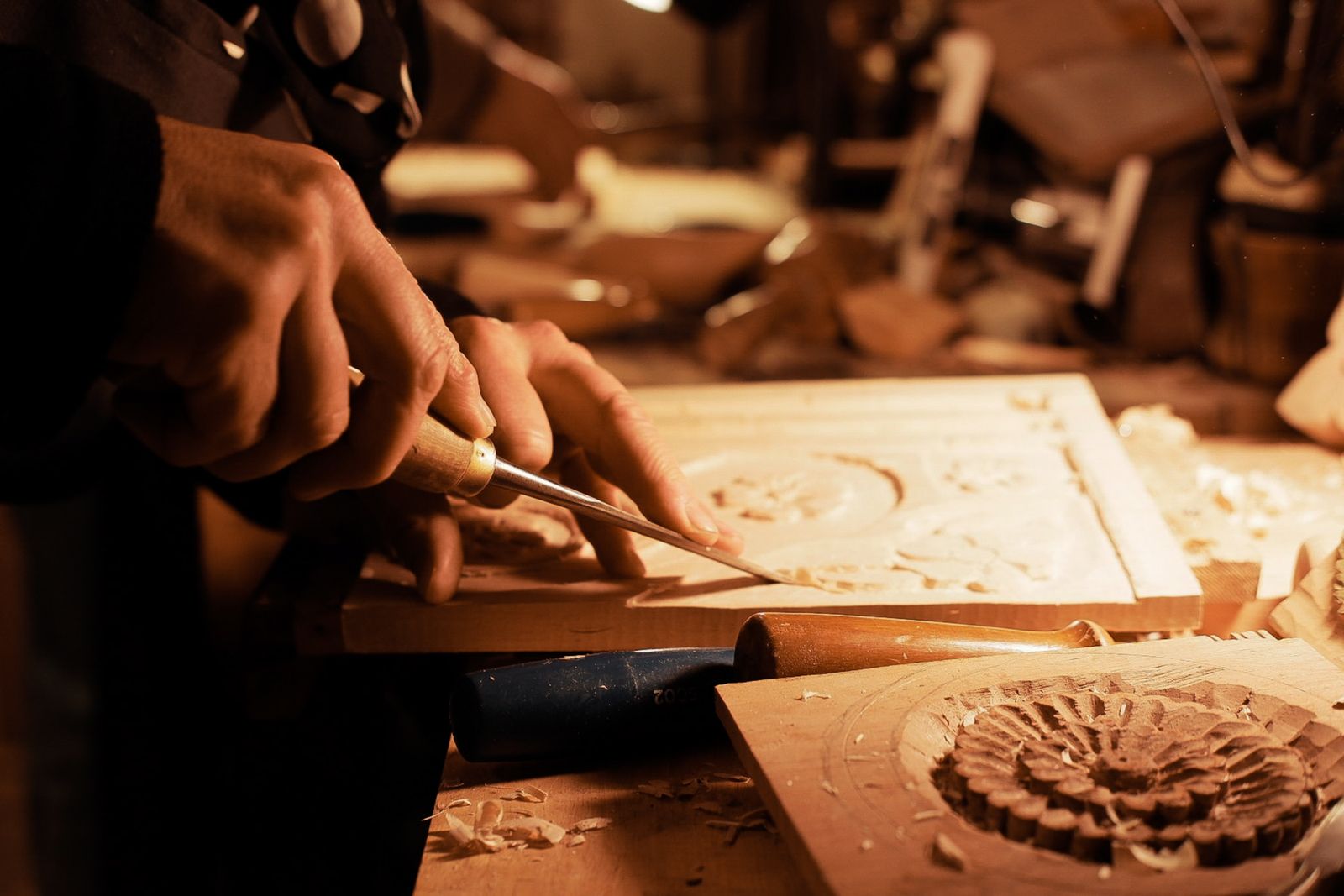
The first pass is rough. He uses a bowl gouge, a curved chisel, and the wood comes off in long springy ribbons that pile up around his shoes. He is establishing the outside profile first: the curve of the belly, the height of the foot, the transition from rim to body. He works from feel more than from measurement. Every few minutes he stops the lathe, runs his palm over the surface, and adjusts.
Then he reverses the piece and hollows the inside. This is the part that takes the most skill. He is removing wood from a spinning bowl that he cannot see through, judging the wall thickness by sound. Thin wood rings differently from thick wood under the chisel. He wants the walls even, about eight to ten millimeters, so the bowl feels substantial in the hand but not clumsy. He wants the interior curve to mirror the exterior. He wants the base flat enough to sit on a table without rocking.
The chalk marks disappear. The color deepens. The grain, hidden all along inside the plain-looking blank, opens up. The heartwood, which looked almost black when wet, dries to a rich toffee brown. The sapwood, which looked yellow, dries to pale cream. The line between them, which the miller worried about, runs across the bowl exactly the way he hoped it would. This is the moment the tree becomes a bowl. Everyone who works in this trade will tell you the same thing: they never get tired of watching it happen. It looks like a coin coming up from the bottom of a well.
Its first kainan
The finishing takes days. The bowl is sanded through five grits, each finer than the last, until the surface feels less like wood and more like the shell of a mango. Then it is oiled. Food-safe mineral oil is rubbed in, allowed to soak, then rubbed off. This happens three times over a week, with drying in between. The last coat is a thin beeswax buff, which brings up the color one more notch without making the bowl feel slippery.
It is stamped underneath. It is wrapped in soft paper. It ships.
Somewhere in Quezon City, or Cebu, or San Francisco, or Dubai, a household opens the box. The bowl comes out. It gets rinsed. It sits on a counter, catching the light, for a day or two while its new owner figures out what to do with it first. Most people, if we are being honest, take a photograph of it before they use it. This is fine. The bowl does not mind.
Its first meal is usually simple. A batch of adobo. A mound of garlic rice. A pile of pancit for merienda. Something the household eats on a random Tuesday, not a fiesta. The point of the bowl is not the fiesta. The point of the bowl is the Tuesday. The size you chose matches what your family eats on Tuesdays, and if you chose right, the bowl will be on your table so often that you will stop noticing it. That is the highest compliment a serving piece can receive.
Thirty years to grow. Twelve months to dry. Two hours to turn. One week to finish. One Tuesday to become part of your kainan. And then, if you take reasonable care of it, twenty or thirty years on your table, going through birthdays and binyags and boodle fights and ordinary weeknights, until someone in the next generation of your family holds it and asks where it came from.
The honest answer is: a paddock in Central Luzon, once. A tree that used to shade a carabao. A daughter who needed sun for her pechay. A chainsaw man on a Tuesday. A miller who waited. A turner who listened for the sound of the walls. All of them, together, made this one bowl. And now it is yours.