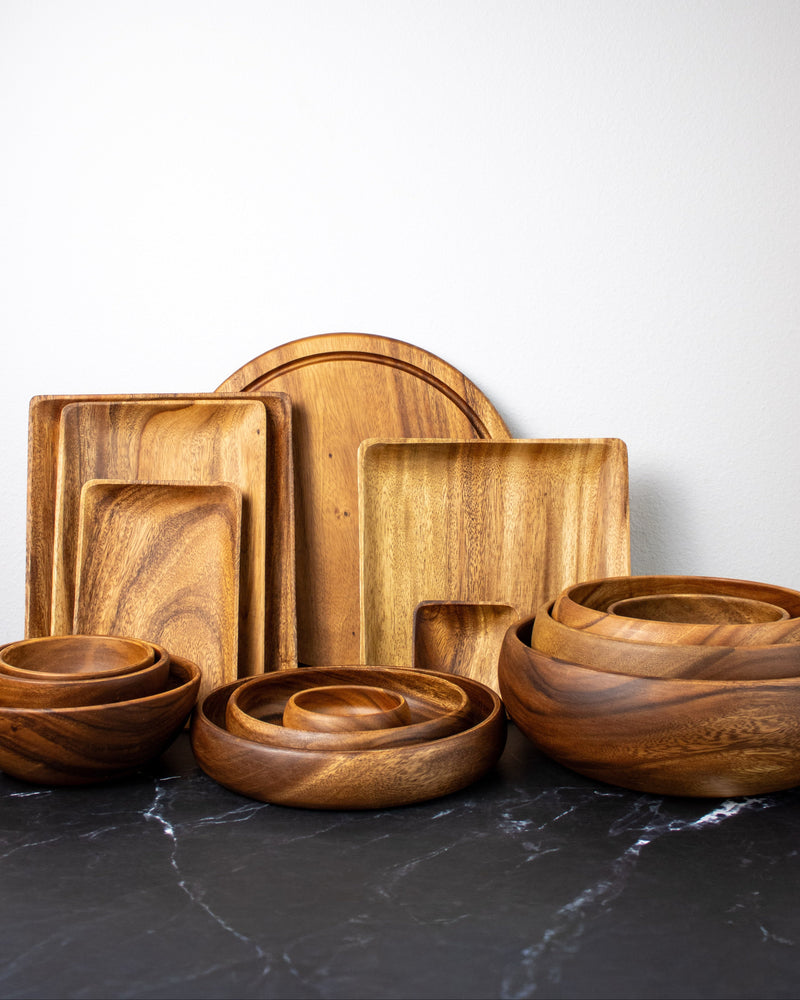
Walk through any homeware store and you will see two woods marketed as the eco-friendly answer for everyday tableware: acacia and bamboo. Both look warm next to plastic, both arrive with sustainability claims, and both promise a kinder dining experience. But they are not the same material, they do not wear the same way, and the green story is more complicated than the marketing suggests. This guide compares them honestly, with a Filipino kitchen in mind, so you can buy once and not regret the choice.
Bamboo vs acacia: the quick verdict
The one-line answer: acacia is a hardwood, bamboo is a grass. That single fact drives every meaningful difference between them. Acacia tableware is cut from solid timber, one continuous piece of grain. Most bamboo tableware is a laminate, thin strips of grass glued together into a block, then shaped into a bowl or plate. Different materials, different objects, different lifespans. The marketing flattens them into "natural wood look," but the bowl in your hand is doing very different things under the surface.
At a glance
- Hardness: Acacia sits around 1,750 on the Janka scale, harder than European oak. Engineered bamboo varies with manufacturer; flat-pressed bamboo tableware usually lands well below.
- Lifespan with daily use: Acacia, 10 to 20 years with basic care. Bamboo, 2 to 5 years before delamination or surface fatigue appears.
- Sourcing: Acacia grows across Southeast Asia, including the Philippines. Bamboo tableware is overwhelmingly manufactured in China.
- Price: Bamboo is cheaper upfront. Acacia costs more per piece, less per year of use.
- Look: Acacia has a real grain, wild and warm, no two pieces alike. Bamboo has a regular striped pattern from the laminated strips.
Who should pick which
- Pick bamboo if you want a light, inexpensive bowl for cereal or salad and you are not bothered by replacing it in a few years.
- Pick acacia if you want pieces that join the kainan table for the next decade and survive a household that uses them daily.

The everyday bowl, in solid acacia
If the verdict points you toward hardwood, the Ama set is the bowl most households actually reach for: deep enough for sinigang, balanced for kanin, built from one continuous piece of grain.
Shop the Ama bowl set →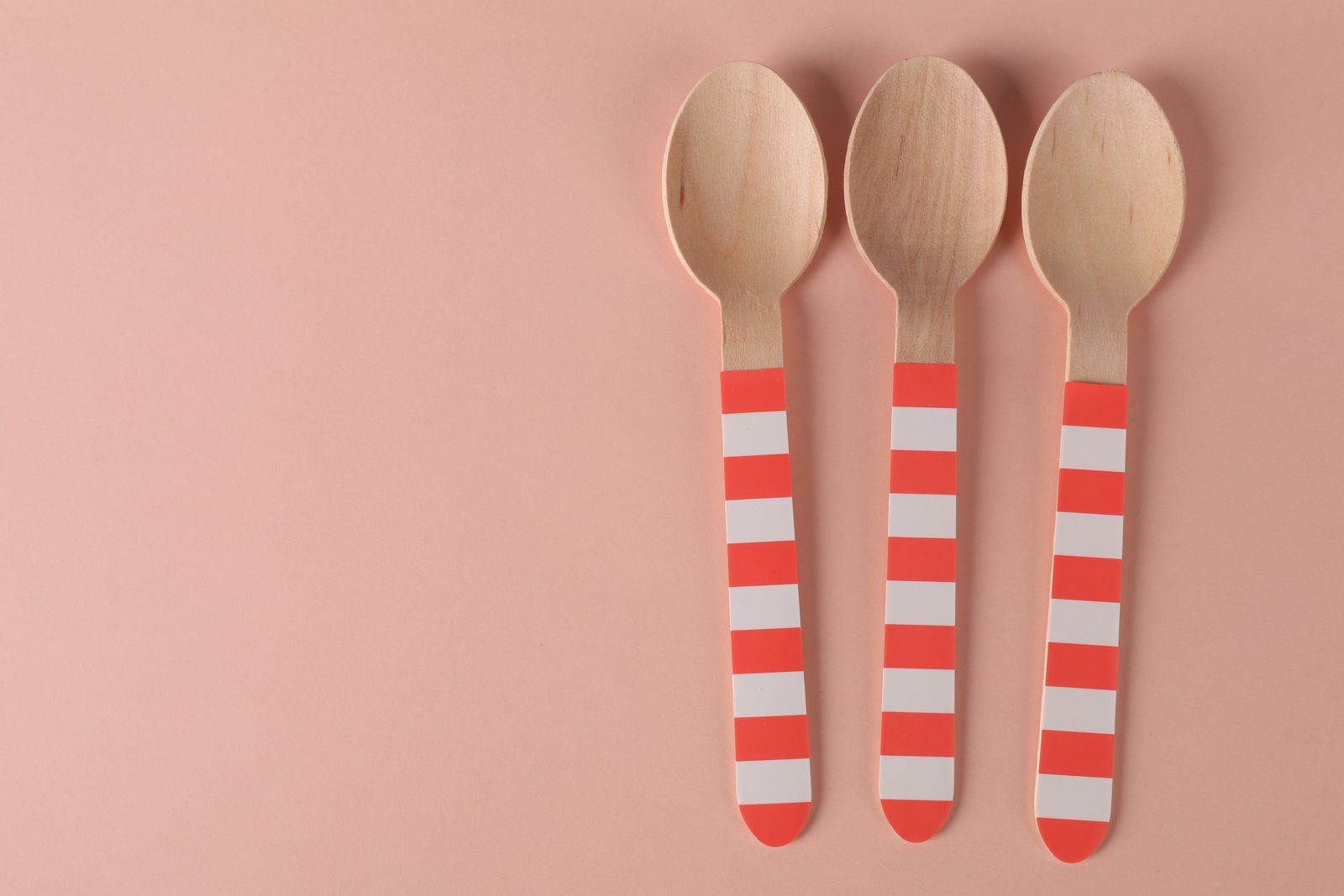
What they actually are: grass vs hardwood
Knowing what each material actually is changes how you read the price tag and the longevity claim. Most shoppers picture both as a form of wood. Only one of them is.
Bamboo, in plain language
Bamboo is a grass, and one of the fastest-growing plants on the planet. A pole can reach harvest size in three to five years. To turn it into a bowl or plate, mills strip the outer skin, cut the pole into thin slats, dry them, then bond them under heat and pressure with adhesive into a solid block. That block is then turned, pressed, or carved into the final shape. The shorter version: without the glue, there is no bowl, only strips. The structural object is the adhesive matrix as much as the bamboo itself.
Acacia, in plain language
Acacia is a dense tropical hardwood. A mature tree reaches harvest size in five to fifteen years depending on species and climate. The Philippines grows several acacia species, including the giant Samanea saman that shades schoolyards and barangay plazas. For tableware, the timber is cut, kiln-dried, then turned or carved from a single block. A solid acacia bowl is one continuous piece of grain, in the same way a river stone is one continuous mineral.
Why solid vs laminated matters
The difference shows up in how each material handles stress. A solid acacia bowl flexes and contracts as a single mass; the grain absorbs movement from temperature and humidity changes. A bamboo bowl is a stack of glued strips, and stress (heat, moisture, repeated impact) travels along the glue lines. When something fails on a bamboo piece, it almost always fails at a glue line, not in the bamboo itself. Solid wood does not have that weak point. It can crack, but it cannot delaminate, because there are no laminations.
Durability and daily use
Tableware lives a hard life. Thrown into sinks, stacked while still warm, hit with knife edges, soaked in suka, set down on counters that just held a hot kawali. Material choice is mostly about how that daily abuse plays out over years, not over the first week.
Hardness and dent resistance
Janka hardness is the standard measure (force needed to embed a steel ball halfway into the wood). Acacia comes in around 1,750 pounds-force, harder than European oak (1,360) and close to hard maple. That is what makes a knife mark on an acacia board sit shallow, why a dropped spoon does not leave a crater, and why the edges of the bowl do not chip when stacked. Engineered bamboo varies a lot. The flat-pressed type used for most cheap bamboo bowls sits in the 1,300 to 1,400 range, which is fine for light contact but shows knife edges and drop marks faster.
Water, warping, and splitting
Both materials dislike prolonged water contact. Neither belongs in a dishwasher, neither should soak overnight. But the failure modes differ. Acacia, being a single piece of grain, will warp slightly with humidity changes and return as it dries. A small crack in acacia can usually be sanded gently and oiled back to function. Bamboo's failure under moisture is the glue: water creeps into the seams, the adhesive weakens, the strips lift. Once a bamboo piece starts delaminating, it is finished. There is no oiling a delamination back together.
Glue lines and delamination
This is the bamboo failure point most reviews skip. Look at a bamboo cutting board after eighteen months in a busy household and you will often see fine hairline gaps where strips meet, sometimes lifting at the edges. That is delamination, and it is not a manufacturing defect. It is laminated grass doing what laminated grass does over time, especially in a humid kitchen that goes through repeated wet-dry cycles. Acacia, having no glue lines in its structure, has no delamination point. The piece only fails if the wood itself splits, which is rare with even basic care.
The sustainability question, honestly
Bamboo wears the green crown in homeware marketing, and the headline numbers are real. The complication is what happens between the bamboo grove and your table.
Why bamboo earns the reputation
Bamboo grows fast, regenerates from the same root system without replanting, sequesters carbon at a high rate, and needs little water or fertilizer. As a raw material, it is genuinely one of the most renewable plant fibers on earth. If a bamboo tableware piece were just bamboo, its environmental case would be clean and short. That is the version of the story you usually read on the packaging.
Where the story thins
But bamboo tableware is not just bamboo. It is bamboo strips plus adhesive, plus often a melamine resin layer (especially on the bowls and plates marketed as "bamboo fiber" tableware). The adhesives commonly used are urea-formaldehyde or phenol-formaldehyde resins. The quantity per piece is small, but it is not zero, and the resin layer is what makes a finished bamboo bowl behave more like a hard plastic than a wood. Then add the manufacturing footprint: the majority of bamboo tableware sold globally is produced in China and shipped worldwide, including back to Southeast Asia. The carbon picture is no longer obvious.
Acacia's case
Acacia is fast-maturing by hardwood standards (years, not decades), grows readily in the Philippines and across Southeast Asia, and the tableware version is usually a single piece of wood with no adhesives in the structure. For pieces sourced and crafted locally, the supply chain is short. We unpack the species and forestry context in detail in our honest look at acacia sustainability, including where to be cautious about provenance claims.
The reframe
The sustainability question is not only "what is this made of." It is also "how many of these will I throw away over the next twenty years." A bamboo bowl that lasts three years, replaced six times, generates more waste and more shipping than one acacia bowl that lasts twenty. Longevity is a sustainability metric the marketing rarely counts, and it is the one that bites hardest in real homes.

Plates built to outlast a replacement cycle
If the longevity math is what convinces you, the Ina plate set is the everyday dinner plate in solid acacia: one piece of grain, no laminations, finished to be re-oiled for years.
Shop the Ina plate set →Food safety, feel, and finish
Food safety on wooden tableware comes down to two things: what is on the surface that touches your food, and how easy that surface is to keep clean over the life of the piece.
Surface porosity and sealing
Untreated hardwood is naturally antimicrobial. Studies of wooden cutting surfaces, including the well-known work out of UC Davis, have shown that bacteria die off on dry wood faster than they do on plastic. The catch is the finish. A piece sealed with food-safe mineral oil or a beeswax blend keeps that property and is easy to refresh at home. A piece sealed with a non-food-safe lacquer can leach into food, especially with acidic ingredients. Bamboo bowls and plates are nearly always sealed, often with a melamine resin layer. That layer is food safe at normal use temperatures but is not heat stable in the way solid wood is, and crucially, it cannot be refreshed. Once worn, the piece is done. For a deeper read on what makes a finish genuinely food safe, see our notes on is acacia wood food safe.
Weight, warmth, and grain
Pick up an acacia bowl and it has heft. The grain is wild, no two pieces identical, the color ranges from honey to deep walnut within the same board. It reads as an object, the kind that earns a place on the table on its own merits. Bamboo tableware is lighter, the pattern is regular (those parallel strip lines), and it reads as utility. Neither is wrong. But if a piece is going to live on your table for a generation, the difference in feel and presence is part of what you are paying for.
Care in a Filipino kitchen
A Filipino kitchen is hard on wood. Suka and patis are acidic and salty, kalamansi juice is sharp, sinigang broth comes hot off the stove, and the ambient humidity outside is what it is. Acacia handles all of it well. Wipe after use, occasional oil, never soak, never dishwasher. Bamboo asks for the same care but has less margin: the glue lines will eventually answer to repeated wet-dry cycles, no matter how careful the wash. If your table sees daily kainan, regular kamayan, or a Sunday boodle fight, the piece that absorbs that punishment for a decade without flinching is the one made of solid wood.
Which to choose for your table
There is no universal winner. There is a right answer per use, and a clear default for pieces meant to stay.
Quick chooser by use
- Everyday bowls (kanin, sabaw, ulam): acacia, every time. They survive heat, moisture, and stacking without complaint.
- Serving boards and platters: acacia. Knife marks, the weight of food, daily wipe-down, all favor solid hardwood. The shortlist of options is in our notes on the best wood for cutting boards in the Philippines.
- Dinner plates: acacia for longevity. Bamboo only if weight is a deciding factor, for example a toddler who tests gravity at every meal.
- Pasalubong and gifts: acacia. The grain reads as heirloom, the piece is one of one, and the recipient will still use it in ten years.
- Light-duty salad bowls or party catering: bamboo can make sense. You are buying low cost with the understanding that replacement is part of the plan.
When bamboo is genuinely the right call
Bamboo earns its place at three uses. When budget is the hard constraint and a bowl is needed today. When extremely light weight matters (camping, small children, outdoor settings, hospital trays). And when the piece is genuinely disposable in your mind, as in catering for a one-time event you will not host again. For these, bamboo's price-per-use is reasonable and the laminated construction is not asked to do more than it can.
Why acacia wins for keepers
For everything that joins the table week after week, acacia compounds. Each year, it costs less per year of use. The grain develops a patina. Small marks become part of the piece's history rather than damage. By year five, the cost-per-use of a solid acacia bowl is below most bamboo equivalents, even accounting for bamboo's lower sticker price. By year ten, the comparison is no longer close. If you are weighing the broader case for the material, our complete acacia wood guide covers species, finish, and care in detail. And if your shortlist also includes other hardwoods, the acacia vs teak tableware piece runs that comparison side by side.

For the boards that earn their place
If the chooser points you toward a serving board, the Pamilya set is the centerpiece: solid acacia, sized for boodle fight and Sunday kainan, no glue lines for knives to find.
Shop the Pamilya board set →Frequently asked questions
Is acacia or bamboo more durable for everyday bowls?
Acacia. It is a solid hardwood around 1,750 Janka, while most bamboo tableware is a laminated, glued construction that delaminates over time. With daily use, an acacia bowl typically lasts a decade or more. Bamboo usually shows surface or seam failure in two to five years.
Is bamboo really more sustainable than acacia wood?
As a raw material, yes, bamboo regenerates faster. But finished bamboo tableware includes adhesives and often a melamine resin layer, and is mostly manufactured in China and shipped worldwide. Solid acacia, locally sourced, has a stronger case once you count longevity, fewer replacements, and the absence of resins.
Is bamboo tableware food safe? Is acacia?
Both can be. Bamboo bowls and plates are usually sealed with melamine resin that is food safe at normal temperatures but cannot be refreshed once worn. Acacia, sealed with food-safe mineral oil or beeswax, is naturally antimicrobial, and the surface can be re-oiled at home for the life of the piece.
Which lasts longer, an acacia bowl or a bamboo bowl?
Acacia, by a wide margin. A well-cared-for acacia bowl lasts ten to twenty years in daily use. A bamboo bowl typically shows delamination or surface failure within two to five years of comparable use, after which it is no longer safe or pleasant to eat from.
Is acacia or bamboo better for cutting boards?
Acacia. It is harder, denser, and a single piece of grain with no glue lines for knife edges to find or moisture to lift. Bamboo cutting boards are common because they are inexpensive, but the glued construction is the failure point, especially in a humid kitchen.
Why does bamboo tableware crack or delaminate?
Because it is not a single material. Thin strips of bamboo are bonded with adhesive, and the adhesive weakens with repeated water exposure, heat, and impact. Once water enters a seam, the strips begin to lift. Solid wood like acacia has no equivalent failure point because it has no seams.