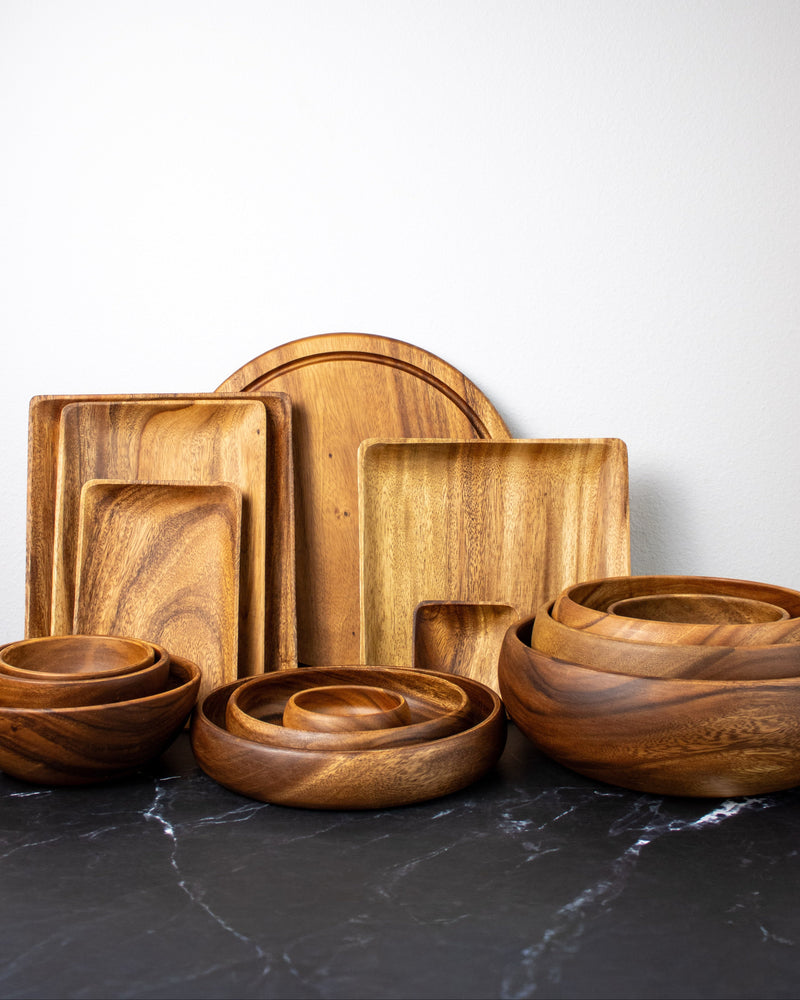
You walked into a tableware shop in Cubao or scrolled past a Shopee listing and noticed two prices sitting side by side. Acacia bowl set at one figure. Mango wood bowl set at noticeably less. Same warm look on camera, both labeled "Philippine hardwood," both finished smooth. The honest question follows: which is actually better for your table?
This guide answers that without nudging you toward either. Both woods are real wood, both work in a real Filipino kitchen, and both have earned a place on local tables. They are not interchangeable, though, and the difference shows up after the first year of daily use, not on the shelf. We will compare them by hardness, grain, food safety, care, sustainability, and the use cases that matter for kamayan, boodle spreads, and everyday kainan. If you want the deeper material story on one of them, our complete acacia wood guide covers the full picture on that side.
The two woods, side by side
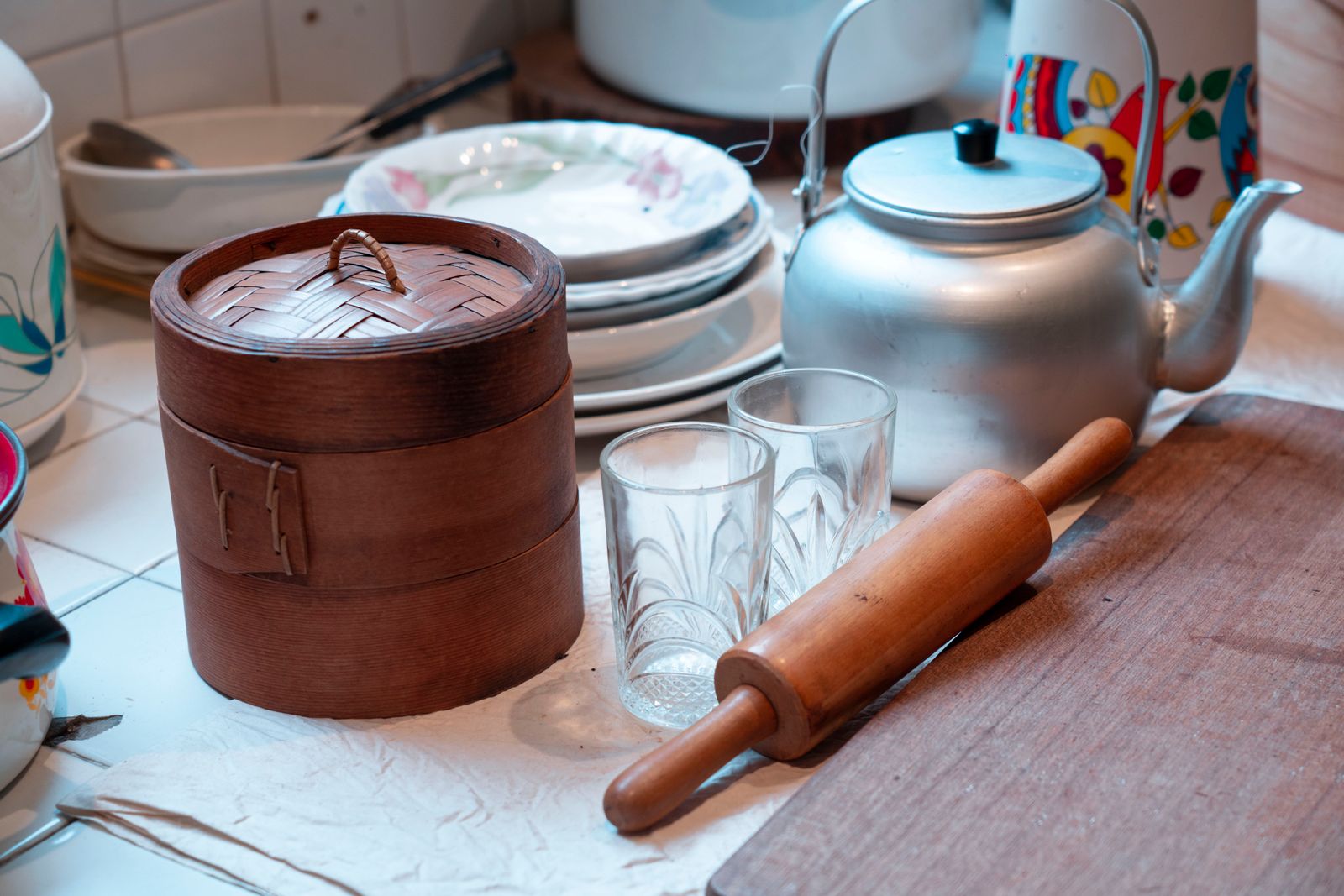
Before the verdict, the basics. Both trees grow in the Philippines, both produce attractive lumber suited to bowls, plates, and boards, and both have been used for tableware for generations. They are also, in commercial reality, the two most common woods you will see on a domestic shelf at a price an ordinary household can pay.
What acacia is
Acacia in the Philippine context usually means Acacia mangium or, more loosely, the broader family of fast-growing tropical acacias farmed across Mindanao, parts of Bicol, and the Visayas. Mature trees reach harvest in 10 to 15 years, which is fast for a hardwood and part of why the price stays accessible. The heartwood runs from warm caramel to deep chocolate brown, often with dramatic figure where the cut crosses a knot or burl. It is dense, naturally oily, and resists water better than most hardwoods at its price point.
What mango wood is
Mango wood, Mangifera indica, is mostly a byproduct. When a mango orchard stops bearing well, usually after 15 to 40 years of commercial fruiting depending on cultivar and climate, the trees are felled to make room for new plantings. That trunk wood, which would otherwise be burned or chipped, gets sawn into boards, bowls, and plates. The grain runs lighter, often pale gold with streaks of pink, gray, or olive, and the figure is more uniform than acacia. It is a softer hardwood, easier to carve, and noticeably lighter in the hand.
Quick verdict at a glance
For shoppers in a hurry, the comparison comes down to a few measurable traits. Acacia is the denser, harder, more water-resistant wood and will outlast mango in daily use, often by a factor of two to three in our own observation of customer pieces brought back for refinishing. Mango is the cheaper, lighter, more uniformly grained wood with a real sustainability angle and a softer aesthetic. Acacia tends to be the better long-term value. Mango tends to be the better entry point. The rest of this guide is the why behind those statements.
Hardness and durability
When two woods look similar on the shelf, the first place they separate is hardness. This is not an abstract spec. It is the number that predicts how your bowl looks after a year of sinigang ladles, how your plate handles a fork dragged across rice, and how your board survives a cleaver going through a whole bangus.
Janka hardness, the actual numbers
The Janka hardness test measures the force needed to embed a steel ball halfway into the wood. It is an industry-standard predictor of dent resistance. Acacia, in the species commonly used for tableware, sits around 1,700 to 1,750 lbf. Mango wood sits around 1,070 lbf. For context, North American hard maple, the wood most American butcher blocks are made from, sits at about 1,450. Acacia is harder than maple. Mango is softer than maple but harder than walnut.
The practical translation: acacia takes a knife edge without leaving a permanent scar in most cases. Mango will show the cut. Neither is fragile, but if you are buying a piece you intend to hand down, the harder wood gives you a longer runway before refinishing.
Daily wear: forks, ladles, and stacking
Most damage to wooden tableware is not from knives. It is from stacking, from the metal edge of a serving spoon scraping rice off the bottom, and from being knocked against the rim of the sink. Acacia's density absorbs these impacts and tends to whiten slightly at the contact point rather than dent. Mango compresses more, so the same impact leaves a small but visible divot. Over a year of daily use, an acacia bowl looks broken-in. A mango bowl in the same household looks well-loved, which is the polite way to say it shows its mileage.
Heat, humidity, and the PH climate problem
Philippine humidity is the silent enemy of all wooden tableware. Cycles of wet and dry, especially the swing between rainy season and the dry burst around April and May, expand and contract wood fibers. Pieces that were not properly seasoned crack at the rim or split along the grain. Acacia, because of its tighter cell structure and higher natural oil content, rides those cycles better. Mango, more porous and lighter, is more prone to surface checking if it is allowed to dry out completely. Neither will survive being left in standing water or run through a dishwasher. Both reward the same care: hand wash, dry quickly, oil regularly.

Built for the long haul
Our Gorosin bowls are turned from dense Mindanao-farmed acacia, the wood that holds up to the daily ladle, the daily stack, and the daily kainan.
Shop the Gorosin Bowl Set →
Grain, color, and character
Durability is the engineering case. The aesthetic case is what makes you reach for one piece over another at breakfast. Both woods are beautiful. They are not, however, beautiful in the same way, and the difference matters depending on what kind of table you set.
Acacia: bold figure, deep tone
Acacia heartwood pulls a wide tonal range from a single tree. A set of six bowls cut from the same log will show caramel, walnut brown, near-black streaks, and often a flash of olive or honey where the cut hits sapwood. The grain itself is busy. It curls around knots, swirls where branches met the trunk, and sometimes throws figured patterns that look almost three-dimensional under good light. Acacia is the wood you reach for when you want the table to do some of the storytelling. It pairs well with neutral linens, terracotta, and the muted ceramic glazes common in modern Filipino tablescapes.
Mango: lighter, calmer, more uniform
Mango wood is closer to a single-tone piece, usually pale honey to soft amber, with occasional streaks of gray or rose. The grain runs straight more often than not, and the visual energy is much quieter. If acacia is the bold print, mango is the linen weave. On a table that already has a lot going on, painted ceramics, embroidered runners, decorative serving pieces, mango wood recedes and lets the other elements lead. On a minimalist table, it can feel almost too quiet, which is a real consideration if you want the wood itself to be part of the visual experience.
How each ages
Both woods darken with use. Acacia deepens, the caramels going chocolate, the figure becoming more pronounced as the surface oils settle into the grain. The piece looks older in the good sense, the same way a leather bag looks better at year three than year one. Mango lightens at first, then settles into a soft, slightly grayer tone, especially if it is washed often without re-oiling. Patina on mango is subtler, and it is more dependent on care. A well-cared-for mango piece at year five looks excellent. A neglected one looks tired. Acacia is more forgiving of inconsistent care, though neither thrives on neglect.
Food safety and care
This is the chapter that matters most if you are putting saucy, acidic, or wet food on the wood. Filipino cooking is full of all three. Kinilaw with suka and calamansi, sinigang ladled over rice, kare-kare with peanut sauce running into the wells of a serving plate. The food safety question is fair to ask, and the honest answer requires understanding porosity and natural antimicrobial behavior.
Porosity and bacteria
All wood has pores. The question is how big they are and how the wood handles moisture and microbes that get into them. Acacia has tighter pores and higher natural oil content, which gives it some inherent antimicrobial behavior. Research dating back to the 1990s, notably the studies by Dean Cliver and colleagues at UC Davis, found that hardwood cutting boards trap bacteria below the surface where they die off rather than multiply. Acacia falls in the favorable hardwood category. Mango, more porous, absorbs more moisture and takes longer to dry. It is still food-safe when properly finished and dried, but the margin is smaller. We have a full breakdown in our guide to whether acacia wood is food safe that goes deeper into the FDA position and the USDA guidance.
Oiling routines
Both woods need food-safe mineral oil, food-grade beeswax, or a coconut-and-beeswax board butter. The routines differ slightly:
- New piece: oil three times in the first week, letting the wood absorb between coats. Wipe excess after about 20 minutes.
- Acacia, ongoing: oil once a month for the first year, then every two to three months thereafter if the surface still feels dry when scratched lightly with a fingernail.
- Mango, ongoing: oil every three to four weeks for the first year. Mango drinks more oil and shows a dry surface sooner. After year one, monthly is usually enough.
- Both: never put either in a dishwasher, never soak overnight, never leave standing water sitting on the surface for hours.
Wet, saucy, acidic dishes
For kinilaw, suka-heavy adobo, anything with patis pooling at the bottom of the bowl, the harder, less porous wood is the better daily choice. That is acacia. A well-finished mango bowl will handle a kinilaw plating once or twice without distress, but used as the household kinilaw bowl over years, it will show staining and grain raise sooner. For dry-side service, rice, pancit, ulam without much sauce, both perform the same. The decision really lives in how wet your food is and how often.

Daily plates that handle the sauce
The Ina plate set is acacia chosen for everyday use, with rims sealed against the kind of wet food a Filipino plate actually carries.
Shop the Ina Plate Set →Sustainability and sourcing
Both woods carry credible sustainability stories. They carry different ones, and the difference is worth understanding before you decide one is "greener" than the other.
Mango as orchard byproduct
The strongest case for mango wood is that it is, in nearly every honest supply chain, salvaged from orchards at the end of their fruiting life. A mango tree produces commercially viable fruit for somewhere between 15 and 40 years, depending on cultivar and climate. When productivity drops, the orchard is replanted, and the felled trunks become either firewood, chipboard, or, with one more step, tableware. Buying mango wood is, in this scenario, a use of material that would otherwise be burned. That is a real environmental win and a fair claim for sellers to make.
The caveat: not all mango wood is reclaimed from spent orchards. Some is sourced from younger mixed plantings, and there is no chain-of-custody certification specifically for mango wood comparable to FSC for tropical hardwoods. Ask the seller where it came from. A good seller can tell you.
Acacia as fast-grown farmed timber
Acacia mangium and related species are farmed at industrial scale across Mindanao, parts of Sumatra, and other tropical regions specifically because they grow fast. A planted acacia reaches a harvestable size in 10 to 15 years, against 60 or more for many hardwoods of similar density. That short rotation means lower land pressure per board foot produced, less pressure on old-growth forest, and the real possibility of FSC-certified plantation supply.
The honest caveat: industrial acacia plantations have, in some regions, replaced biodiverse forest with monoculture. The wood itself is renewable. The land-use story depends on where the plantation sits and what was there before. Sellers who can name their region and certification chain are giving you better information than sellers who cannot.
What sustainable means in PH supply
For a Filipino household buying from a Filipino brand, the question is less about FSC certificates and more about whether the supply chain is local, traceable, and honest about its sourcing. Acacia is most often grown in Mindanao and milled in Cebu or Pampanga. Mango is most often reclaimed from Luzon or Visayas orchards. Both keep value in the local economy. Both, when sourced properly, avoid tropical deforestation. The greener choice depends less on the species and more on the seller's transparency.
The verdict, by use case
There is no universal winner. There is a clear winner per use case, and that is the way the question deserves to be answered. If you came to this guide for a single sentence, here it is: acacia is the better long-term investment for daily-use tableware, mango is the better budget entry and accent material, and the gap matters most for wet, acidic foods and least for dry serving.
Best for daily-use bowls and plates
For bowls and plates that go through a wash cycle every day, that hold sinigang one meal and kare-kare the next, acacia wins clearly. The hardness margin, the lower porosity, and the better humidity tolerance all add up over years. A well-made acacia bowl set, properly cared for, will outlast a mango set in the same household by roughly two to one. If your budget allows the higher upfront cost, you pay less per year of use even though you paid more on day one.
Best for serving boards and boodle spreads
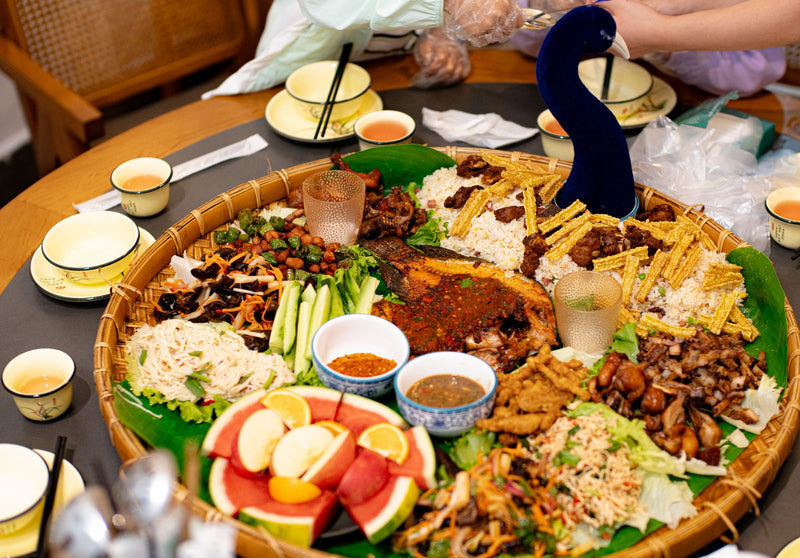
For larger serving pieces, boards for ulam laid out kamayan style, big platters for a boodle fight on banana leaf, the wood is taking less knife abuse and more visual duty. Acacia's bolder grain wins on the table presence side. Mango's lighter color can be a good fit if the spread is already visually dense with colored rice, grilled fish, and atchara, and you want a calmer base. For a serving board that is also going to take regular chopping, acacia is again the harder, longer-lived choice. If you want to compare acacia against the next tier of premium hardwoods, our breakdown of acacia versus teak tableware covers that comparison in full.
Best for budget vs longevity
If you are setting up a household for the first time and the budget is tight, a mango wood set is a respectable starting point. It will last several years with care, look good in photos, and not embarrass you in front of titas. If you are buying with the intention of pasalubong for a wedding, a milestone gift, or a heirloom-grade table, the longevity case for acacia is strong enough that the cost difference is small over the life of the piece. The math works out in favor of acacia for anyone who plans to keep the set more than five years.

Boards built for the boodle
The Pamilya board set is acacia at serving scale, sized for kamayan spreads and built to take the cleaver as well as the platter.
Shop the Pamilya Board Set →Frequently asked questions
Is acacia or mango wood better for kitchenware?
Acacia is the harder, less porous wood and is generally better for daily kitchenware, especially anything that holds wet or acidic food. Mango wood is a fair lower-cost option for occasional use and accent pieces. For an everyday set you expect to keep for years, acacia is the stronger choice.
Which is harder, acacia or mango wood?
Acacia is significantly harder. On the Janka hardness scale, acacia rates around 1,700 to 1,750 lbf, while mango wood rates around 1,070 lbf. For reference, North American hard maple is about 1,450 lbf, so acacia exceeds maple while mango sits below it.
Is mango wood food safe?
Yes, mango wood is food safe when properly finished with a food-grade oil or wax and kept dry between uses. It is more porous than acacia, so it needs more frequent oiling and faster drying after washing to stay in good condition. Avoid soaking it or putting it in a dishwasher.
Does acacia wood last longer than mango wood?
In equivalent daily use, acacia typically lasts roughly twice as long as mango. The hardness, lower porosity, and better humidity tolerance all contribute. With proper care, an acacia set can stay in regular use for a decade or more, while a mango set in the same conditions usually shows wear sooner.
Which wood is more sustainable?
Both have credible sustainability stories. Mango wood is usually reclaimed from spent fruit orchards, putting otherwise wasted material to use. Acacia is fast-growing plantation timber, often FSC-certifiable. The greener choice depends more on the seller's transparency about sourcing than on the species itself.
How do I care for acacia vs mango wood tableware?
Both need hand washing in warm water, quick drying with a soft towel, and regular food-safe oiling. Mango wood typically needs oiling every three to four weeks for the first year because of its higher porosity. Acacia generally needs oiling monthly for the first year, then every two to three months afterward.