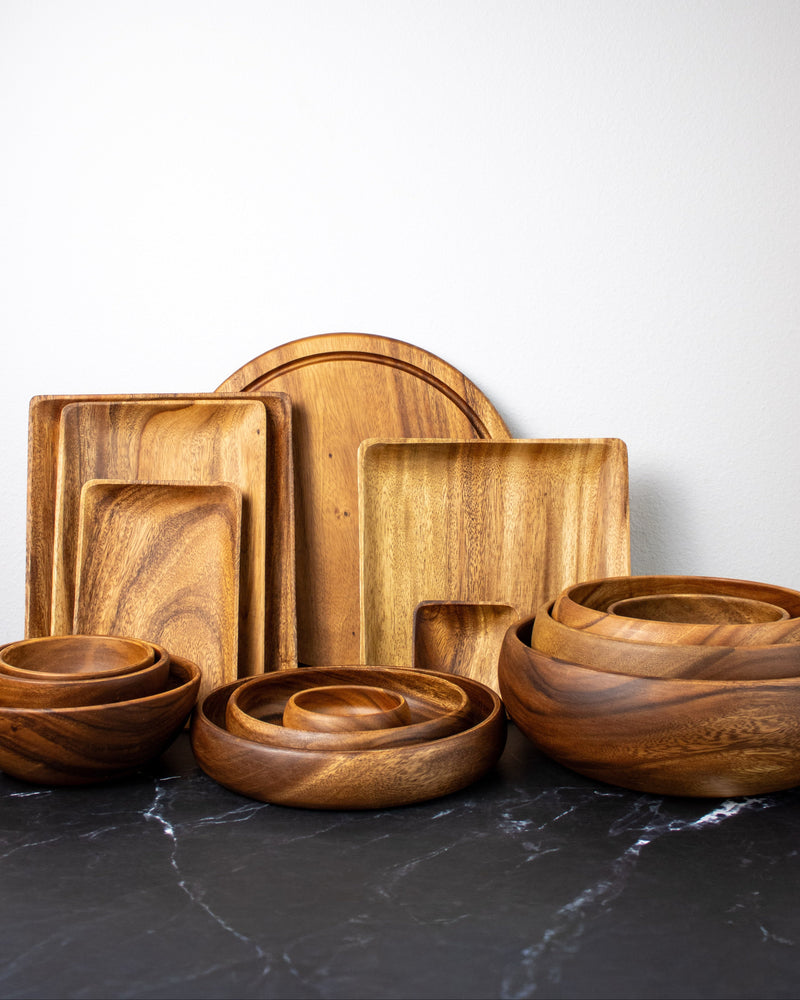
What a well-made acacia piece is actually built to last
Most conversations about retiring a wooden piece start too early. Someone notices a scratch, a shallow dent, a patch of dryness on a favourite bowl, and asks whether the piece is done. In almost every case, the honest answer is no. Acacia is one of the longest-living materials that comes into a Filipino kitchen, and a piece that looks used is very often a piece that has years, sometimes decades, still in it.
Before we get to the five signals that mean a piece has truly earned its retirement from food service, it helps to set a realistic baseline. Knowing what a healthy lifespan actually looks like changes the way you read every mark on the wood.
The realistic lifespan of a daily-use acacia piece
A dense, oil-rich acacia bowl or plate that gets hand-washed, dried immediately, and oiled every 4 to 6 weeks will comfortably last 20 years of daily kainan, and often much longer. Serving bowls and platters, which see the table only once or twice a week, can pass 30 years and still hold food beautifully. Cutting boards, which take the most punishment, sit at the lower end of that range because knives cumulate wear that even the best oiling cannot undo. A well-treated board still lands at 10 to 15 years of daily cutting before restoration or retirement becomes a real conversation.
Compare that to almost anything else on a Filipino table. Plastic goes brittle in a few years. Melamine chips and stains. Nonstick pans lose their coating in three seasons of hard use. Ceramic can outlast wood, but one dropped plate ends the run. Acacia sits in a small category of tableware that is actually designed to be handed down.
What shortens the run, and what stretches it
Three habits shorten an acacia lifespan more than anything else: overnight soaking in dishwater, laying wet pieces flat to dry, and never oiling. Three habits stretch it: hand-washing in warm water, upright air-drying, and a light mineral-oil coat every month for pieces in active rotation. Our guide on the nine acacia care mistakes everyone makes lays out each one and the 60-second habit that fixes it.
Beyond care, one other factor matters: the density of the wood you bought in the first place. Thin, lightweight acacia from fast-grown plantations will not last the way heavy, close-grained heartwood does. A dense piece rings when you tap it, feels heavier than it looks, and shows tight lines in the grain. That piece is the one worth caring for. That piece is the one this article is about.
Decline versus end-of-life
Decline is gradual and mostly cosmetic. A colour that pales, a rim that feels slightly rough, a surface that no longer beads water, a small dent from a dropped ladle. All of these are decline, and all of them are reversible. End-of-life is different. End-of-life shows up as damage that cannot be sanded, oiled, or coaxed back to a state where the piece can safely hold food. The five signals in the next chapter are the honest markers of that boundary. Anything short of them is almost always a restoration project, not a retirement.

Bowls made for the 20-year arc
The Ama bowl is the piece we build for daily use, deep enough for sinigang and rice, heavy enough to feel earned in the hand from day one.
Shop the Ama Bowl →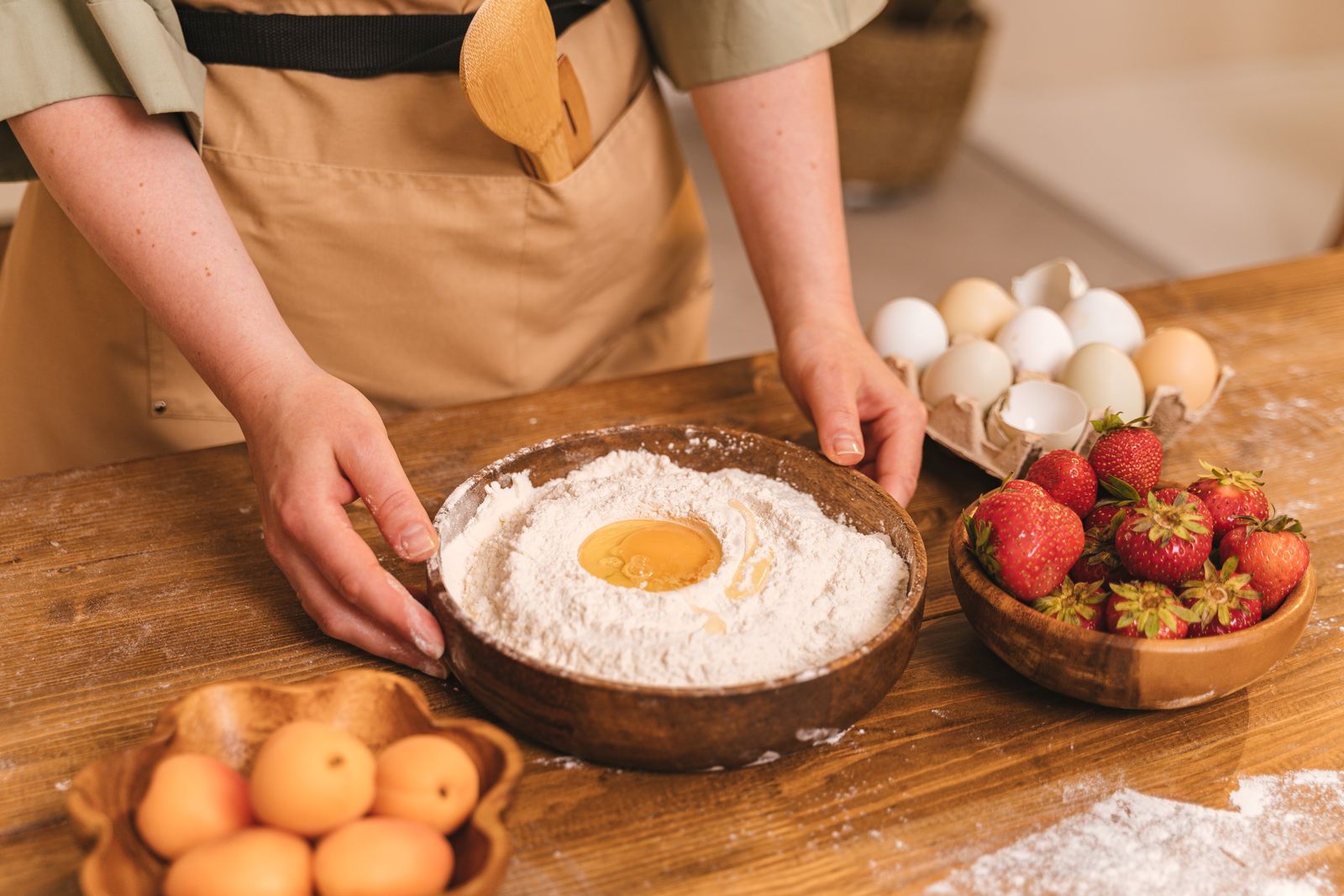
The five signals that mean the piece has left food service
Retirement from food service is a specific call, and it should be made against specific evidence. Not because the piece looks tired, not because a friend commented that it looks old, but because one of five concrete signals is present. If none of these are true, the piece belongs on the table. If any of these are true, it is time to have the conversation.
Signal 1: a crack that travels through the food surface
A hairline crack at the rim of a bowl or the edge of a board is not, on its own, a retirement signal. Oiled early and monitored, most hairlines stay stable for years. What is a signal is a crack that has travelled through the wall of the bowl into the interior, or split a board across the full grain, or opened wide enough that food and moisture can settle into it. Once that gap exists, hand-washing cannot reliably clear it. Water sits in the crack, bacteria and mold find a home, and the piece becomes a hygiene problem no matter how well you dry it.
The test is simple. Wash the piece, hold it up to strong light, and look at any crack you see from both sides. If light passes through, or if the crack visibly opens under gentle pressure, the piece is done as a food vessel. Our fuller treatment of what to do when a wooden bowl cracks walks through the borderline cases in more detail.
Signal 2: a set-in odor that will not wash out
Wood that has been used well takes on a gentle patina of the food it has served, and that is not a problem. A serving bowl for sinigang will always smell faintly, warmly, of home. Retirement territory is different. If the piece smells sour, rancid, or musty even after a full wash and a day of airing, and if that smell comes back the moment the wood gets damp, the fibers have absorbed something that will not leave.
Two causes usually explain this. First, olive oil, vegetable oil, or virgin coconut oil applied as a conditioner has gone rancid inside the grain, and no wash will lift it. Second, food residue has been left inside a deep bowl long enough to ferment, and the smell has bonded to the wood. In both cases, one round of sanding and re-oiling with food-grade mineral oil may recover the piece. If a full sand-and-refinish still leaves the odor, retire the piece.
Signal 3: splinters or fibers lifting from the surface
Splinters are the signal most people underrate. A raised sliver of wood along the rim, a fiber that lifts when you run a finger across the base, a small flake at the edge of a board, all of these are small in the moment and dangerous over time. Once the surface starts to shed, food catches on the lifted fiber, moisture gets under it, and the sliver deepens. Worse, splinters end up in the mouth of whoever eats from the bowl.
A single lifted fiber, caught early, sands out cleanly with 320 grit paper and a fresh oil coat. Widespread lifting across a surface, or splinters that reappear a week after sanding, mean the finish has failed at the fiber level and the piece is no longer safe for direct food contact.
Signal 4: structural warp that has set
A slight cup in a board or a small oval in the rim of a bowl is often correctable if you catch it early. Lay the piece with the concave side down, cover with a damp cloth, weight it evenly, and leave for a day or two. Many mild warps relax. What is a retirement signal is a warp that has set, meaning it does not respond to that treatment, and that meaningfully changes how the piece works. A board that rocks so hard the knife slips off. A bowl that no longer sits level on the table and pools broth to one side. A plate that has cupped enough that food slides.
Set warp is not a hygiene problem the way a crack is. It is a use problem. The piece is still safe to eat off, in principle, but it fights you at every meal. That is a legitimate reason to move it off the table and into a second life where its shape no longer matters.
Signal 5: deep char, heat damage, or dark grain rot
Two kinds of dark spots signal end of life. The first is a burn ring or scorch mark from a hot pot placed straight on the wood, deep enough that sanding cannot lift it without dishing out the surface. The second, and more serious, is dark grain rot: black or grey patches spreading through the wood, sometimes soft to the touch, that mean fungal decay has reached below the surface. Rot is different from a mold spot on the surface, which is treatable with the vinegar-and-salt rescue our guide on removing mold from wooden tableware walks through. Rot means the fiber itself is decomposing, and there is no way to restore integrity to wood that has begun to break down structurally.
Restoration as the bridge before retirement
Between the piece that is fine and the piece that is finished sits a wide territory of pieces that can be restored. This is the chapter most households skip. They see a dull surface or a small hairline and jump straight to buying new. Almost always, twenty minutes of work brings the piece back to years of active service. Here is the honest ladder of what is worth trying and when.
Tier one: the sand and oil refresh
For dullness, fuzzy grain, a rough feel, or a surface that has stopped beading water, the fix is a light sanding followed by re-oiling. Wash the piece, dry it fully, and let it sit overnight. In the morning, sand very lightly with 220 or 320 grit sandpaper, going with the grain and never across it. Two or three minutes of gentle work per surface is all it needs. Wipe off dust with a barely damp cloth, let dry a full day, then apply food-grade mineral oil generously with a clean cotton rag. Let the oil sit 20 to 30 minutes, wipe off the excess, and repeat the oil step the next day if the wood still looks thirsty. Most pieces recover to something very close to their original look and feel.
Tier two: the deeper refinish for a vintage piece
For an older piece that has years of stains, several small marks, and a surface that never quite comes back with a light sand, a fuller refinish is worth trying. Start with 150 grit to lift the old finish and set stains, move through 220, then 320, and finish with a mineral oil and beeswax blend for a slightly firmer surface. This is the process our guide on restoring a vintage acacia piece walks through, including the moments to stop and reassess if the wood is not responding.
Tier three: the honest limit
Restoration has a boundary. It can bring back a surface, close a rim by re-oiling before a hairline travels, and pull a mild warp back toward flat. It cannot close a through-crack, remove a set-in odor after two full sandings, seal a splinter that keeps returning, or reverse rot. When you have run through the restoration ladder and one of the five retirement signals is still present, the piece is telling you it has finished its work on the table. That is not a failure of care. It is a decade or more of good service reaching its natural end.

The set built to be handed down
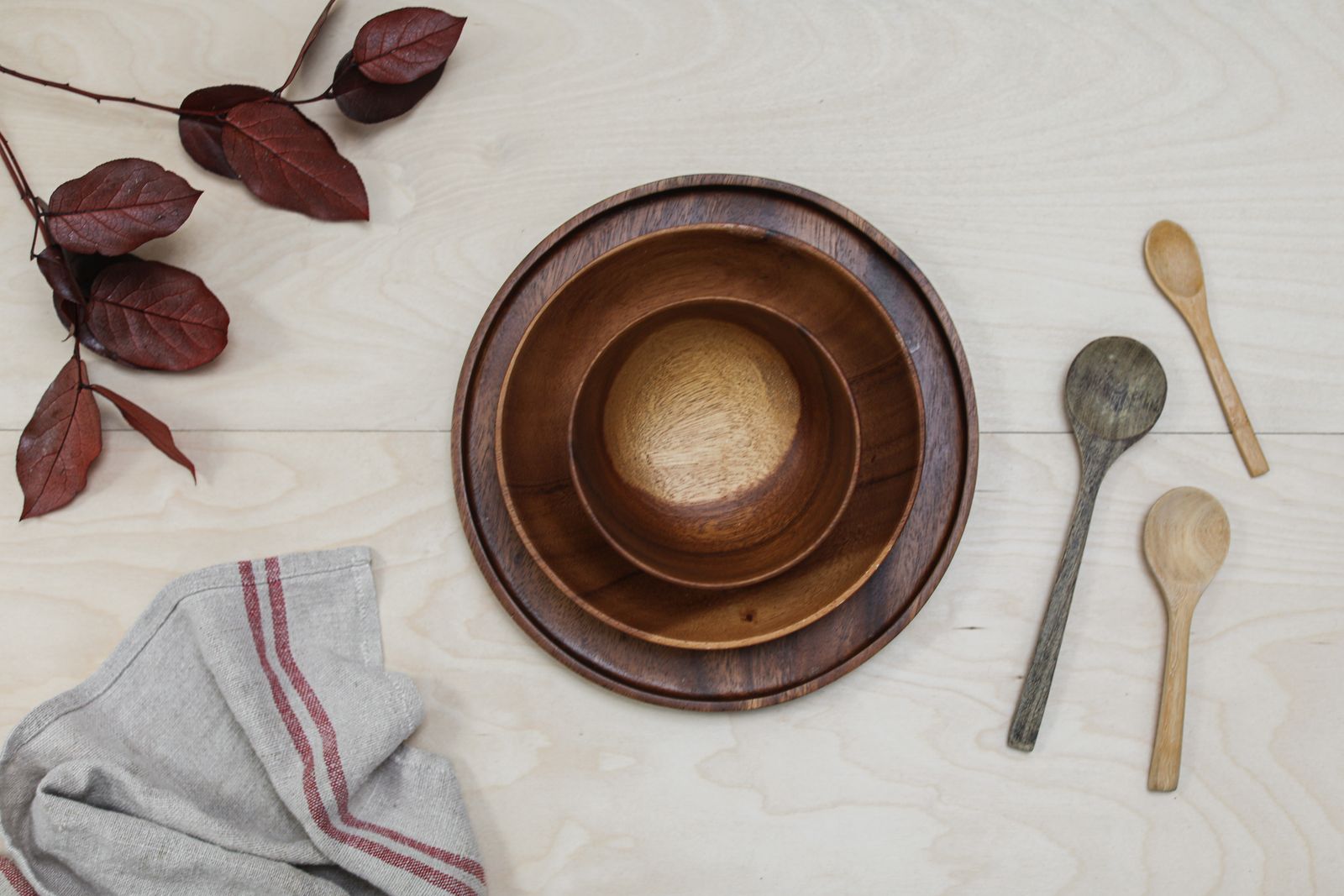
The Gorosin bowl set is the heirloom-tier piece, dense heartwood cut to sit at the family table for two or three generations of restorations.
Shop the Gorosin Bowl Set →Second lives: what a retired piece can still do
A piece retired from food service is not a piece thrown away. Acacia is beautiful, dense, and full of grain character, and there are half a dozen roles in the home where a bowl that can no longer hold sinigang still earns its shelf space. These are the ideas we see most often in the homes of long-time customers, gathered from years of "what did you do with your old one" conversations.
The fruit bowl or entryway catch-all
A bowl with a cracked or heat-damaged interior is still a beautiful fruit bowl on the counter. Mangoes, calamansi, saging na saba, the fruits that do not need to sit in a food-safe surface, all live happily in a retired acacia bowl. On the entryway console, that same bowl becomes the catch-all for keys, coins, a phone, the small metal objects a household drops on arriving home. The piece keeps its daily role, just in a different room.
The candle holder or wick bowl
A shallow retired bowl makes an excellent home for a pillar candle. Line the interior with a small circle of foil to catch drips, set the candle in the centre, and the acacia grain glows warm around the flame. Deeper bowls can hold a nest of tea lights for a hosting evening. This is one of the most common second lives we see, especially for smaller bowls that never held enough food to justify replacing, but are too beautiful to store away.
The planter, with a liner
A retired bowl becomes a plant home with one small preparation. Because raw acacia will absorb watering-can water and eventually rot, you need a physical liner. Slide a small plastic nursery pot inside the bowl, or line the bowl with a piece of pond-liner plastic cut to fit, then add soil and plant. Small herbs, a pothos, a snake plant, an orchid in its clear cache pot, all work beautifully. The wood grain sets off the green in a way ceramic pots cannot match. A retired serving bowl on a windowsill with a kalamansi seedling in it is one of the most Filipino-feeling second lives we know.
The riser, staging tray, or photo prop
Retired boards, especially those with a set warp or a heat mark, become risers for a coffee table, staging trays for a bar cart, or photo props for a home business selling baked goods or handmade objects. A board no longer used to cut is still a board that holds a candle and two coasters beautifully, or a stack of coffee-table books, or a folded blanket at the end of a bed. Boards with character live longer as objects than most pieces of decor bought new.
The pasalubong or dry-food tray
A retired bowl or platter can still hold dry food that does not sit against the wood long enough to absorb into any damaged fiber. Pasalubong for guests to take home, a pile of biscocho or polvoron at merienda, unshelled peanuts at an inuman, all sit fine on a retired piece. This is the softest retirement of all, keeping the piece adjacent to the food it used to serve, without exposing it to the moisture and residue that ended its life at the sinigang bowl role.

Boards that outlast their first retirement
The Pamilya board set is the piece that will see decades of cutting, then a second decade as a serving riser or console tray when its blade days are done.
Shop the Pamilya Board Set →Letting go sustainably, when the piece is truly finished
Some pieces reach the end of every possible role. The bowl is cracked through, the second-life planter role finally rotted the base out, the board split down its length in a season of dry weather. When that happens, the last question is how to send the piece out of the house without adding to a landfill. Untreated acacia is one of the most environmentally forgiving materials in the home, and there are three honest paths for it.
Compost or green waste, for pieces finished with mineral oil
A piece that has only ever been treated with food-grade mineral oil, beeswax, or nothing at all is compostable. In garden compost, a broken bowl in pieces will break down over 12 to 24 months, faster if chipped small. If your household has no compost, most Philippine local government units accept untreated wood in the green waste or yard waste stream, which is chipped and returned to the soil. Pull off any metal fittings first, break the piece down with a hand saw into forearm-sized pieces so it processes cleanly, and set it out with the rest of the yard waste.
Firewood or kindling, for a home with a kitchen fire
For households that cook over wood, or have a bakery oven, an outdoor kalan, or a fire pit, a retired acacia bowl becomes clean-burning kindling. Acacia burns hot and long thanks to the same density that made it a good table piece. Only burn wood you know has been finished with mineral oil or left raw. Never burn a piece that has been treated with polyurethane, lacquer, or an unknown commercial finish, since those release fumes that should not be near food or air a household breathes.
The craft second-life, for a maker who wants it
Woodworkers, art students, and craft schools are often glad to take retired hardwood offcuts for small projects: cutting into coasters, turning into spoons, chipping for smoker chunks, or breaking down for inlay work. Post a photo on a local buy-nothing group or on a barangay Facebook page describing the piece as "retired acacia, free to woodworker," and it will find a home within a day in most Metro Manila neighbourhoods. Passing the wood into a new object is often the most satisfying farewell of all.
A note on why this matters
Wooden tableware is one of the few kitchen categories where the end-of-life story can genuinely close a loop. A piece that came from a well-managed tree, held two decades of meals, spent a second decade as a fruit bowl or planter, and finally returned to the soil as compost is a piece whose environmental cost was, on the whole, paid many times over. This is a big part of why we lean into acacia as a material at all, and it is covered more fully in our guides on whether acacia is sustainable and on building an eco-friendly kitchen with wood.
Frequently Asked Questions
How long should a good acacia bowl actually last?
With hand-washing, immediate drying, and a light mineral-oil coat every 4 to 6 weeks, a dense acacia daily-use bowl comfortably runs 20 years, and often longer. Serving pieces used weekly rather than daily can pass 30. Cutting boards land lower at 10 to 15 years of active cutting, because knives cumulate wear that oiling cannot undo.
Does a small crack mean I have to retire the piece?
Almost never. A hairline at the rim, caught early and oiled, usually stays stable for years. The retirement signal is a crack that has travelled through the wall of a bowl or across the full grain of a board, wide enough that food and water settle into it. Hold the piece up to strong light and look at the crack from both sides. If light passes through, it is time to retire it from food use.
Can I still use a warped acacia board for cutting?
A mild cup that responds to the damp-cloth-and-weight treatment is fine to keep cutting on. A set warp that makes the board rock, or that pools liquid to one side, is a use problem rather than a hygiene one. The board is still safe, but it fights you at every meal. That is a good reason to move it into a second life as a riser, staging tray, or console piece.
What can I do with a retired wooden bowl besides throw it away?
Most retired bowls have a decade or more of second life still in them. Common uses are fruit bowls, entryway key catchers, candle holders, planters with a plastic liner inside, and pasalubong or dry-food trays. Retired boards work beautifully as coffee-table risers, bar-cart staging, or photo props. A piece off the table is not a piece finished.
Is it safe to compost or burn old acacia tableware?
Yes, if the piece was finished with food-grade mineral oil, beeswax, or nothing at all. Pieces treated with polyurethane, lacquer, or unknown commercial finishes should not be burned or composted. For mineral-oiled pieces, break down into forearm-sized pieces with a hand saw and add to home compost or municipal green waste, or use as kindling in a wood-fired stove or outdoor fire pit.
How do I know if the odor in my bowl is a retirement signal?
A warm, faint smell of the food a piece has served is normal patina. A retirement signal is a smell that reads sour, rancid, or musty, that persists after a full wash and a day of airing, and that returns the moment the wood gets damp again. Try one round of light sanding and re-oiling with food-grade mineral oil first. If the smell survives that, the fibers have absorbed something that will not leave, and the piece is done as a food vessel.