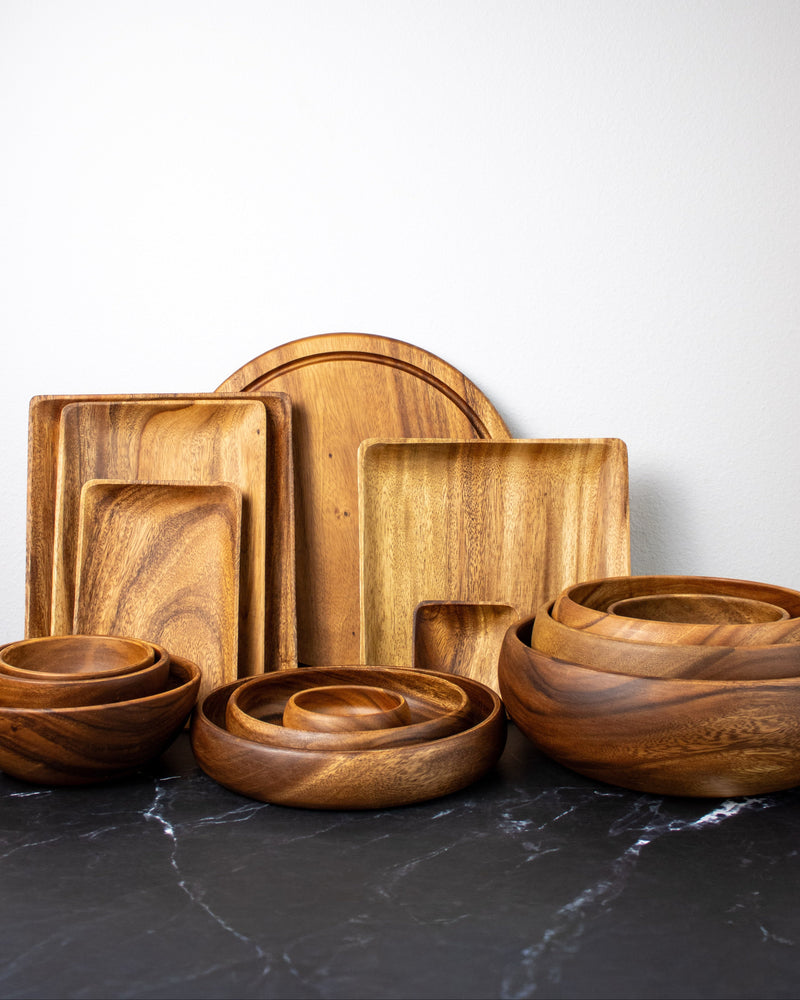
You noticed the crack while drying the bowl after Sunday lunch, or maybe when you pulled it down from the shelf to plate mangoes for merienda. The line is thin, or it is not so thin, and now you are wondering if the piece you got as a wedding gift from your ninang is finished. Before you wrap it in newspaper and mourn, take a breath. Most wooden bowls that develop a crack are not ruined. Some are, and knowing the difference is the whole game.
This guide walks through what the crack actually is, what caused it (the Philippine climate is usually part of the story), what you can fix at your own kitchen counter, and how to keep your other bowls from ending up in the same conversation.
First, don't panic. Assess the crack
Wood is a living material even after it leaves the tree. It expands, contracts, and occasionally shows the stress of that movement as a crack. Before you decide what to do, you need to know what kind of crack you are looking at. Grab a bright light, run your finger across the surface, and look closely.
The three crack types you will see
Almost every crack in a wooden bowl falls into one of three categories.
- Hairline check. A shallow surface line, often following the grain, that appears as the wood adjusts to a new humidity level. You can feel it with a fingernail but you cannot see through it. These are the easiest to address and the most common in a Philippine kitchen.
- Drying split. A deeper crack, sometimes running from rim toward the base, that opens when a bowl has been kept too dry for too long. You can often see light through it if you hold the bowl up. These need repair, not just polish.
- Impact fracture. A crack that starts at a specific point of trauma. A drop on the tiles, a bump against the granite counter, a heavy plate stacked on top. These may branch, chip the rim, or run across the grain instead of with it.
Structural or cosmetic
Press gently on either side of the crack. If the two sides move independently or you feel a slight flex, the crack is structural. If the bowl feels rigid and the crack is only a visual line, it is cosmetic. Cosmetic cracks are almost always fixable. Structural cracks need more careful judgment, and sometimes the honest answer is that the bowl becomes a display piece.
The complete acacia wood guide covers grain behavior in detail if you want to understand why acacia in particular develops these patterns. Short version: acacia is a dense, tight-grained hardwood, and its cracks tend to be small and manageable rather than catastrophic.
When it is still safe for food
A hairline check that does not penetrate through the wood is still food-safe for most uses. So is a small drying split that has been properly cleaned, filled if needed, and re-oiled. The concern with any crack is bacteria harboring in a space you cannot clean. If you can dry the crack fully after washing, and the wood surface stays sealed with oil and wax, dry and low-moisture food (rice, bread, fruit, dry ingredients) is fine.
When to retire from food service
Take a bowl out of food rotation if the crack goes all the way through, if the two sides move against each other, if there is any dark discoloration inside the crack (that is bacterial or mold growth), or if the bowl has been used for wet food (adobo, sinigang, sabaw) and cannot be dried completely. A retired bowl is not a wasted bowl. We come back to what to do with it in the last chapter.

When the diagnosis is retirement
If your everyday bowl is beyond saving, the Ama set is the honest, hardworking replacement. Built for daily rice, ulam, and merienda rounds.
Shop the Ama Bowl Set →What actually causes wooden bowls to crack
Understanding the cause matters because it tells you which of your other bowls are at risk. In our experience, four culprits account for almost every crack we see.
Humidity shock
The Philippine climate is not one climate. A bowl that lives in an air-conditioned Makati condo at forty percent humidity behaves very differently from the same bowl in a Quezon City lanai at eighty-five percent. Move the bowl between them and the wood expands and contracts unevenly, releasing stress as a crack. The classic scenario is the pasalubong bowl gifted from Baguio, brought down to Metro Manila, and set on the dining table without a settling period.
We wrote a full piece on protecting acacia from humidity if you want the mechanics. The short answer: give a bowl seven to fourteen days to acclimate in a room that matches where it will live before you start using it for hot food.
Drying out
Wooden bowls need oil the way leather needs conditioning. When the oil dries out and is not replaced, the wood loses flexibility. The first month you skip oiling, nothing happens. The sixth month you skip it, a hairline check appears near the rim. Direct sun makes this worse. A bowl left on a window sill facing the afternoon sun is a bowl asking to split.
Thermal shock
Pouring hot sabaw from the pot straight into a cold bowl is one of the most common causes of an immediate crack. The inside surface expands rapidly while the outside stays cool, and the wood tears. The same happens in reverse: a bowl of warm rice placed on a cold marble counter. Let hot food rest a minute in the pot before transferring, and warm the bowl briefly under running tap water first.
Impact and stacking pressure
Stacking a heavy ceramic plate on top of a nested wooden bowl set puts steady pressure on the rims. Over months, this can start a stress crack at the rim edge. Dropping a bowl is obvious. Less obvious is the slow damage from a cabinet where the door bumps the bowl every time it closes, or a shelf where bowls slide against each other with every fetch. On dishwashing, one more note: heat and prolonged water exposure from a dishwasher cycle is a fast track to cracks. Our full explanation is at can you dishwasher acacia wood. The short answer is no.
Repair options you can actually do at home
Not every crack needs a woodworker. Most home cooks can handle the top three repair scenarios with a trip to Handyman or True Value and thirty minutes of patient work.
Hairline cracks: mineral oil and beeswax
This is the repair for surface checks that have not fully separated the wood.
- Wash the bowl with warm water and a small amount of mild dish soap. Rinse and towel dry.
- Let the bowl air dry for at least six hours, ideally overnight, in a room away from direct sun and away from aircon.
- Warm food-grade mineral oil slightly (not hot, just above room temperature). Pour a generous amount along the crack and across the surface. Let the oil soak in for four hours minimum. The oil will migrate into the check and swell the wood back toward closed.
- Wipe off excess oil. Apply a thin layer of beeswax or a food-safe beeswax and mineral oil blend, working it into the crack area with a clean cloth.
- Rest the bowl for twenty-four hours before use. Repeat the oiling weekly for the next month.
Nine times out of ten, this closes a hairline check to the naked eye and restores structural integrity.
Small splits: food-safe wood glue
For a split you can see through but that is under half a centimeter wide, food-safe glue works. Titebond III (a Type III polyvinyl acetate wood glue) is the standard. It is FDA-approved for indirect food contact once cured, which means it is safe for bowls and boards after the glue is fully set and the surface is refinished.
Do not use white school glue (it is not water resistant), household superglue (cyanoacrylate is not food-safe), or two-part epoxy (unless specifically rated food-safe, and most kitchen counter epoxies are not).
- Clean the crack with a soft brush to remove crumbs and old oil.
- Apply Titebond III sparingly into the split with a toothpick or thin card, working it deep. Wipe surface excess immediately with a damp cloth.
- Clamp the bowl gently with a rubber band wrapped around the exterior. Do not over-tighten. Wooden bowls have curves and a strong clamp can crack a new spot.
- Let the bowl cure for twenty-four hours minimum. Titebond III lists full strength at seven days.
- Once cured, sand the glue line lightly with 320 grit paper, then refinish with mineral oil and beeswax as above.
Deeper cracks: sanding, filling, refinishing
For a wider split, mix fine sanding dust from the same bowl (or the same wood type) with Titebond III to make a color-matched filler. Press the paste into the crack, let cure, sand smooth, and refinish. This works cosmetically but the bowl should be used for dry food only afterward.
When to call a woodworker (or retire the piece)
If the bowl has multiple radiating cracks, a broken-off chunk, or a crack that runs across the grain and destabilizes the base, it is time to either bring it to a local woodworker (any furniture repair shop in Cubao, Marikina, or the woodworking corners of Bacoor will look at it) or accept that the bowl retires from food service. A skilled woodworker can rebuild rims, insert Dutchman patches, and refinish. Ask about food-safe finish before you commit.
How to prevent future cracks
Once you have identified the cause of the crack, you already know what to change. Here is the maintenance rhythm that keeps a bowl going for decades.
The monthly oiling most Filipino homes skip
Wooden bowls need re-oiling once a month, or more often in aircon rooms where the air is drier. A tablespoon of food-grade mineral oil, rubbed in with a clean cloth, left to soak for an hour, then wiped down. That is the whole ritual. It takes five minutes. Skip it for six months and you are looking at a hairline crack. The full acacia bowl care guide walks through timing, oil choices (mineral oil versus walnut versus mixed blends), and how to tell when a bowl is thirsty.
Where not to store wooden bowls
- Directly under or beside an aircon vent. The cold, dry blast dehydrates wood fast.
- On a shelf above the stove or oven. Heat rises, and repeated warming cycles are a slow crack invitation.
- In direct afternoon sun. Even filtered sun through a curtain adds up over months.
- In a sealed plastic container. Trapped moisture leads to mold. Wooden bowls need to breathe.
The best spot is an open shelf, mid-height, in a room that stays within twenty to thirty degrees Celsius and fifty to seventy percent humidity most of the time. That is where most Filipino dining rooms sit naturally.
Handling temperature transitions
Warm the bowl before hot food goes in. Rinse it under warm tap water, or leave it out on the counter for ten minutes while the sabaw simmers. Never take a bowl straight from an air-conditioned dining room and pour boiling contents into it. And never put a hot-from-food bowl directly into cold water in the sink. Let it rest first.
The stacking rule
Nesting bowls of the same set stack safely because they are designed to. Stacking a ceramic plate, a metal serving tray, or a heavier bowl on top of a wooden bowl is where damage starts. If you need to save space, nest same-material with same-material, and keep the heaviest piece on the bottom.

Bowls sized for the rhythm of a Filipino table
The Gorosin set is our nesting daily-driver: rice, ulam, mangga, halo-halo. Sized to stack safely and oil quickly.
Shop the Gorosin Bowl Set →What to do with a bowl you cannot save
Sometimes the honest answer is that a bowl is done as a food vessel. That does not mean it is done. A well-made wooden bowl has decades of usefulness left even when it can no longer hold your rice.
Repurposing for dry display
A cracked bowl is beautiful as a fruit display on the dining table. Fill it with mangoes, calamansi, lansones, or santol during the season. It can also live on the entry console as a catch-all for keys, coins, and folded receipts. Dry ingredients like garlic bulbs, sibuyas Tagalog, and dried chili also work.
Gifting to plant parents
Drill a small drainage hole in the base (a woodworker can do this cleanly), line the interior with a plastic saucer, and you have a planter. Philodendron, snake plants, and small succulents thrive in wooden planters. A cracked bowl reincarnated as a monstera home is a lovely pasalubong for the tita in the family who is deep in her plant era.
When replacement is the honest answer
If the bowl was a workhorse and the crack means it can no longer serve at the table you gather at every night, replacement is not a defeat. It is a decision to keep the practice going. The bowl on the shelf can hold fruit while the new bowl handles the sinigang.
Choosing a replacement built to last
When you replace, look for a set with clear grain, no visible knots along stress lines, and rounded rims (sharp rims are more prone to chipping). A good weight in the hand is a sign of dense wood, which is more crack-resistant than lightweight softwoods. Buy from a maker who tells you how their pieces are finished and what oil they recommend. That is the seller who will still be around when you need a matching piece.

An everyday set for a table you use hard
Manila is our mid-weight, mid-size set: made for the family dinner that happens seven times a week, sized to survive stacking, oil-ready out of the box.
Shop the Manila Bowl Set →Frequently asked questions
Can I still use a cracked wooden bowl for food?
Yes, if the crack is a hairline check or a small sealed split, and you use the bowl for dry or low-moisture food like bread, fruit, or rice. Any crack that penetrates the wall, that traps moisture, or that shows dark discoloration should retire the bowl from food service.
What is the best food-safe glue for a cracked acacia bowl?
Titebond III is the standard choice. It is a Type III polyvinyl acetate wood glue that is FDA-approved for indirect food contact once cured. Avoid white school glue, cyanoacrylate superglue, and non-food-rated epoxies.
Will oiling close a hairline crack?
Often, yes. A hairline check is a wood that has lost moisture and shrunk. A warm mineral oil soak, followed by beeswax, lets the wood absorb moisture and swell back toward its original dimensions. Repeat weekly for a month for best results.
Why do wooden bowls crack in the Philippines more than elsewhere?
Not more, but differently. The country has strong humidity swings between aircon rooms and open lanais, between the wet season and the summer, and between elevations like Baguio and Manila. Wood adjusts by expanding and contracting, and rapid swings are what release stress as cracks.
Can a cracked wooden bowl be saved by a professional?
A skilled woodworker can rebuild rims, insert Dutchman patches to bridge splits, and refinish a bowl to food-safe standards. Look for furniture repair shops or artisan woodworkers in Cubao, Marikina, or Bacoor, and always ask about food-safe finishes before committing.
Is a cracked bowl a sign of poor quality wood?
Not necessarily. Even the densest, best-selected acacia will crack if it is thermally shocked, kept next to an aircon vent for a year, or never oiled. Quality wood cracks less often and more predictably, but no wooden bowl is immune to environment.