The Filipino kitchen was already low-waste
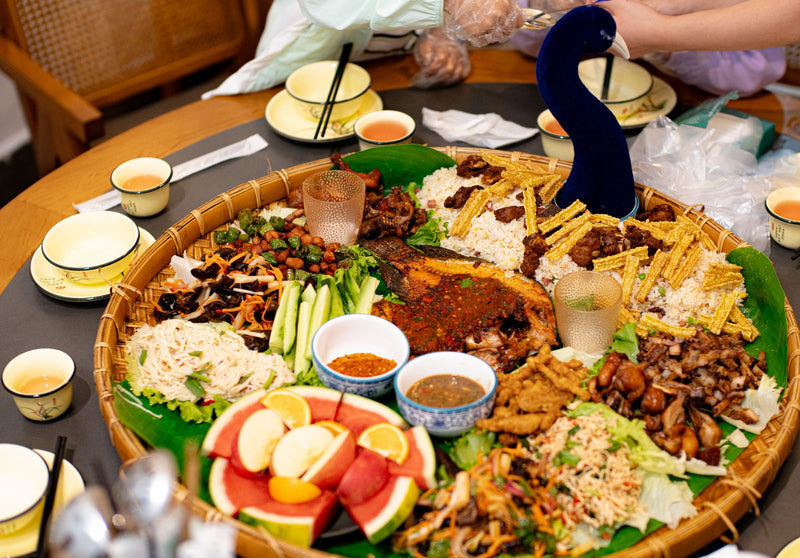
Before "eco-friendly kitchen" became a category on a shopping site, it was just how a Filipino household ran. Walk into any lola's kitchen in the province and you are looking at a system that has been optimizing for reuse and low waste for generations. The banana leaf laid down under a mound of rice for a boodle fight is not a design choice, it is a plate that composts itself. The bilao that sifts rice, catches lansangan for merienda, and doubles as a serving tray for kakanin is a single object doing five jobs across a lifetime. The palayok on the stove has been simmering something in that same household since before you were born.
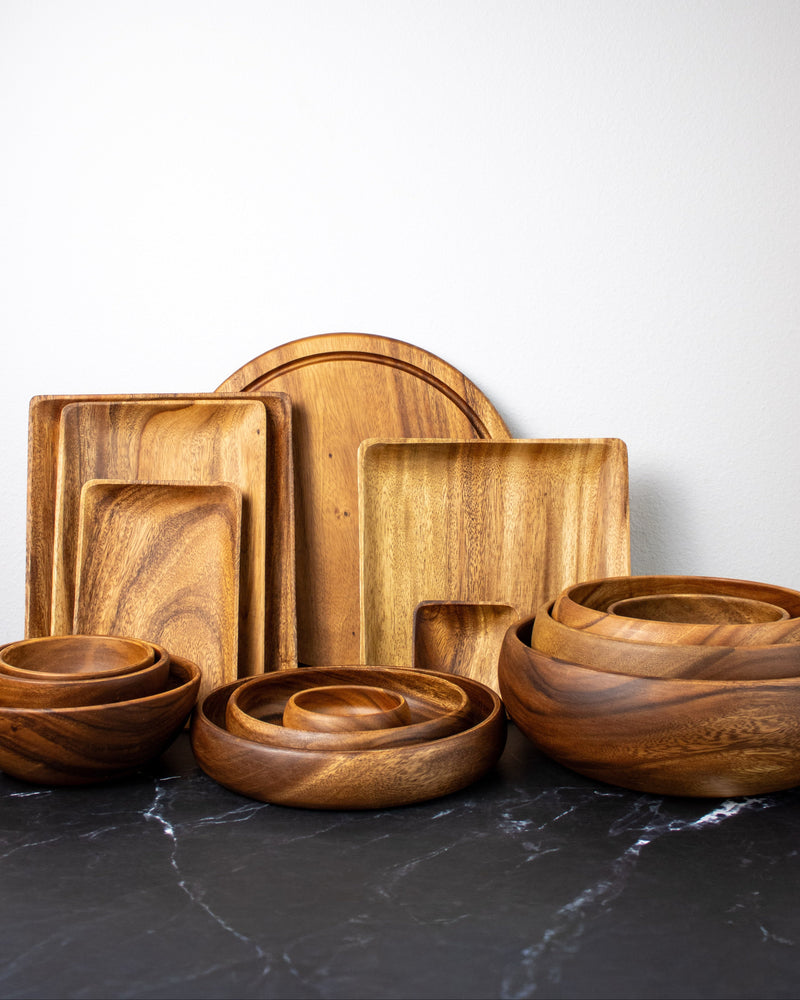
The point is not that Filipino kitchens are behind the trend. The point is that the trend caught up. Solid wooden tableware is not a departure from that heritage. It is the continuation of it, in a form that suits a modern condo unit as well as it does a bahay kubo.
Banana leaf, bilao, palayok: the original zero-waste kit
The banana leaf is worth pausing on because it is the clearest example of what a low-waste vessel actually looks like. It is grown a few steps from the kitchen. It is harvested with a bolo. It carries a mound of rice, ulam, and vegetables for a whole family. When the meal is done, it goes to the compost pile or to the pigs. The end of its life feeds the next meal. Our piece on serving kakanin on banana leaves walks through why this system still works for merienda spreads today.
The bilao is the same story in a longer arc. Woven from bamboo or nito, it lives for years in the kitchen, moves between sifting, drying, serving, and displaying, and when it finally gives out it becomes garden material. The palayok, an unglazed earthenware pot, carries flavor across decades. Old palayok in a family kitchen carry the seasoning of every sinigang and adobo they have ever held. When one finally cracks, it goes back to clay, back to soil.
The compost economy of a busy kitchen
The other half of the low-waste kitchen is what happens after the meal. Bones go to broth. Peelings go to the compost or to the animals. Cooking oil, if it can be reused, is filtered and reused. What comes out of a Filipino kitchen at the end of the day is a small amount of paper, a small amount of plastic (usually from imported goods), and a bag of organic material bound for the garden. A landfill contribution measured in handfuls, not bags.
This is the baseline. When we talk about building an eco-friendly kitchen with wood, we are not building it from scratch. We are extending a system that already works.
Where wood fits in the lineage
Wooden tableware sits between the banana leaf (single meal, then to compost) and the palayok (decades of daily use) on the same continuum. A well-made acacia bowl is a piece your family will use for twenty or thirty years. When it finally cracks past the point of food safety, it does not go to the landfill. It becomes a fruit bowl, a key catcher by the door, or eventually mulch. The wood was a tree, becomes a bowl, then goes back to soil. The line is unbroken.

The everyday foundation of a low-waste kitchen
The Staple Set is the small kit of pieces most families reach for every day. Buying them once, in solid wood, is what makes the whole eco math work.
Shop the Staple Set →
What wood actually does in a low-waste kitchen
The reason wood pulls its weight in an eco-friendly kitchen is not romance. It is arithmetic. Every plastic cutting board in a household is a countdown clock. Every paper plate at a fiesta is a one-way trip to the landfill. Every disposable serving tray at a catered handaan is a piece of PET that will outlive the person who ordered it. Replacing those with solid wooden pieces is where the numbers move.
Replacing single-use at fiesta scale
A typical Filipino fiesta or handaan for twenty people, done on disposables, produces two garbage bags of paper plates, plastic cups, and single-use serving trays. Done on wood and ceramic, it produces one dish tub of things to wash. Across a year of birthdays, baptisms, and Christmas parties, one family can send fifty or a hundred pounds of single-use tableware to the landfill, or send none. The math is not close.
Wooden serving pieces do the heavy lifting here because they are the ones that get borrowed, moved, carried across the yard, and set on a long table under a canopy. Ceramic works for smaller salu-salo, but the moment the guest count crosses fifteen, most households reach for disposables to avoid breakage. Wood solves both problems. It is unbreakable in normal use, and it looks right on the table.
The plastic cutting board math
A cheap plastic cutting board lasts, in an active household, about eighteen months before it is gouged deep enough to trap food and needs to be replaced. A solid acacia cutting board, cared for correctly, lasts twenty years. That is roughly fifteen plastic boards retired over the same period. Every one of those plastic boards is a piece of HDPE or polypropylene that will not decompose in any human timeframe. Every one of them started with fossil feedstock. The switch to one wooden board is the single easiest sustainability move most kitchens can make.
The same logic runs across bowls, plates, and serving pieces. If a wooden piece is going to last ten times as long as its plastic or disposable equivalent, the lifecycle footprint is roughly a tenth. This is before you count the fact that solid wood is a stored-carbon product, not a fossil-derived one.
The end-of-life question
The other advantage of wood is that its retirement is graceful. Ceramic breaks and goes to the landfill in shards. Plastic scratches, harbors bacteria, and goes to the landfill in one piece. Wood cracks slowly, gets demoted from food service to decoration to key bowl to compost. There is no single-day disposal event for a wooden piece. The retirement takes years.
If you are wondering how the wider math on acacia specifically holds up, our piece on whether acacia is actually sustainable walks through the chain of custody, plantation-versus-salvage sourcing, and the certification questions that matter more than the sticker.
Building a low-waste kitchen around wood, piece by piece
The practical question, if you are actually trying to build this in your own household, is what to buy first and what to skip. Not every kitchen job belongs to wood. The trick is knowing which ones do.
Start with the pieces you use every day
Everyday plates and rice bowls are the highest-leverage first purchase. They are the pieces that see the most meals, the most washes, and the most retirement of their disposable equivalents. A set of six to eight solid wooden plates and matching bowls handles daily kainan for a family of four and leaves enough for a small merienda spread when a neighbor drops by. This is the core of the kit. Buy this once and the paper-plate purchases stop.
Right after the plates come the serving bowls and platters. These are the pieces that decide whether you can host a handaan without reaching for disposables. Two large serving bowls and one long board cover most spreads for eight to twelve people. Add one more of each and you can host twenty.
Cutting and serving boards do the heaviest work
The cutting board is where the plastic-replacement math is starkest, and where the eco payoff shows up fastest. One thick acacia board handles vegetable prep, bread, ulam plating, and cheese boards for guests. If the household cuts a lot of raw meat, add a second board dedicated to that job so the vegetable board stays clean. Two boards, replaced never, versus fifteen plastic boards across the same decade.
Long serving boards do double duty. They plate lechon at Christmas, hold the lumpia at a birthday party, and become the base of a Filipino cheese board on a Tuesday night. In a small kitchen, a single long board can replace half a dozen catering trays across a year.
What to keep in ceramic, glass, and metal
Wood does not solve every problem. Storage containers should stay glass or stainless. The stovetop needs cast iron, stainless, and the good old palayok. Anything that goes in the oven needs ceramic or metal. Anything acidic that sits for a long time (a vinegar-heavy salsa left overnight) is happier in glass. Wood is the material for cutting, serving, and eating. It is not the material for cooking or long-term storage.
Being honest about this matters because the moment you try to force wood into a role it cannot play, you end up with a cracked, warped piece that gives up early. The eco math depends on the wood lasting. Use it where it lasts.

One board that outlasts fifteen plastic ones
The Pamilya board set is built for the kind of daily prep and weekly hosting that would otherwise retire a stack of plastic boards. The wood is thick, the finish is renewable, and the piece is meant for decades.
Shop the Pamilya Board Set →Choosing wood pieces that outlast the trend
The whole eco calculation collapses if the wood does not last. A twenty-year board is sustainable. A two-year board is worse than a plastic one, because you have burned wood and finish and shipping and still ended up with a landfill contribution. The buying rules that keep a piece in service for decades are simple and worth knowing before you spend the money.
Solid wood over veneer, always
Veneer is a thin layer of real wood glued to a core of MDF or particleboard. It looks fine on day one and starts failing the first time it meets water. The veneer lifts, the core swells, and within eighteen months the piece is unusable. Solid wood behaves differently. It absorbs water evenly, releases it evenly, and can be sanded and re-oiled indefinitely. Check the end grain of any wooden piece before you buy. Continuous wood grain on the edge means solid. A visible layer of different material underneath means veneer.
Thickness is durability
A bowl with walls thinner than six millimeters warps fast. A board thinner than an inch cups within a year. Thick wood costs more upfront because there is more wood in it, and that is the whole point. The thicker piece survives twenty years of thermal cycling, water contact, and daily use. The thin piece survives two. Weight is a proxy for thickness. Pick the piece up. If it feels light for its size, it is thin.
Source matters more than certification
Certification sticker on a piece of acacia is useful, but it does not tell you what you need to know. Where did this specific tree come from? Was it plantation-grown, storm-fall salvage, or the byproduct of legitimate roadwork clearance? Reputable Philippine workshops mostly work with salvage and end-of-life urban trees, which is a lower-impact source than plantation cutting. Our piece on acacia and Philippine forestry covers this in detail, and it is worth reading before you spend on a "certified" imported piece.
A finish that can be renewed
Skip pieces with heavy lacquer or polyurethane finishes. Those coatings peel over time, cannot be renewed at home, and lock food-safe questions inside a plastic-like shell. Look for pieces finished with food-grade mineral oil, beeswax, or a stated food-safe salad-bowl finish. All of these can be topped up at home with a bottle of oil and a rag, forever. A piece that can be refinished is a piece that can last thirty years.
Care habits that keep wood out of the landfill
The single biggest lever on the sustainability of a wooden kitchen is not what you buy. It is how you care for it after you buy it. A well-cared-for acacia bowl outlasts a neglected one by a factor of five to ten. All of the eco math above assumes the piece is being cared for. Here is what that actually looks like on a Tuesday night.
The daily habit: sixty seconds after kainan
Wood pieces come off the table first, before ceramic and metal, and get washed by hand in warm water with a small drop of mild dish soap. Soft side of the sponge only. Rinse in seconds, not minutes. Towel dry all the way around, including the base. Stand upright on a rack so air moves around both faces. Total time per piece is about sixty seconds. The whole eco value of wood depends on this habit being real, not aspirational.
The single biggest mistake is leaving wood soaking in the sink overnight. That one habit is what kills most wooden pieces in the first two years. Wash, dry, put away. If you have inherited a piece that has been badly cared for, our full care guide walks through the rescue.
The monthly habit: oiling
Active pieces (daily plates, weekly serving bowls, the cutting board that gets used most nights) want a light coat of food-grade mineral oil every four to six weeks. Small bottle, clean rag, wipe on with the grain, let it sit twenty minutes, wipe off the excess. Fifteen minutes for the whole set. This is the step most households skip, and it is the one that decides whether the piece lasts five years or twenty-five.
The annual habit: assess and rescue
Once a year, look at each wooden piece in good daylight. Check the rim of bowls for hairline cracks. Check boards for cupping. Check the surface for fuzziness or a chalky, dry look. Most issues at this stage are cosmetic and reversible: a light sanding with 320-grit paper, a heavier re-oiling, sometimes both. Twenty minutes a year, per piece. This is what keeps the piece out of the landfill.
End of life: compost or repurpose
When a piece finally cracks past food safety (a split all the way through the rim, or lifted splinters that cannot be sanded flat), it retires. It does not go straight to the landfill. Bowls become fruit displays, key catchers, or planters for succulents. Boards become bases for potted plants or, if broken up, kindling for a bonfire on the beach. What is left after all that becomes garden mulch. There is no version of this piece that ends in a landfill.

The complete kit for a household that hosts
The Family Hosting Set is the long game. Plates, bowls, boards, and serving pieces sized for a real Filipino family table, built to be the last set the household ever needs to buy.
Shop the Family Hosting Set →Frequently asked questions
Is wooden tableware more sustainable than bamboo?
They are close, and the answer depends on the specific piece. Bamboo grows faster and is often marketed as more eco, but most commercial bamboo tableware is bonded with resins that are hard to recycle and cannot be re-oiled at home. Solid hardwood pieces last longer, refinish forever, and compost cleanly at end of life. For long-term kitchen use, solid wood usually wins on lifecycle footprint.
How long does an acacia bowl actually last?
A well-made solid acacia bowl, cared for correctly, lasts twenty to thirty years in daily service. Poorly made or thin acacia can fail in eighteen months. The gap between the two outcomes is roughly evenly split between the quality of the piece and the care it receives. Buy well, wash by hand, oil monthly.
What do I do when a wood piece finally breaks?
Retire it from food use if the crack reaches the rim or splinters lift. Demote it to a fruit bowl, a key catcher, a planter, or a decoration. When it can no longer serve any of those roles, break it up and compost it or use it as garden mulch. Wooden pieces do not need to end their lives in a landfill.
Is it more sustainable to buy new wood or vintage?
Vintage or inherited wooden pieces are the most sustainable option because the material footprint is already paid. If you can rescue a lola's bowl with a sanding and an oiling, do that first. When buying new, prioritize local workshops using salvage or end-of-life wood over imported plantation product.
Does using wood mean giving up my dishwasher-friendly kitchen?
Wood pieces need to be hand-washed, but ceramic, glass, and stainless can still go in the dishwasher. The typical setup is wood pieces washed first at the sink (sixty seconds each), then the rest of the load goes into the machine as usual. You are not choosing between wood and convenience. You are moving a small subset of the wash to the sink.
How does wood compare to ceramic on lifecycle footprint?
Ceramic has a higher upfront footprint because of the firing energy, but it lasts a long time if it does not break. Wood has a lower upfront footprint and composts at end of life, but only lasts if it is cared for. In a typical household, both are far better than plastic or disposables. The honest answer is that a mixed kitchen of wood and ceramic beats a single-material kitchen either way.