What you are actually looking at
You reached into the cabinet for a bowl, turned it over, and saw the spots. Black, greenish, sometimes a soft powdery white, sometimes a faint pink blush along the rim. The first instinct is to throw the piece out. The second is to scrub it with something aggressive. Both are wrong. Before you do anything, look carefully at what you are seeing, because the treatment is different for each type.
Surface mildew versus deep mold
Ninety percent of the time, what looks like mold on Filipino wooden tableware is surface mildew. It grows on the finish, not in the wood. Run a dry fingertip across the spot. If a smear comes away and the wood underneath looks clean, it is mildew. That is the easy case. If the spot has a fuzzy, three-dimensional texture that stands up from the surface, or if scraping reveals discoloration that has soaked into the grain, that is deeper mold and needs the full treatment in Chapter 3.
Colors and what they usually mean
Color is not a perfect diagnostic, but it points you in the right direction.
- Black or dark green spots: the most common in Philippine kitchens. Usually Aspergillus or Cladosporium species growing on residual oil and food traces. Surface-level, wipes off, low risk.
- Powdery white bloom: often mineral salts from tap water or an efflorescence from the oil finish reacting with humidity. Not always mold at all. A vinegar wipe confirms it.
- Fuzzy grey or blue-green: Penicillium species. Common on wood that has sat damp in a stack. Wipes off but tends to come back if the storage habit does not change.
- Pink, orange, or reddish patches: the ones to take seriously. Can indicate Fusarium or a yeast colony. Treat, monitor, and if it returns twice, retire the piece from food use.
- Grey and dry, no fuzz: not mold. That is oxidation and dryness. Skip this article and read our care and oiling guide.
Is the piece still safe to use
The honest answer, in line with US FDA and USDA guidance on food-contact wood surfaces, is that surface mildew fully cleaned and dried does not disqualify a piece from food use. Wood is naturally antimicrobial once dry, which is why butcher blocks have been legal for centuries. What disqualifies a piece is mold that has penetrated the grain, mold that returns within days of every cleaning, and any pink, orange, or rust-colored growth that comes back after a full treatment. If the piece passes the vinegar wipe and the 24-hour dry, it is back in service.
Why this is a Philippine problem
If you grew up here, you already know the answer. The air itself is wet. But it helps to see the numbers, because they explain why a bowl that would live cleanly for years in a dry climate turns spotty here in weeks if you skip a step.
The 70 percent humidity threshold
Mold spores need three things to grow: a food source (residual oil, food traces, or the sugars in the wood itself), a mild temperature (anywhere between 20 and 35 degrees Celsius is ideal, which is most of the Philippines most days), and moisture. The moisture threshold is roughly 70 percent relative humidity, or a wood moisture content above 15 to 18 percent. Below that, spores are dormant. Above that, they grow. Standard Philippine indoor humidity ranges from 75 to 90 percent for most of the year, higher in Baguio, Tagaytay, and any coastal home. You are living above the threshold by default.
Rainy season, tag-ulan, and the cabinet trap
From June to November, the ambient humidity in Metro Manila often runs 85 to 95 percent for weeks at a time. Cabinets and drawers, especially the ones built into interior walls with no ventilation, hold that humidity like a sealed bag. A bowl that went in dry can pull moisture out of the air, week after week, until the surface layer of oil breaks down and spores find their food. This is why the annual "why is there mold on my lolo's bowls" question shows up in September, not January.
Why acacia handles this better than most
Not all hardwoods respond the same way to Philippine humidity. Acacia grown in Batangas, Nueva Ecija, and Bukidnon is one of the more forgiving woods for this climate because it already grew up in it. The tree spent decades pulling moisture out of the same air its future bowls will sit in, and its cell structure is denser and more oil-rich than most imported hardwoods. Mango wood is similar. Teak, olive, and beech are more prone to surface mildew here because their grain is less adapted. If you are shopping and want to understand why some woods hold up in kainan season and others do not, our comparison of acacia against teak covers the humidity behavior in detail.

Bowls that handle Philippine air
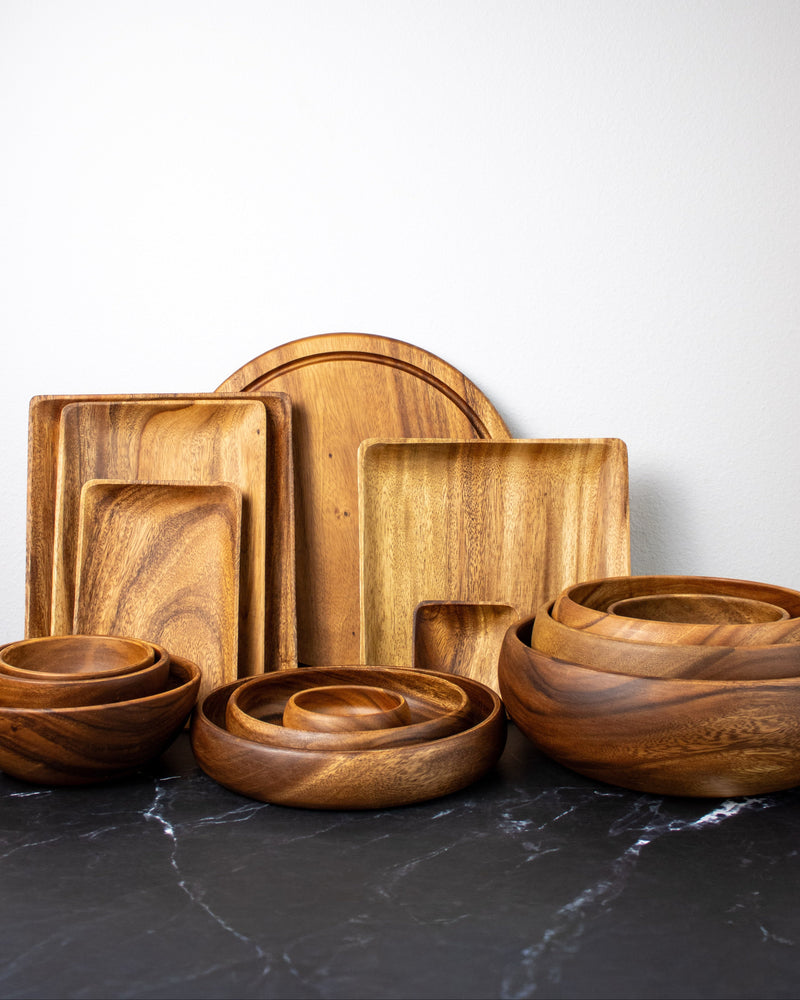
The Ama bowl set is turned from Philippine-grown acacia that already spent its life in the same humid air your kitchen sits in. That is the quiet reason it holds up through the tag-ulan months when other woods spot.
Shop the Ama Bowl Set →How to remove mold from wooden tableware
Here is the method, in order, that we recommend to every customer who writes in with a photo of a spotted bowl. It works on acacia, mango, teak, and most other hardwood tableware. The whole process takes about 30 minutes of active work spread across a day and a half, and it uses ingredients you already have in the kitchen.
What you need
- Distilled white vinegar (suka na puti, the plain kitchen kind)
- A small bowl of clean water for the 1 to 1 mix
- A soft cotton cloth or two, plus a second dry towel
- A soft-bristle brush or an old, clean toothbrush for corners
- Food-grade mineral oil for the restore step (see Chapter 4)
- Optional: coarse salt for a mild abrasive on stubborn spots
The five-step vinegar method
- Mix one part white vinegar to one part water in a bowl. Do not go stronger than 1 to 1 on the first pass. Undiluted vinegar can lift the oil finish more than needed and turn a small job into a full restoration.
- Dampen the soft cloth in the mix and wring it out well. The cloth should be damp, not dripping. Wood soaked in vinegar is still wood soaked in liquid, which is exactly what caused the problem.
- Wipe the affected areas with the grain, in short strokes. Do not scrub in circles, which can drive the residue deeper into the pores. For corners, joints, and any carved detail, use the toothbrush lightly.
- Let the vinegar sit on the surface for 5 minutes. This is where the acid does its work on the spores. If the spots are stubborn, add a pinch of coarse salt to the cloth on the second pass and rub gently. The salt gives just enough abrasion to lift set-in residue without scratching.
- Rinse with a barely damp clean-water cloth, then dry immediately with a dry towel. Get every drop off the surface. Do not run the piece under the tap. You are cleaning wood, not washing dishes.
Why not bleach, hydrogen peroxide, or dishwasher detergent
Bleach is the reflex reach in most Filipino households, and it is the wrong tool for wood. Chlorine bleach is highly alkaline and strips not only the mold but the food-safe oil finish, the wood's own resinous oils, and the natural color of the piece. The wood comes out pale, brittle, and more porous than before, which means it is more welcoming to the next round of spores. Bleach residue also lingers in the grain long after rinsing. It is the fastest way to turn a small mildew problem into a permanent piece of firewood. Hydrogen peroxide at 3 percent is less harsh but has the same downside on the finish. Dishwasher detergent is even worse than bleach because it is enzyme-driven and eats fats, meaning the oil layer disappears in one wipe. If you have ever wondered whether the dishwasher itself is an option for a mildewed bowl, our piece on acacia in the dishwasher explains why that is a dead end.
Sun-drying, done gently
After the vinegar treatment, stand the piece in indirect morning sun for 30 to 60 minutes. UV light kills residual spores, and the gentle warmth pulls moisture from the surface without shocking the grain. The house rule: no direct noon sun, no leaving the piece out for hours, no concrete or metal surfaces underneath. Concrete radiates heat back into the wood and cracks it. Use a wooden bench, a rattan tray, or a folded cotton cloth. If the sky is grey, skip this step and use a well-ventilated indoor spot with a moving fan instead. Then let it stand upright indoors for a full 24 hours before you oil it. The wood needs to reach a moisture content below 15 percent again, and that takes time you cannot rush.
Restoring the piece after mold
Removing the mold is only half the job. The other half is putting the wood's protective layer back, because bare wood in Philippine air is a fresh invitation for the same spores to return. This is where most household treatments fail. The vinegar works, the piece looks clean, it goes back in the cabinet, and two weeks later the spots are back. The missing step is the oil.
Re-oil with food-grade mineral oil
Once the piece has stood for 24 hours and the wood feels fully dry to the touch, oil it. Use food-grade mineral oil, sold at pharmacies and grocery stores, sometimes labeled "butcher block oil" or "cutting board oil." Do not use olive oil, coconut oil, or any cooking oil that can go rancid. Rancid oil in wood smells sour and, ironically, feeds mold. Pour a small amount on a clean cotton cloth. Wipe the entire surface, inside and out, going with the grain. Let it sit for 20 to 30 minutes so the wood drinks it in. Wipe off the excess with a clean part of the cloth. Repeat the next day if the wood still looks thirsty.
When light sanding helps
If the mold left a faint stain or a slightly rough patch after cleaning, a light sanding smooths it out. Use 220-grit sandpaper or finer (320 is even better). Sand with the grain, not across it, for two or three minutes. Wipe off the dust with a barely damp cloth, let the piece dry for a full day, then oil as above. This works for surface mildew stains. Deep, dark staining that reaches into the grain is a signal to retire the piece from food use.
When to retire a piece from food use
Three signs mean it is time to move a piece from the kainan table to a decorative role.
- Mold has returned twice after full treatment, in a piece that is stored the same as its unaffected siblings. That points to mold in the grain, not on the surface.
- Pink, orange, or rust-colored growth that survives a full vinegar and sun treatment. These species are less common but are the ones you do not want on food surfaces.
- Cracks that trap the growth. If the mold hides in a hairline crack you cannot clean, the crack is the real problem, and the crack does not close. Our piece on what to do about a cracked wooden bowl covers when a crack is cosmetic and when it is a retirement signal.
A retired piece is not garbage. A bowl that cannot hold sinigang can still hold house keys, dry pasalubong, or a candle on the console table. The wood does not stop being beautiful because it stopped being food-safe.

Plates built for the humid months
The Ina plate set is turned thick enough to hold its shape through rainy-season humidity and finished with food-safe oils that resist the spot pattern most imported plates show by August.
Shop the Ina Plate Set →Prevention: the habits that stop mold before it starts
Every household we talk to that stopped having mold problems changed one or two habits, not all of them. Here are the ones that make the biggest difference, in rough order of impact.
Dry fully before storing
This is the single biggest lever. A bowl put away when it feels dry to the touch is still holding moisture in the base, the pedestal, and the end grain. Stand every washed piece upright on a dish rack or on its edge against the backsplash for at least two hours, ideally overnight, before it goes into a cabinet. The base is where mold starts, because that is where water pools and where air does not reach. If you can only give a piece 20 minutes before dinner, dry it with a towel first, then finish the air-dry after the meal. For the full daily wash routine that keeps water contact under a minute, see our guide on why the dishwasher is out and what the 60-second hand-wash looks like.
Never stack wet or damp pieces
Stacking bowls or boards before they are dry traps moisture between them, which is the exact condition mold needs. If you are short on cabinet space, a rattan tray or a wire dish rack with vertical slots keeps pieces separated and lets air move. This one change alone eliminates most cabinet mold in Filipino kitchens.
Air circulation in the cabinet
Sealed cabinets in interior walls trap humidity. If you can, leave the cabinet doors open for an hour after washing, or install a small vent grille. In older wooden aparadors, a small block of charcoal or a bag of silica gel packets on the shelf pulls moisture out of the air and can be replaced every few months. The goal is not to make the cabinet dry, which would crack the wood, but to keep it below the 70 percent humidity line.
Re-oil on a schedule
Active pieces (daily plates, weekly serving bowls, cutting boards) want a light oiling every 4 to 6 weeks. Display pieces can stretch to every 2 to 3 months. The oil is your first line of defense against mold because it fills the pores that spores would otherwise settle into. If the wood looks chalky or dry in side light, it is thirsty, and thirsty wood mildews first. A 15-minute oiling session for the whole household's wooden tableware, done once a month, is the cheapest anti-mold insurance you can buy.
Keep the storage area cool and shaded
Wooden tableware stored above a stove, next to an oven, or in direct afternoon sunlight through a window will move through daily temperature and humidity swings that stress the finish. The cooler and more stable the storage, the slower the finish breaks down, and the fewer chances mold gets. A shaded interior shelf is better than a lighted display cabinet by a west-facing window.
Year-round humidity-proofing by season
Filipino weather is not one weather. The care rhythm for June is not the care rhythm for February. Here is how to adjust across the year without overthinking it.
Dry season (December to May)
Humidity often dips to the 55 to 70 percent range in the cooler months in Metro Manila, and lower in Baguio. Mold pressure is low. The risk here is the opposite problem: wood drying out too fast, especially in air-conditioned rooms. Oil more, not less. Aim for every 4 weeks on active pieces and every 6 to 8 weeks on display pieces. Watch for the chalky, pale look that says the finish is thin. This is also the season to catch up on any pieces you have been meaning to sand and restore.
Rainy season (June to November)
Humidity above 85 percent for weeks. Mold pressure is high. The response is not more oiling (oil on top of humid wood traps moisture), but more airflow. Open the cabinets for an hour after washing. Do a quick vinegar wipe on any piece that has been sitting unused for two weeks, before the spots show. Add a moving fan in the kitchen if you can. Silica gel or charcoal in the cabinet is worth the small effort. If a typhoon week brings the house humidity to 95 percent for days, take active pieces out of the closed cabinet entirely and store them on an open shelf where air moves.
Special cases: Baguio, coastal homes, aircon rooms
Baguio and other highland homes run cool and damp year-round. Mold pressure is a full-year problem, not a seasonal one. Vinegar-wipe unused pieces monthly, oil every 4 weeks, and keep storage as ventilated as possible. Coastal homes deal with salt in the air as well as humidity, which is not itself a mold accelerator but does break down oil finishes faster. Rinse pieces occasionally with a barely damp fresh-water cloth to clear salt film, then re-oil. Aircon rooms, oddly, can be the driest environment in a Philippine home. Wooden tableware stored in an aircon dining room needs oiling closer to every 3 weeks, or the finish thins and the wood becomes brittle. The overall principle: adjust the frequency of oil and airflow, not the method.

A board that earns the care rhythm
The Pamilya board set is thick enough that the humidity swings across seasons do not warp it, and finished with the oil layer that gives you a real head start against mold pressure in the wet months.
Shop the Pamilya Board Set →Frequently Asked Questions
Is mold on wooden tableware dangerous to eat off?
Surface mildew fully cleaned and dried does not disqualify a piece from food use, per US FDA and USDA guidance on food-contact wood surfaces. Deep mold that penetrates the grain, or pink and orange growth that returns after treatment, is a signal to retire the piece from food service. When in doubt, clean, dry, and watch for two weeks before returning it to the table.
Can I use bleach to remove mold from acacia bowls?
No. Chlorine bleach strips the food-safe finish, damages the wood's own natural oils, and leaves residue in the grain. The piece comes out more porous than before, which invites the mold back within days. White vinegar at a 1 to 1 dilution is the right chemistry for wood and works on the same spore species.
How long does it take to fully remove mold from a wooden bowl?
Active work is about 15 minutes: mix vinegar, wipe, rinse, dry. The full process, including 30 to 60 minutes of gentle sun-drying and a 24-hour indoor air-dry before re-oiling, takes a day and a half. Do not rush the drying step. Wood that goes back into storage still holding moisture will mildew again within the week.
Why does mold keep coming back on the same bowl?
Three usual causes: the piece is being stored while still slightly damp, the cabinet has poor airflow, or the oil finish is too thin to seal the grain. Fix the drying habit first, then check cabinet ventilation, then re-oil the piece to full saturation. If mold returns after all three, the growth is likely in the grain and the piece should move to a display role.
Is sun-drying wooden tableware safe?
Yes, if you keep it gentle. Indirect morning sun for 30 to 60 minutes on a wooden or fabric surface is fine and helps kill residual spores. Direct noon sun, or leaving the piece out for hours, will crack the wood faster than any mold problem. Never sun-dry on concrete, tile, or metal because those surfaces radiate heat back into the wood.
Does oiling wooden tableware really prevent mold?
Yes, indirectly. The oil layer fills the pores in the wood surface where mold spores would otherwise settle and feed. A well-oiled piece is roughly twice as slow to mildew in the same conditions as a bare piece. Food-grade mineral oil every 4 to 6 weeks on active pieces is the standard schedule, and the single easiest habit you can add to prevent recurrence.