What the Family Hosting Set Is Actually For
The Family Hosting Set is not the biggest set we make, and it is not the smallest. It is the one sized for the way most Filipino households actually eat when the table has more than the immediate family around it. Six to eight guests. A Sunday lunch that starts at noon and drifts into merienda. A monthly salu-salo where the same friend group has been rotating houses for years. The regular handaan that punctuates the calendar without needing to be a milestone.
This guide is for the reader who already knows they want a coordinated wooden hosting set and is stuck between sizes. We will walk through what the Family set was built around, what is inside it, how it compares against the Mini and Royal at the decision point, how it handles the real meals it was designed for, and what living with one actually looks like over the years. By the end you should be able to tell whether the Family set is the right first hosting set for your kitchen, or whether your hosting pattern calls for a different size entirely.
The gathering size it was built around
Six to eight is not a random number. It is the guest count that shows up again and again in Filipino hosting, whether the setting is a Manila townhouse, a Daly City split-level, or a condo in Cebu. Immediate family plus a set of in-laws. A birthday for a kid with the ninongs and ninangs. A Sunday lunch where three cousins swing by after mass. The math lands in the six-to-eight range because that is roughly what fits comfortably around a standard dining table without folding chairs pulled in from the sala.
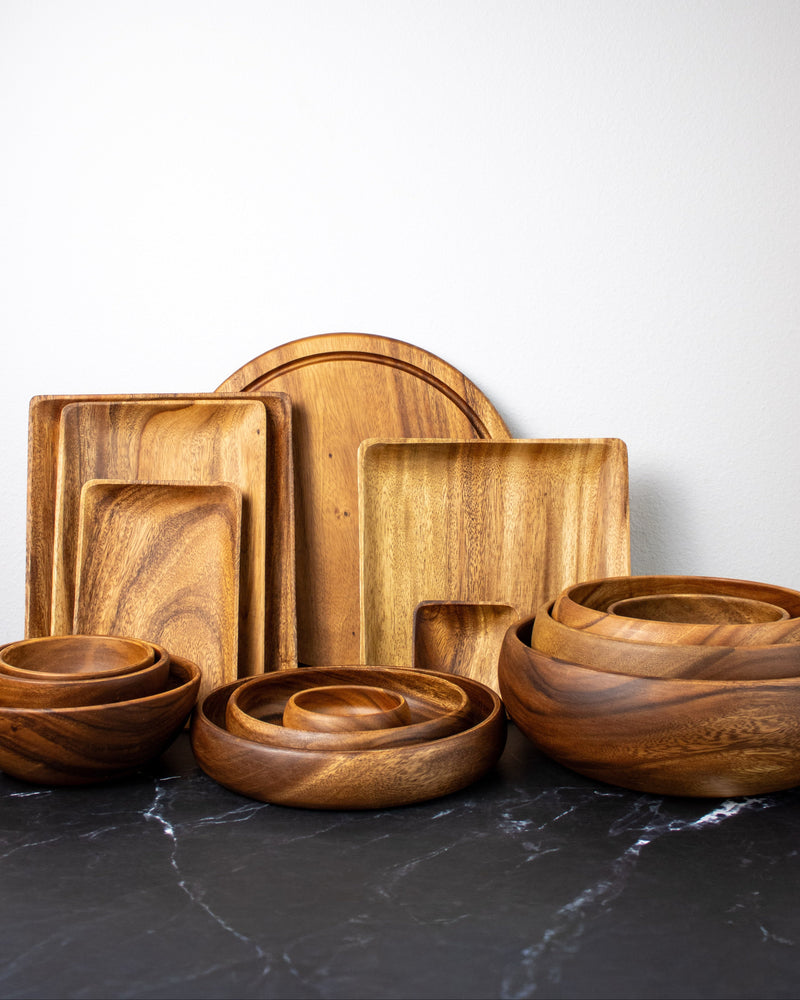
The Family Hosting Set was designed to be the working tableware for this exact scale. The centerpiece platter holds enough rice for eight without leaving a mound sitting cold at the end of the meal. The serving bowls multiply to handle three or four ulam without borrowing from the everyday kitchen. The individual plates count out to eight, the sawsawan dishes count out to eight, and nothing feels overscaled when the table is set for six.
The households it fits
Two profiles of household lean on the Family set more than any other. The first is the monthly host: the friend group that has been rotating houses for years, the family that hosts the same three or four gatherings a year plus a handful of smaller ones, the household that pulls out the set for Sunday lunch when the extended family is passing through. The second is the weekly host: the household with extended family nearby, the kitchen everyone gravitates toward, the couple whose Sunday table anchors the week for a rotating cast.
For both profiles, the Family set becomes muscle memory. It gets used often enough that setting the table stops requiring thought. The pieces develop the softer surface and deeper color that acacia takes on with use. The set stops being ceremonial and starts being furniture, in the good sense, the way a kitchen table becomes furniture once enough meals have happened on it.
What "family" means in the Filipino sense
The name of the set is worth pausing on, because "family" in Filipino English is not the same word as "family" in American English. It stretches. It includes tita Nena who is not actually your tita but has been at every important meal since you were four. It includes the cousins who married in and the cousins who married out but still show up. It includes the ninongs and ninangs, the kumpares and kumares, the neighbors who lend the extra folding chairs and stay for dinner.
The Family Hosting Set is sized for family in that extended sense, not the nuclear four. That is why six to eight is the target rather than four to six. If you have ever done the math of who is coming for Noche Buena and realized "family" quietly grew to nine while you were making the list, you already understand why the set is calibrated the way it is.

The set for the households that host most
The Family Hosting Set is calibrated for the six-to-eight-guest handaan, sized for the way most Filipino kitchens actually cook and gather.
Shop the Family Hosting Set →
What Is Inside the Family Hosting Set
A hosting set is only as good as the piece count matches the meal. The Family set was built by working backwards from the food, not forwards from a generic dinner-set template. Every piece exists because a specific role at a Filipino table needed filling.
The centerpiece platter
The largest piece in the set is the centerpiece platter, the wooden expanse that anchors the middle of the table for the entire meal. In a multi-ulam handaan it holds the rice, mounded and steaming, ready to be scooped onto individual plates. In a boodle fight it becomes the base for banana leaves and the mound of rice and ulam that follows. In a merienda it holds the bibingka or puto or biko without needing to be paired with anything else.
The platter is sized so that a Family-scale rice serving does not look lost on it, but it does not dominate a standard dining table the way the Royal centerpiece does. This is the piece that most reveals the difference between a hosting set built for Filipino eating and a Western serving platter: it is meant to stay on the table for the whole meal, not appear briefly during a course.
The serving bowls
The serving bowls do the heaviest work at any traditional handaan. A Sunday lunch might have kare-kare in one, sinigang in another, adobo or afritada in a third, and a vegetable dish like pinakbet or ginisang gulay in a fourth. The Family set includes enough bowls of varying depth to cover this without asking you to plate the vegetable ulam in a Corelle bowl for lack of options.
Depth matters more than most buyers realize. Ulam with sabaw needs a deeper bowl than pancit or lumpia. Sets that skimp on deep bowls force households to serve saucy ulam in whatever mixing bowl the kitchen has on hand, which breaks the visual unity of the setup. The Family set solves for this with a mix of depths rather than four bowls of identical shape.
Individual plates and sawsawan dishes
Each guest gets an individual acacia plate, deeper than a standard Western dinner plate so that rice and sabaw scooped from the communal bowls do not run off the edge. This is one of the details that quietly separates hosting sets designed for kainan from ones designed for European service. A flat plate under sinigang is a cleanup job waiting to happen. A plate with a proper lip contains the meal.
Alongside each plate sits a sawsawan dish, the small wooden cup for suka, patis, toyomansi, or whatever dip the meal calls for. Filipino eating treats sawsawan as personal rather than shared. Each guest tunes their own suka-with-siling-labuyo to their own tolerance, and the small dish at each place setting is the vessel that makes that possible. If you have ever hosted a Filipino meal and watched everyone reach for the one central saucer of vinegar, you understand why sawsawan dishes at each place matter.
Why acacia does the work
The reason the whole set is acacia rather than a mix of ceramic and wood is practical, not aesthetic. Acacia is dense enough to handle hot serving bowls without warping. Its closed grain resists suka and patis stains that would soak into softer, more porous woods. It is grown across the Philippines and Southeast Asia rather than imported from elsewhere. And it ages beautifully, developing a deeper color with use rather than looking tired after a year.
For a longer look at why acacia beat out bamboo, mango, and other candidates as the default wood for Filipino hosting pieces, our guide to how acacia becomes tableware walks through the density, grain, and finishing that make it work at the table.
Family vs. Royal vs. Mini: The Sizing Decision Tree
This is the chapter most readers came here for. If you have been circling three product pages trying to decide, the framework below is the shortest path to a decision that will still feel right in a year.
Start with your largest realistic gathering
The mistake most first-time buyers make is sizing to their average meal. Average meals do not need a hosting set. Weeknight dinners and quick lunches happen on everyday plates. A hosting set is bought for the meals that are actually gatherings, and the right question is how large your largest gathering realistically gets in a typical year.
"Realistic" is the word doing the work. Not the wildest one-time scenario. Not the fiesta you hosted once in 2018. The largest gathering that actually happens on the regular calendar. If that number is four or fewer, you are in Mini territory. If it is six to nine, Family. If it is ten to fourteen, Royal. For most Filipino households, the honest answer sits in the Family range, which is why the Family set is the set most often bought first.
When the Mini is not enough
The Mini Hosting Set is beautiful and useful, but it does not stretch. A Mini set trying to serve seven ends up with the vegetable ulam plated in a mixing bowl and one guest eating rice from an everyday plate because the individual count ran out. The moment your largest realistic gathering crosses four, the Mini stops being the right primary set. It may still earn a place later as a second set for the weekly rotation, but it should not be the only hosting set in a house that has extended family passing through.
The exception is the condo dweller whose largest possible gathering is bounded by the dining nook, not by desire. If your table physically cannot seat more than four, the Family set is oversized for your kitchen and the Mini is the right call. Our writeup on the Mini Hosting Set for small gatherings covers that use case in more detail.
When the Royal is overkill
The Royal Hosting Set is the right answer for households whose regular calendar includes fiesta-scale gatherings, Noche Buena for a dozen or more, baptism receptions held at the house, or milestone birthdays where the cousins fly in. If those meals are your baseline hosting pattern, the Royal earns its keep and the Family set will leave you short every time.
But if your annual calendar has one big gathering and eleven months of six-to-eight-guest handaan, the Royal is overkill. It will sit in storage most of the year. The centerpiece platter alone is too large for a standard kitchen cabinet, which turns storage into a real design problem in most homes. For the household whose big gatherings are three or four times a year, the Family set covers most of them and can be supplemented with a serving board or a rented centerpiece for the outliers. The Royal Hosting Set explained covers when the bigger set genuinely does earn its keep.
The three-question filter
If you are still torn, run through these in order and stop at the first answer that clarifies the decision.
- What is the largest realistic gathering you host in a typical year? Four or fewer means Mini. Six to nine means Family. Ten or more means Royal.
- How often does that largest gathering happen? If the answer is monthly or more, the Family set will get more use than any other piece of tableware you own. If the answer is once or twice a year, weigh the storage question next.
- Where will the set live when you are not using it? Measure your largest available cabinet or sideboard. If a Royal centerpiece platter will not fit, the Family set is the answer even if your gathering math points larger. The set you cannot store is the set you will not use.
For most households, question one lands on Family and question two confirms it. If you host the standard Filipino calendar (a few birthdays, a Noche Buena, a Sunday rotation) at the six-to-eight scale, the Family set is your primary hosting tableware and probably will be for the next decade. Our broader chooser on choosing the right Filipino hosting set walks through the framework across all three sizes if you want a side-by-side.
The default answer for most Filipino households
If the decision tree keeps landing on six-to-eight guests hosted monthly, the Family Hosting Set is the piece calibrated for exactly that rhythm.
Shop the Family Hosting Set →How the Family Set Handles Real Filipino Meals
Piece counts on a product page do not tell you how a set actually performs at a table. This chapter walks through the real meals the Family set was designed for, and where it fits versus where it stretches.
A typical Sunday handaan
The Sunday handaan is the default use case. Rice on the centerpiece platter. Kare-kare, sinigang, adobo, and pinakbet in four serving bowls. Individual plates and sawsawan dishes set at each place for six to eight guests. Bagoong in a small dish on the side for the kare-kare. Everything the Family set was designed to hold, held.
The rhythm at this scale is calm rather than frantic. The rice platter stays warm at the center. Serving bowls get passed and returned. Sawsawan gets tuned by each guest. Second helpings happen without anyone getting up to fetch a fresh bowl, because the serving bowls are still comfortably full after the first pass. This is the meal the set was built for, and it shows in the fit.
Boodle fight for six
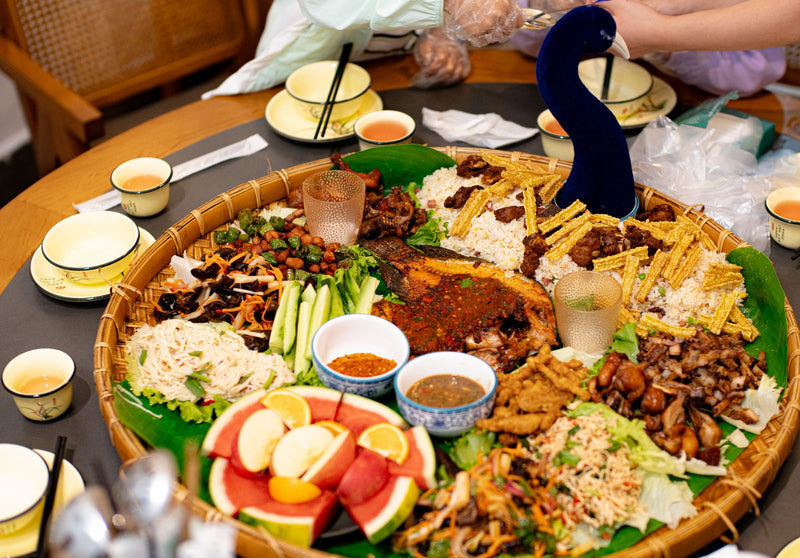
A Family-scale boodle fight is not the same as the massive banana-leaf spread that anchors a barrio fiesta, but it is closer to how most households actually do boodle fight at home. Six people around a long table, banana leaves laid down, rice mounded down the center, ulam clustered along the length, sawsawan dishes at each place. The Family set's centerpiece platter is the right length to anchor this without dominating the table, and the serving bowls hold the saucy ulam that cannot ride directly on the leaf without flooding the rice.
If your hosting pattern is boodle-fight-heavy at a larger scale, the Royal centerpiece may end up being the piece you actually want. But for boodle fight at family scale, the Family set is calibrated for exactly that.
Merienda with in-laws
Merienda does not need the full set. A merienda spread of bibingka, puto, suman, and a pot of kapeng barako does not need serving bowls deep enough for sinigang. It needs the centerpiece platter (which handles the rice cakes and pasalubong beautifully), a couple of the individual plates, and maybe a bowl for the tsokolate. The Family set stretches down to this use case gracefully because the pieces are still sized right for a small spread, they are just not all used at once.
The other place the Family set earns its keep at merienda scale is when the "quick merienda" turns into an impromptu dinner, which it does at Filipino gatherings more often than not. Having the full set already in the kitchen means the shift from merienda to full handaan does not require a scramble.
Noche Buena scaled down
If your Noche Buena is intimate rather than extended, the Family set handles it. Lechon paksiw on the centerpiece platter or a serving board. Hamon and queso de bola on plates. Pancit in a serving bowl. Fruit salad in another. Rice at the center. Six to eight family members around the table at midnight. This is Noche Buena at Family scale, and the set covers it without needing to borrow anything.
The trade-off is honest: if Noche Buena in your household means twelve to fourteen guests every year without fail, the Family set will leave you short and the Royal is the right sizing target. But if your Noche Buena has become a quieter, family-only event (which many households have shifted toward in recent years), the Family set fits the new shape of the meal.
Living With the Family Set: Care, Longevity, and Gifting
Buying a hosting set is easy. Living with one for a decade is where the honest information matters. This chapter covers what the ongoing relationship with the Family set actually looks like.
The care commitment, honestly
Acacia hosting pieces cannot go in the dishwasher. Heat and prolonged water exposure are the two conditions under which wood warps and cracks, and the dishwasher provides both. Every piece in the Family set gets hand-washed with warm water and mild soap, dried immediately with a clean towel, and never left to soak in a sink of standing water.
For a Family-scale meal, this comes out to about 30 minutes of dishwashing after the guests leave, which is not appreciably more than a ceramic set the same size. Every couple of months, or whenever the wood starts to look dry, re-oil the pieces with mineral oil or a food-safe wood conditioner. This is a 15-minute job that keeps the finish alive and prevents the surface from developing micro-cracks. Our writeup on whether you can dishwasher acacia wood goes deeper into why the answer is a firm no, and what happens when people try.
How the set ages
Well-cared-for acacia gets better with use, not worse. The color deepens as the wood absorbs the oil from repeated conditioning. The surface takes on a softer sheen from the small acts of use: hands, spoons, food, cleaning. Grain patterns that were subtle at year one become more pronounced. If you have ever inherited a set of wooden serving pieces from a lola and noticed they look richer than any new set you have seen, that is what a decade of proper use looks like.
The failure modes are all the ones the care commitment is designed to prevent. Warping from the dishwasher. Cracks from leaving pieces in water. A dull, dry surface from years of no oiling. Follow the care routine and none of these happen. Ignore it and the set will look tired at year three.
When the Family set is the right gift
The Family Hosting Set is one of the strongest gifts you can give at scale. For a Filipino wedding, it is calibrated exactly for the hosting rhythm the couple is about to build. For a housewarming, it is the piece the new household will use every time it hosts, which is a lot in a Filipino kitchen. For a 25th or 50th wedding anniversary, it is the upgrade the couple probably would not buy for themselves but will use for the rest of their hosting life.
The gift math works because the Family set is right-sized for most households. Giving a Royal set as a wedding present risks handing the couple a set that lives in storage. Giving a Mini set risks handing them a set they will outgrow within a year. The Family set fits the sweet spot of the couple's next decade of hosting. Our roundup of Filipino housewarming gifts covers where hosting sets fit alongside other traditional gifts.
How to store it
Storage is the constraint nobody mentions on a product page. The Family set's centerpiece platter is the largest piece in the set and the one that decides where the whole set lives. It fits in most standard kitchen cabinets when stored flat, but not vertically like a dinner plate. Serving bowls nest reasonably well. Individual plates stack. Sawsawan dishes fit in a drawer or a small basket.
For most kitchens, a dedicated cabinet shelf or the top of a sideboard is the natural home for the set. Avoid storing acacia pieces above or next to a stove where prolonged heat and steam will dry the wood out faster than the oiling routine can keep up with. A cool, dry, ventilated spot is what wood tableware wants.
The hosting set that grows into your kitchen
Sized for the meals you actually host, cared for by hand, and built to look better at year ten than year one. The Family Hosting Set is the working tableware of a Filipino kitchen that gets used.
Shop the Family Hosting Set →Frequently Asked Questions
How many people does the Family Hosting Set serve?
The Family Hosting Set is calibrated for 6 to 8 guests comfortably. It scales down to four without feeling oversized and can accommodate up to about nine if the menu is on the lighter side. For gatherings that consistently exceed eight, the Royal Hosting Set is the better fit.
Is the Family Hosting Set enough for Noche Buena?
Yes, if your Noche Buena is at family scale rather than extended-family scale. The set handles a six to eight person Noche Buena without needing extra pieces. If your Noche Buena regularly seats ten or more, the Royal set is the right sizing target instead.
Can I use the Family set for boodle fight?
Yes, at Family scale. The centerpiece platter anchors a boodle fight for six comfortably, and the serving bowls hold the saucy ulam that cannot ride directly on the banana leaf. Larger boodle fights (10-plus guests) call for the Royal set or a supplementary long serving board.
How do I care for acacia hosting pieces?
Hand-wash with warm water and mild soap, dry immediately with a clean towel, and never soak the pieces or put them in the dishwasher. Re-oil every couple of months with mineral oil or a food-safe wood conditioner. Store in a cool, dry, ventilated spot away from direct heat.
Is the Family Hosting Set a good wedding or housewarming gift?
Yes. The Family set is one of the strongest hosting gifts because it is sized for the exact hosting rhythm a new Filipino household is about to build. It is more likely to be used than a Royal set (which risks sitting in storage) and less likely to be outgrown than a Mini set.
Can I mix Family set pieces with pieces from the Mini or Royal?
Yes. All three sets are made from the same acacia stock with the same finish, so the wood tone and grain character coordinate visually even when piece sizes differ. Many households add a Mini set for weekly use or a Royal centerpiece for seasonal hosting, and the pieces look intentional together on the table.
Does the Family Hosting Set include utensils?
The set is oriented toward Filipino hosting where individual utensils are pulled from the everyday kitchen and shared serving spoons are used at the communal bowls. Check the current product page for the exact piece count and whether wooden serving utensils are included in your configuration.