A Filipino housewarming is not just a tour of the new place. It is a pabahay, a blessing for the bahay and the family inside it, and the gift you bring carries weight. Salt for prosperity. Rice for abundance. Coins for luck. The old symbols still matter, but the modern question is what to add to that bowl on the table that the family will still be using when the kids are in high school.
This guide is for anyone invited to a Filipino housewarming and looking for something that respects the tradition. Whether the new home is a condo in Quezon City, a townhouse in Cebu, or a first apartment in Daly City, the principle is the same. The best gift is the one that gets used at the first meal and every meal after. Below are eight gift ideas built around that test, plus the customs and choices that sit underneath them.
Why Filipino Housewarmings Ask More of a Gift
A Filipino housewarming is rarely just a casual drop-by. It is woven into a bahay blessing, a first meal, or a salu-salo where the new home is formally introduced to the people who matter. The gift is part of that introduction. It is presented to the family, but it is really being offered to the house itself.
The pabahay tradition and what the gift is really for
Pabahay refers to the act of moving in and inviting the community to share that moment. Older relatives often bring symbolic items first: a small bag of bigas, rock salt in a clean jar, a few coins tossed at the entrance. These are not literal gifts in the Western sense. They are blessings made tangible. When you bring a larger gift, you are adding to that blessing, which is why a generic candle set or a wine basket can feel oddly weightless. It is not bad. It just does not participate in the ritual.
Salt, rice, and coins, and the heirloom equivalent
The traditional triad has a logic. Salt preserves. Rice sustains. Coins circulate. A modern heirloom gift extends that logic by being something the family will use at every meal that follows. A wooden bowl that holds the rice. A serving board that the salt and suka end up beside. A platter big enough for the next handaan. The symbolic items get consumed within a week. The heirloom version stays.
Why disposable gifts feel wrong at a Filipino housewarming
Filipino homes are dense with meaning. The display cabinet holds the wedding china. The altar has the framed photo of Lola. The kitchen has the kawali your tita gave you when you moved out. A gift that ends up in a drawer or, worse, regifted at next year's exchange, fails the unspoken test. The test is simple: will this object still be in the house in twenty years, and will someone remember who gave it.
The heirloom test
You can apply it to any candidate gift. Will the family use this at least once a month. Will it survive being washed by three different people who do not all follow instructions. Will it look better, not worse, after five years of use. If the answer is yes to all three, the gift belongs at a Filipino housewarming. If it is yes to one, you are buying a decoration.
Gifts for the Kitchen and the First Meal
The first meal cooked in a new Filipino home is almost always something with sabaw. Sinigang. Kare-kare. Nilaga. Tinola. There is a reason. Soup fills the house with steam, the steam carries the smell into every room, and the smell signals that the house is no longer empty. Your gift has its best chance of joining that first meal if it can hold rice, sabaw, sawsawan, or the ulam itself.
Gift 1: An acacia bowl set for the inaugural sinigang or kare-kare
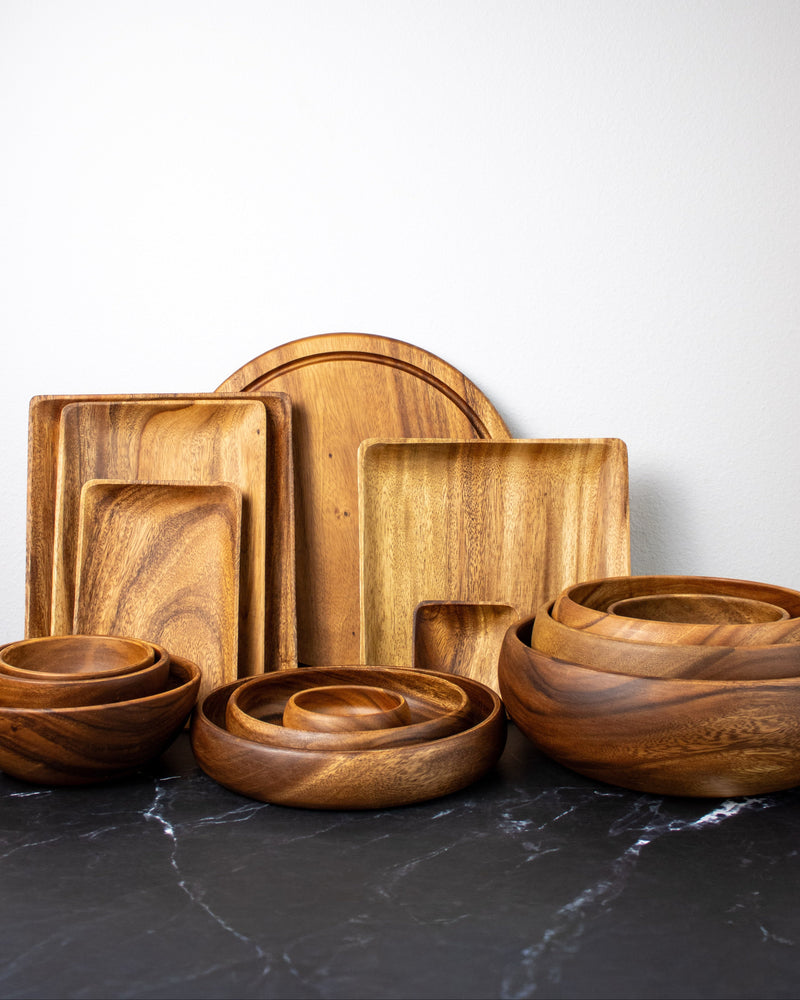
A set of four to six matched bowls in solid acacia is the most useful gift in this category. The wood is dense enough to handle hot rice and saucy ulam without warping. The grain pattern means no two bowls are identical, which the family will notice across years of meals. For couples, a set of two larger bowls is often more useful than four small ones, since the bowls double as serving pieces.
Gift 2: Wooden serving boards for pasalubong and pulutan
Serving boards are the workhorse of Filipino hosting. Lechon kawali sliced and fanned out. Inihaw na liempo with atchara on the side. Cheese, longganisa, and chicharon laid out for inuman. A solid acacia board with a defined edge handles all of these without sliding around. Boards also tend to travel: someone always asks to borrow them for a barkada gathering, and the borrowing is part of how a gift becomes embedded in a family's social life.
Gift 3: A mortar and pestle for fresh sawsawan
Sawsawan is not optional in a Filipino kitchen. Fresh calamansi crushed with siling labuyo. Bagoong mashed with garlic. Toyo with kalamansi and a touch of crushed ginger. A heavy stone or hardwood mortar gets used at almost every meal that includes grilled or fried protein, which in a Filipino home is most of them.
Why the first meal matters
If you walk through a new Filipino home a year later, the family will often tell you exactly what they cooked the first night. The bowl that held the rice that night becomes the rice bowl. The board that held the lechon becomes the lechon board. Gift the object, and you are quietly nominating yourself to be remembered with the meal.

For the family settling into the new bahay
A complete hosting set built for the first handaan and every salu-salo that follows it.
Shop the Family Hosting Set →Gifts for Hosting and Salu-Salo
Filipinos host. It is not a hobby, it is closer to a civic duty. A new home means a new venue, and within months the family will be expected to host a salu-salo for relatives, godparents, neighbors, and workmates. Gifts that arrive ready for hosting solve a real and predictable problem.
Gift 4: A family hosting set for the first handaan
A coordinated set of bowls, platters, and serving pieces in the same wood and finish creates an instant tablescape. The host does not have to think about whether the bowl matches the platter. Everything came from the same gift, which means everything reads as intentional on the table. For a family moving into a house big enough for twelve at the table, this is the single most useful gift you can bring.
Gift 5: A mini hosting set for couples and smaller homes
For a couple in a condo or a first apartment, a full family set is too much. A scaled-down version with two larger bowls, a serving platter, and a board hits the same hosting purpose without overwhelming a small kitchen. It also signals respect for the recipient's actual life. Nobody wants to receive a gift that does not fit in their cabinet.
Gift 6: A long serving platter built for kamayan
Sooner or later, the new home will host its first kamayan or boodle fight. A long, flat acacia platter handles banana leaves, rice mounded down the center, and ulam fanned across the length without flexing or staining. If you are looking for guidance on what they will eventually host, our piece on how to host a boodle fight walks through the staging in detail, and gifting the platter sets them up to do it well.
Why hosting-ready gifts get used every weekend
A vase gets used on the day it arrives. A hosting set gets used the next time anyone visits, which in a Filipino household is usually within a week. The frequency of use is what builds the relationship between gift and family. The piece is no longer something you gave them. It becomes the bowl, the platter, the board, and the giver's name attaches to it.

For couples and first-apartment homes
A compact set that suits a smaller kitchen and still handles a proper salu-salo for close family.
Shop the Mini Hosting Set →
Gifts That Carry Story and Provenance
The difference between a wooden bowl and an heirloom is not the wood. It is the story attached to it. When the family pulls the bowl out for Christmas Eve and a cousin asks where it came from, the answer matters. A gift that comes with a known origin earns its place in the family record.
Gift 7: A single-source acacia statement piece
A single large bowl, carved from one piece of acacia, with a maker and a region attached to it, sits differently in a home than an anonymous import. The grain tells you it came from one tree. The finish tells you a person sanded and oiled it by hand. The weight tells you the wood is solid through. A statement piece like this becomes the bowl on the table when the family gathers for noche buena.
Hand-finished bowls versus mass-produced wood
Mass-produced wooden tableware is often a thin veneer over engineered material, or a hardwood treated with finishes that wear off within a year. Hand-finished pieces in solid acacia hold up under daily use because there is nothing to delaminate and nothing to wear through. The difference shows up at year five, when the cheap pieces have cracked and the heirloom piece has only deepened in color.
Asking the giver about the tree, the carver, the region
If you are buying the gift, ask the maker where the wood came from. If you are receiving it, ask the giver. A bowl from a fallen acacia in Pampanga has a different story than one cut to spec in an industrial plant. Filipino acacia, particularly from older trees, has tight grain and a deep tone that imported alternatives rarely match. We cover this distinction in detail in our guide on filipino hospitality and salu-salo pakikisalo, where the object and the gathering reinforce each other.
How story turns an object into an heirloom
An heirloom is not a category of object. It is a category of memory. The story is what makes a bowl repeatable across generations, because the bowl gets pulled out and the story gets retold. Wedding gifts work this way. Inaanak gifts work this way. Our piece on inaanak baptism gift ideas walks through the same logic in the godparent context, and the housewarming version is simply the home-scale equivalent.

A statement piece with provenance
A single large acacia bowl, carved from one piece, finished by hand. The kind of object a family keeps.
Shop the Gorosin Bowl Set →Pairing Gifts With Filipino Blessing Customs
The gift is one piece of a larger sequence. Many Filipino housewarmings include a formal house blessing, a salu-salo, and a tour. Knowing where your gift fits in the sequence helps you present it in a way that honors the occasion.
What to bring to the bahay blessing itself
If the house blessing is a Catholic pagbabasbas with a priest, families often appreciate something useful for the blessing meal itself: a bowl, a platter, or a piece that can hold the food blessed during the rite. For Protestant, INC, or non-religious households, the function is similar even if the ritual differs. The piece that holds the blessed rice carries a quiet symbolism that is hard to match with a gift card.
Gifts presented during the salu-salo versus before
Some gifts arrive early so the family can use them at the gathering. Hosting sets, serving boards, and bowls all fall into this category. Other gifts are presented during the salu-salo as part of a more formal moment. Statement pieces, framed items, and anything personal usually work better this way. If you are unsure, send a message to the host and ask. Filipinos rarely mind being asked, and they appreciate the thought.
Including a handwritten card with the Filipino term for the piece
A small but meaningful touch: write a card that names the piece in Tagalog or the relevant regional language. "Para sa unang sinigang sa bagong bahay." "Para sa kanin tuwing Linggo." This grounds the gift in the language of the home it is entering. It also gives the family something to keep with the object, which extends the memory.
Coordinating with the family altar or display area
Many Filipino homes have a designated display area for important objects: the antique platter from the lola, the wedding picture, the saint's image. If your gift is intended as a display piece rather than a working one, ask the host where they plan to keep it. This avoids the awkwardness of a beautiful bowl that ends up unused because nobody knew it was meant to sit out.
Choosing the Right Gift for the Recipient
The same gift category can be wrong for one home and perfect for another. Matching the gift to the recipient is the difference between a thoughtful choice and an expensive miss.
First apartment, first house, or forever home
A first apartment usually means limited storage and a smaller table. A scaled-down hosting set or a single workhorse bowl outperforms a full set that has nowhere to live. A first house, often a townhouse or starter home, can accommodate more, but the family is still building toward their long-term setup. A forever home, where the family plans to stay for decades, can absorb statement pieces and heirloom investments without strain.
Couple, family, or solo recipient
Couples often appreciate sets sized for two that scale up when guests arrive. Families benefit from full hosting sets and the kind of platters that handle weekend salu-salo. Solo recipients, including widowed parents moving into a new place after the kids have left, often prefer single pieces of higher quality over sets. A beautiful single bowl on the table is not a lesser gift than a six-piece set. In many cases it is the better one.
Budget tiers and what they actually buy
Under PHP 2,000 or roughly USD 40, you can buy a single well-made acacia bowl or a small board from a trusted maker. Between PHP 2,000 and 5,000, or USD 40 to 100, you reach mini hosting sets and mid-sized statement bowls. Above PHP 5,000, or USD 100 and up, you reach full hosting sets and larger heirloom-grade pieces. The honest principle: one well-made object beats three forgettable ones at any tier.
When to give a set versus a single statement piece
Give a set when the family is actively hosting and needs working pieces. Give a single statement piece when the recipient already has the basics and would appreciate something to anchor the table. For wedding-adjacent housewarmings, where the couple has just registered and received many sets already, our wedding registry filipino tableware guide explains the overlap. For corporate or office-related housewarmings, the calculus shifts again, and our corporate filipino heritage gifts piece covers that context.
Frequently Asked Questions
What is the traditional Filipino housewarming gift?
The traditional triad is salt, rice, and coins, meant to bless the home with preservation, abundance, and prosperity. Modern gifts build on this foundation by adding pieces the family will use at the first meal and every meal after, such as wooden bowls, serving boards, and hosting sets.
Do you still give salt and rice at a Filipino housewarming?
Yes, many families still observe the custom, especially when an older relative leads the moving-in ritual. The symbolic items are usually brought by close family and presented during the bahay blessing. Larger gifts from guests typically complement rather than replace the tradition.
How much should I spend on a Filipino housewarming gift?
A reasonable range is PHP 1,500 to 8,000, or roughly USD 30 to 160, depending on your relationship with the family. Close family and ninongs and ninangs often spend more. The principle that matters is choosing one well-made piece over several forgettable ones at any budget.
Is it okay to give a used or vintage piece as a housewarming gift?
Yes, particularly if the piece carries family or regional history. A bowl, platter, or board that has been in your own family is often welcomed as a meaningful gesture, provided you explain its origin clearly. The rule is honesty: present the piece for what it is, with the story attached.
What gift should I bring to a bahay blessing versus a salu-salo?
For a bahay blessing, bring something that can be present during the rite itself, such as a bowl or platter the family can use for the blessed meal. For a salu-salo alone, hosting pieces or statement bowls work well, and you have more flexibility on when in the gathering to present them.
Can I give acacia wood pieces if the family already has wooden tableware?
Yes. Most Filipino households accumulate wooden pieces over years, and additional pieces in matching wood tend to expand the set rather than duplicate it. If you are concerned, ask the host whether they need more bowls, more platters, or a different piece entirely.