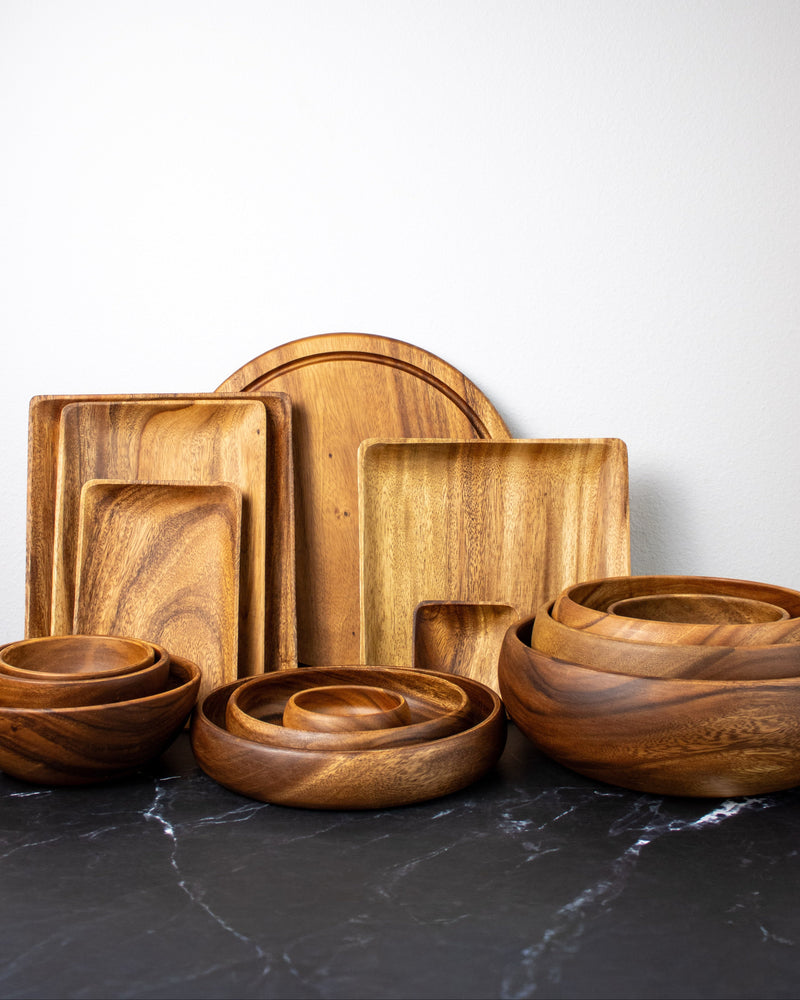
The tree that doesn't get planted for this
Acacia in the Philippines is not a timber crop. Nobody plants a hectare of it the way you would plant mango or coconut, with a yield in mind and a harvest year circled on a calendar. The tree shows up in schoolyards, along provincial roads, in the back lot of a family house in Tarlac. It throws shade over a sari-sari store for forty years. It drops pods that kids pry open looking for something to chew. Then a typhoon comes, or the road widens, or the elders pass and the lot gets cleared, and the tree comes down.
That is the moment our craft starts. Not in a sawmill, not in a plantation. In whatever happened to the tree before anyone thought about a bowl.
Our workshop in Pampanga sources logs from across Luzon: storm-fall pieces brought in by suppliers who know us, end-of-life trees from family land where the owners would rather see the wood used than burned, the occasional clearance from roadwork that would otherwise become firewood. If you want to understand where acacia wood actually comes from in this country, the honest answer is: it comes from the landscape giving things up. We meet it after it falls.
This matters for what you end up holding. A 30-year-old acacia tree did not grow to become a bowl. It grew to be a tree. The bowl is something we recover from the tree, after the tree's first life is over. That sequence is unusual in tableware. Most wooden dinnerware on the global market comes from plantation timber sized and felled for a product line. Ours comes from a tree that already had a life, a place, a shadow it cast for decades. The grain story is written before our turner ever picks up a tool.
How acacia enters the workshop
A log arrives whole, bark still on, often with the cuts from the chainsaw that brought it down still pale and fresh. It gets stacked in the yard under a galvanized roof, off the ground on bearers so air can move underneath. Acacia is wet wood when it comes in. A freshly fallen trunk can be 40 percent water by weight. You cannot turn that on a lathe. You cannot even cut clean billets from it. It has to lose water first, slowly, on its own time, before anything else can happen.
Why a 30-year-old tree makes a bowl, not the other way around
The age of the tree is the bowl's age. A trunk that has lived through 30 wet seasons has a density and a color depth that you cannot fake. Younger acacia is pale and uniform. Older acacia is the wood you recognize, the warm honey-to-chocolate gradient that runs across a single board. We do not engineer that. The tree did. We just have to read it correctly when the time comes.
The grain story already written
Walk past a stacked log and you can already see what kind of pieces it will yield. A trunk that grew straight in open ground gives clean, long-grain stock that suits a serving board. A trunk that grew leaning, or that healed around an old branch wound, gives the swirled figure that turners chase for bowls. The tree decided this years before us. Our job is to not waste it.
Reading the log before the first cut
The first cut is the most important cut, and it does not happen with a saw. It happens with a stick of chalk and a long look.
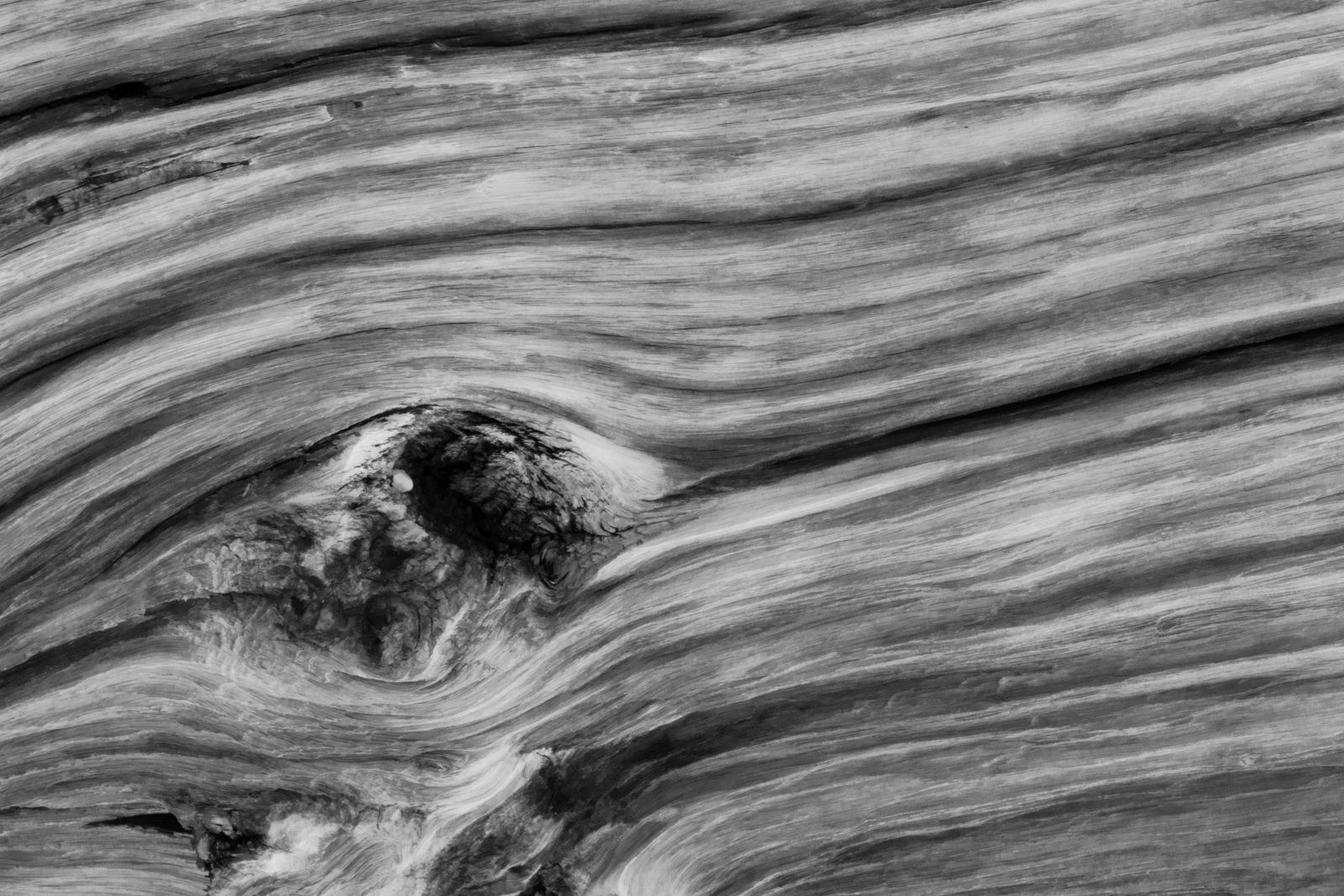
The lead turner walks around a log slowly. He runs a hand along the bark, feels for soft spots that mean rot underneath. He looks at the end grain where the chainsaw exposed it, reading the rings, reading where the heartwood and sapwood meet, reading the small dark spirals that mark old stress. He looks for knots, for color shifts, for the hairline checks that have already started as the wood gives up water. Then he marks: here a bowl, here a board, here a smaller bowl, here nothing, here a section to set aside for later when we know what it wants to be.
"A butcher looks at a hanging carcass and sees cuts. A turner looks at a log and sees bowls. The log already decided. We just have to not get it wrong."
This is the stage where most of the craft happens before anyone sees craft happening. A misread log wastes weeks of drying time and a year of the tree's life. A well-read log gives you four or five pieces that each carry the section of the trunk best suited to them. The boards you find in our Pamilya board set come from the straight-grown sections that took the chalk for length. The bowls in the Gorosin bowl set come from the rounded crotch sections, where the grain swirls around the old branch joints and produces that figure you can spend an evening looking at.
Marking the log: where the bowls hide
The chalk lines look casual. They are not. Each one anticipates how the wood will move as it continues to dry, how the bowl wall will sit relative to the grain, how the heart of the trunk will read on the finished piece. The turner is thinking about a bowl that does not exist yet, in wood that is still partly water.
Why no two pieces match, and we stopped trying
Early in the workshop's life there was an instinct, common in craft, to push toward uniformity. To pick logs and cuts that gave matching sets. We have largely stopped doing this. Acacia will not be standardized without being wasted, and trying to force two bowls to match means binning the third and fourth that did not. A pair of bowls in our work will share a maker, a method, a finish, and a family resemblance in color and grain. They will not be twins. We decided long ago that this is the point, not a problem.
The pieces that don't make it
Not every section of a log becomes tableware. A piece with a deep check that we did not catch until the second look gets pulled and re-marked for a smaller bowl or a kitchen tool. A piece with soft rot gets cut around. Off-cuts that are too small for any of our pieces go to the carpenters next door, to the kids in the neighborhood, or into the fire that heats water for coffee in the morning. Nothing is thrown out. Acacia is too slow-growing to waste.
The lathe, and the sound of a workshop in Pampanga
If you walk into our shop in the morning, before the lathes start, you can hear roosters from the next compound, a tricycle on the road, and the air moving through the open sides of the building. Then the first lathe kicks on, and the room changes. There is the steady hum of the motor, the higher whine when a tool first meets the wood, and then the deeper, quieter cut as the tool bites in clean. Shavings curl off in long pale ribbons that fall in piles around the turner's feet. The air smells like wet wood and a little like coffee, because someone is always making coffee. This is the room where acacia stops being a log and starts being a piece.
Pampanga is the right province for this kind of work. There is a reason we are here and not somewhere else, and we have written more about that in our piece on Pampanga as the craft capital of the country. The short version is that the woodworking skills in this region run back generations. The turners we work with did not learn on YouTube. They learned from fathers and uncles who learned from theirs. You can see it in how they stand at the lathe, in how steady the tool rest is even when nothing is bearing down on it, in how they read a piece by ear as much as by eye. A cut sounds wrong before it looks wrong. They hear it first.
Rough turning: shaping the rough form
A blank gets mounted on the lathe. The first pass is rough turning. The turner brings the spinning wood down to its outside shape, then hollows out the inside, leaving the wall thicker than the finished piece will be. This is fast, in the way that experienced work looks fast. A rough bowl can come off the lathe in 20 minutes. But what comes off the lathe is not a bowl. It is a bowl-shaped object with too much water still in it.
The rest period
This is the part that does not show up in a video. The rough-turned piece goes onto a shelf, or into a box of its own shavings, and it sits. It loses water. As it loses water it moves: it shrinks more across the grain than along it, so a round bowl goes slightly oval, the rim shifts, the wall thicknesses settle. Depending on the piece, this rest lasts anywhere from two weeks for a small bowl in dry months to four months for a large vessel coming off a fresh log in the rainy season. We do not rush it. A bowl that goes back on the lathe too soon will move after it is finished, and a finished bowl that moves cracks. There is no recovering from that. The rest is non-negotiable.
Final turning: the wall comes down
When the piece is settled, it goes back on the lathe. The turner remounts it, trues it up again (the oval is gone, now it spins round-but-different), and starts the second cut. The wall comes down to its final thickness. The outside profile gets refined. The base gets cut. The rim gets its final lip. This is slower than the first pass and a lot quieter. The turner is taking thin shavings, sometimes single curls, listening for the moment the wood reads consistent under the tool. When it comes off the lathe this time, it is a bowl.
Sanding, the part nobody photographs
The lathe finish is not the finished surface. This is the thing that surprises people. You can take a piece off the lathe that looks done. It is round, it is smooth in the right places, it holds its shape. Run a hand inside the bowl, though, and you can feel the small ridges left by the cutting tool, the tiny scallops where the bevel rode. Your finger feels them. Your mouth would feel them too. Tableware is not tableware until those are gone.
So we sand. By hand, by power sander, by every grit in the rack. We start at something like 80 grit, the rough paper that takes the lathe marks off and evens the surface. Then 120, 180, 240, 320, sometimes 400, sometimes 600 for a piece where the customer is going to run their thumb along the rim and we want them to feel only wood. Six or seven progressions for a single bowl. Hours.
You will rarely see a photo of this stage. It is dusty, the worker is masked and goggled and bent over the piece, and the action looks repetitive because it is. It is also the stage where a bowl stops being woodwork and starts being something your hand wants to hold. Most of the difference between a piece that feels expensive and one that feels almost-finished is here. It is not in the wood. It is in the hours someone spent with paper.
Why the lathe finish is never the finished surface
A turning tool, even a freshly sharpened one, cuts the wood. Cutting leaves a surface with direction in it: tiny parallel lines, micro-tear in places where the grain reversed, the small hills and valleys of the tool's bevel. Sanding does something different. It abrades the surface evenly in all directions, leveling those features. You can see the change as it happens, but you mostly feel it. The piece warms under your hand as you work. The surface goes from cool and faintly grainy to warm and continuous.
What each grit does
The early grits remove the lathe marks and any tiny tear-out. The middle grits take down the scratches the early grits left behind. The high grits are not really removing material at all anymore. They are polishing the wood fibers themselves, closing the surface, getting it ready to drink oil evenly. Skip a grit and you can see it: the higher grit cannot remove the scratches the lower grit left, and the oil finish later will read them. So we go through every step, even when it feels like the piece is already done.
How we know a bowl is ready
It is a feel, not a number. The sander runs the back of his hand across the rim and across the inside of the bowl, slowly, more than once. He is looking for any place where the skin catches. If nothing catches, the piece moves on. If something does, he goes back to whatever grit he was last on and works the area again. A piece can pass on the third check or on the seventh. There is no clock.
Oil, time, and the finish that's actually food-safe
The wood is ready to drink. Acacia, sanded clean, will absorb a finish thirstily on the first coat and less and less on each one after. We use food-safe mineral oil for most pieces and a mineral oil and beeswax blend for the pieces that get especially heavy contact with food. That is the entire ingredients list. There is no varnish on a Dalisay bowl. There is no lacquer. There is no polyurethane.
This is a choice, and it is the right one for tableware. A film finish (varnish, lacquer, polyurethane) sits on top of the wood, sealing it. That is fine for a piece of furniture you look at. It is wrong for a piece that meets food, hot rice, citrus, suka, knife edges. The film cracks. It chips. The chips end up in the food. The wood underneath turns gray where moisture finds the breach. And you cannot refresh it without stripping the whole piece.
An oil finish does the opposite. It soaks in. It cures inside the wood, not on top of it. When the surface eventually dries out (and it will, with use), you wipe a fresh coat of oil on, let it sit, and the piece is renewed. The finish is not protecting the wood from you; it is letting the wood live in your kitchen for decades.
What goes onto the wood, and what stays out
Mineral oil, food-grade, the kind sold for cutting boards. Beeswax in the pieces that get the blend, sourced clean. That is it. No stains, ever. The color you see on a finished Dalisay bowl is the color the tree grew. No dyes. No tints. No "wood enhancer." If a bowl in a set runs a little lighter than its sibling, that is because the section of the trunk it came from ran a little lighter. We do not correct it.
Why the first oil coat looks like magic
Watch a sanded acacia bowl take its first coat of oil and you will understand why nobody on the team gets tired of doing it. The wood is pale and dry and almost matte. The oil goes on with a cloth in long strokes. As it sinks in, the grain wakes up. Color depth that was hiding in the dry surface comes forward. The chocolate and honey bands sharpen against each other. Figured sections (the swirls around old branch joints) light up. You are not adding color. You are letting the wood show you what was already in it. We will sometimes pause the line just to watch this happen on a particularly good piece.
The cure
A bowl that has just been oiled is not ready to ship. The oil needs to penetrate fully and the surface needs to settle. We give a piece multiple coats with rest between, then a final cure period before it is wrapped and boxed. Skipping this is how you end up with oil bleeding through tissue paper in a gift box, which is somebody's bad birthday. So we wait. By the time a piece reaches you, it has been finished for days, not hours.
What arrives at your table
The bowl in your hand, if you trace it back, is a tree that grew for thirty years on land somewhere in Luzon, that fell or was felled at the end of its life, that arrived in our yard whole and wet, that was read by a turner with chalk, that dried, that was rough-turned, that rested for weeks while it lost its water and chose its shape, that came back to the lathe to take its final wall, that was sanded by hand through six or seven grits over hours, that was oiled in coats with cures between, and that was finally wrapped and sent to you.
Honest range, start to ship, for a bowl from our Gorosin bowl set: roughly six to ten weeks of total elapsed time, most of which is the wood resting and curing rather than active labor. Active hours of skilled work per piece are smaller than that suggests, but they are concentrated, and they are not interchangeable. The first cut on the lathe cannot be made by a beginner. The sanding cannot be hurried. The oil cannot be skipped. A plate from our Ina plate set follows a different path through the workshop, shaped flat rather than turned, but with the same logic: read the wood, take the rough form, rest it, finish it slow.
Roughly how long one bowl takes
If you want the honest number rather than the marketing one: six to ten weeks of clock time per piece, with active work concentrated in maybe a day's worth of skilled hours spread across that window. The rest of it is the wood doing its part, which is non-negotiable. You cannot pay extra to skip it. We have tried.
Why the small imperfections are the proof
A small mark in the grain. A faint figured section that runs darker on one side of a board. A bowl in a pair that is a half-shade warmer than its sibling. These are not flaws to apologize for. They are how you know the piece came from a tree, was read by a person, and was finished by hand. A bowl with no variation is a bowl that came out of a mold somewhere. Ours did not. The makers we work with, who we wrote about in our piece on the artisans behind the workshop, leave their hands on these pieces by design.
Care from here: the piece keeps changing
The bowl is not finished when it reaches you. It will deepen in color over the first year as it meets sun on your dining table. The grain will continue to read more sharply with use. The first time you serve hot rice in it, the wood will warm under the heat and the smell will come back briefly: the workshop smell, faint, just for a moment. Re-oil it once or twice a year, more if it lives near a window. The piece is now in its second life, in your kitchen, on your table, around your kainan. The tree's first life was thirty years long. The bowl's life on your table can be at least that again.
That is what you are buying when you buy an acacia bowl from us. Not a bowl. The days.