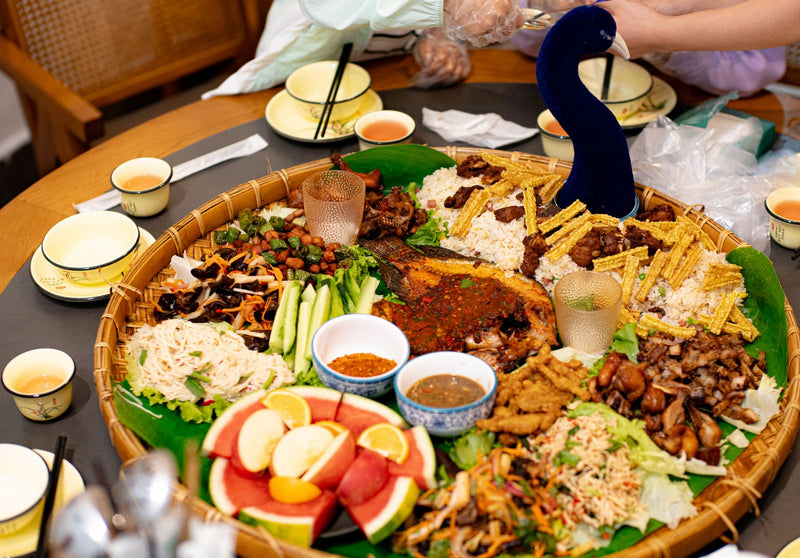
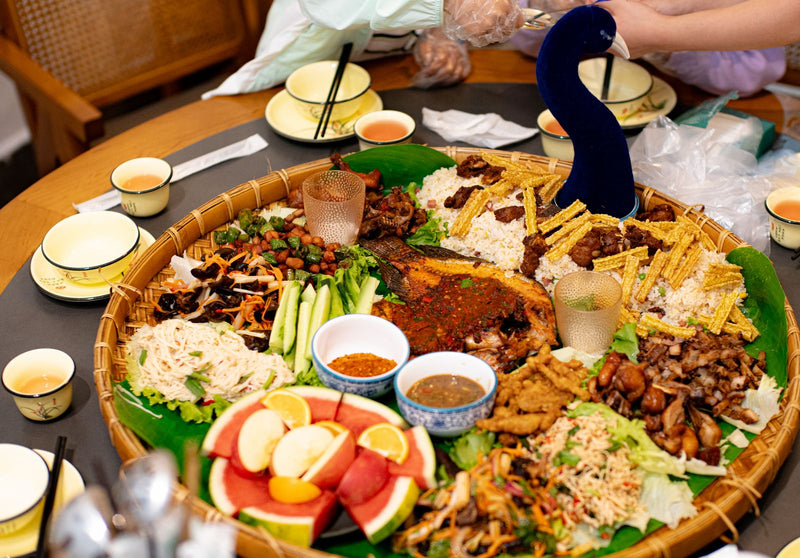
Media Noche is the meal that closes the year and opens the next one, laid out at 11 PM on December 31 and eaten at the strike of midnight, ideally with the fireworks still going and the torotot still ringing in your ears. In a Filipino household it is a different beast from the Noche Buena you cooked a week earlier, even though it looks like the same table from the outside. Media Noche is louder, more superstitious, more prescriptive about what appears on the wood and what does not. This guide covers what the meal actually is, the twelve round fruits and where to put them, the food backbone (and why nanay quietly moves the chicken off the table), the polka-dot-and-gold aesthetics, the pacing so you land the feast at exactly 12:00 and not 11:20, and the reality of hosting two midnight meals seven days apart without burning out the household.
What Media Noche Actually Is
Before you set the table, it is worth being clear about what Media Noche is doing. It is not the Filipino version of a Western New Year's Eve party, even though a Western New Year's Eve party is happening in the same country at the same time. Media Noche is a prosperity ritual disguised as a meal. Every dish, every fruit, every color on the table is a wish for the year that starts in the next hour, and that wish is meant to be eaten. If you understand that, the rules about what belongs on the table and what does not stop feeling arbitrary.
A midnight meal with a Spanish spine
The name itself is Spanish. Media Noche translates as midnight, and the Filipino version carries the Spanish and Latin American thread of a family meal eaten at the changing of the year. What Filipinos added is the layer of Chinese-influenced prosperity symbolism (round fruits, long noodles, sticky rice) and the domestic superstitions that get passed down through the lolas. The result is a meal that is Spanish in its clock, Chinese in its menu logic, and Filipino in its execution.
How it differs from Noche Buena
Noche Buena, one week earlier, is a communion meal. It is quiet, it lasts four hours, it opens softly and closes at dawn. Media Noche is the opposite kind of midnight. It is compressed, loud, and everything that lands on the table is coded. Where Noche Buena expects hamon and queso de bola as the anchors, Media Noche expects twelve round fruits and a bowl of pancit. Where Noche Buena's pacing rewards slowness, Media Noche punishes it. If the pancit hits the table at 10 PM you have already missed the point.
What Media Noche is asking of the host
- Build a table of wishes. Everything on it should map to something the family wants more of in the coming year.
- Time it to midnight, not to hunger. The feast is the celebration of the turn, not the meal that fills you up before the fireworks.
- Honor the omissions. What you do not put on the table matters as much as what you do.
- Make it visible. Media Noche is a bright meal. Every light in the house stays on, doors stay open, coins in pockets rattle. The table should read from across the room.

The Twelve Round Fruits
The twelve round fruits are the most visible tradition of Media Noche and the one most families get slightly wrong. The rule is straightforward: twelve fruits, one for each month of the coming year, round in shape (roundness stands in for coins and continuity), displayed in the home from a few days before New Year's Eve, and eaten from January 1 onward. Where families slip is treating the display as decoration. It is not. It is the centerpiece of the meal, and the table setup should orbit around it.
Which twelve fruits
The traditional twelve are flexible, but most Filipino households pick from this pool: apple, grapes, orange, pineapple (yes, pineapple counts as round in this tradition because of its shape and its "many eyes"), watermelon, cantaloupe, honeydew, pear, plum, kiwi, mango, lanzones, guyabano, chico, atis, or pomelo. The point is twelve distinct varieties, not twelve pieces of one fruit. Uniformity works against the wish. The twelve months of the year are not identical, so the fruits should not be either.
How to display them
A wide, low wooden bowl or a shallow round platter is the traditional vessel. The fruits sit whole and arranged, not sliced, from at least December 29 onward. The height should stay under 20 centimeters or so, because guests will need to see over the display when they sit for the midnight meal. If you have a long dining table, some families set the fruit bowl on the sideboard or the altar table and keep the dining table clear for the food. Both are acceptable. What is not acceptable is hiding the fruit in the kitchen. It is meant to be seen.
Grapes get their own count
Layered on top of the twelve-fruit tradition is the Spanish practice of eating twelve grapes at midnight, one for each strike of the clock, each one paired with a silent wish. The two traditions coexist. The twelve round fruits are the display and the January table; the twelve grapes are the midnight ritual itself. If you are hosting, put a small bowl of exactly twelve grapes at each place setting a few minutes before midnight. Do not put them out earlier. They are meant to be a moment, not a bowl of party snacks.
A short shopping order for the fruit
- Anchor with three large: pineapple, watermelon or cantaloupe, and a small pomelo. These give the display its scale.
- Layer six mid-size: apples, oranges, pears, mangoes, kiwis, plums. These fill the visual bowl.
- Finish with three clusters: a bunch of grapes, a small cluster of lanzones, and a handful of chico or atis. These add texture and complete the twelve.
- Buy December 28 or 29. Any earlier and the softer fruits start to lose. Any later and the good pomelos are gone.

The hosting set that carries the twelve fruits and the midnight feast
The Family Hosting Set gives you the shared bowls and boards to display the twelve fruits from December 29, then rotate straight into pancit, hamon, and lechon at 11:45 PM without losing the table.
Shop the Family Hosting Set →The Food Backbone (and Why Nanay Moves the Chicken)
The Media Noche menu is smaller than the Noche Buena menu but more coded. Every anchor dish carries a wish, and there is one bird that quietly does not get invited. If you are hosting for the first time, the tradition to internalize is this: put on the table the things you want more of, and leave off the things that describe the year you do not want to have.
Pancit for long life, uncut
Pancit malabon, pancit palabok, pancit canton, pancit bihon, pancit habhab, all qualify. What matters is that the noodles are long and that they do not get cut during cooking or plating. Long noodles are long life, and slicing them shortens the wish. Present the pancit in a wide, shallow serving vessel so the noodles stay visible and long. A generous wooden platter or a shared bowl works better than portioning it into small plates.
Sticky rice, biko, or kakanin
Sticky rice dishes (biko, suman, palitaw, bibingkang malagkit) go on the table because the family that eats sticky rice sticks together in the coming year. This is the tradition talking, and it is a lovely one. A round tray of biko cut into diamonds is standard. If you already ordered kakanin for Noche Buena, order the same suki again for December 31. Do not try to reuse the December 24 kakanin. It has been in the fridge for a week.
Fish, seafood, or lechon for abundance
A whole fish (head and tail intact) or a platter of prawns and crabs signals abundance from the sea, meaning a year that flows. Lechon or hamon signals a year that is generous. Many families do both, especially if the hamon from Noche Buena has enough left over for a second appearance. The whole-fish presentation reads best on a long wooden serving board where the tail can hang slightly off the edge, not on a rectangular ceramic platter that cuts the fish into a shape.
The chicken question
Most Filipino families do not put chicken on the Media Noche table. The reasoning is a superstition worth understanding rather than dismissing: chickens scratch the ground to find food, and if chicken appears on the New Year's Eve table, the household will spend the coming year scratching for a living, day by day, without ever accumulating. Whether or not you believe it, the tradition is strong enough that a lola will quietly move the tinola into the kitchen if you serve it. Do not fight her. If you want a hot sabaw dish, serve nilagang baka or sinigang na baboy or a seafood soup instead. Save the chicken adobo for January 2.
Other coded pieces
- Eggs for fertility and new beginnings, often as a garnish on the pancit or as a small dish of hard-boiled quail eggs.
- Ube, purple foods, or anything violet for luck and mystery. Ube halaya, ube kakanin, and purple yam desserts are common closing dishes.
- Sweet, sticky, or golden foods for a sweet, sticky, prosperous year. Leche flan, yema, and turon land here.
- Salted or overly bitter food is traditionally omitted on the actual midnight table. Ampalaya can sit out this one meal.

The Aesthetics: Polka Dots, Gold, and Noise
The Media Noche visual language is louder than Noche Buena's. Where the Christmas Eve table wants candlelight and warm neutrals, the New Year's Eve table wants brightness. Every light in the house should be on at midnight (dark rooms invite darkness for the coming year), doors and windows should be open (to let in luck and let out the old year), and the table itself should carry gold, red, and round shapes wherever it can. Polka dots on the tablecloth or napkins are not decoration in a Western sense. They are round, which means coins, which means prosperity.
The palette
Warm wood, brass or gold accents, red or maroon linens, and green or purple as accent colors. Ceramic white works but reads flat next to the fruit display. Wood adds warmth and depth and pairs naturally with the golden hamon glaze, the reddish-orange pancit, and the fruit colors. If you have a wooden serving board with visible grain, put it near the fruit bowl. The two textures amplify each other.
Round wherever possible
- Round plates at each place setting, not square.
- Round serving bowls for the pancit and the fruit display.
- Round place mats or polka-dot linens for coin symbolism.
- Coins in pockets and in a small bowl on the sideboard. Loose change works. The point is the presence of coin shapes.
The polka dot rule
Wearing polka dots at midnight (on your clothes, on the tablecloth, on napkins) is one of the most quietly universal Filipino New Year traditions. It is round, it is repeating, and it stands in for a year of continuous small prosperities. If you are setting a formal table, a red or gold polka-dot table runner reads better than a solid one. If you are keeping it minimal, polka-dot napkins are enough. Do not skip this. It is a small effort with a full traditional payoff.
Noise as a design element
Torotot, pots and pans, firecrackers, and household horns at midnight are meant to scare away bad spirits and clear the year. If you are hosting kids, set a bin of torotot and small noisemakers on a low table by the door, ready for midnight. If you are hosting a quieter household or a diaspora Media Noche where fireworks are not legal, a Bluetooth speaker playing loud kundiman or a bell rung at midnight fulfills the same function.

Round wooden plates that anchor the polka-dot palette
The Ina Plate Set gives every seat a round wooden foundation that reads warm against gold napkins, red runners, and the twelve-fruit bowl in the middle.
Shop the Ina Plate Set →Timing: The Three-Hour Build to Midnight
Media Noche is the meal most first-time hosts serve too early. The instinct is to feed guests at 8 or 9 PM the way you would a normal dinner, then have a light midnight snack for the countdown. That is a New Year's Eve dinner. It is not Media Noche. In Media Noche, the food lands at 11:45 PM, the fruit bowl is already at the center of the table, the pancit is steaming, the fish is whole and glazed, and the family is standing behind their chairs waiting for the clock. This section is the pacing.
Working backward from 12:00
- 10:00 AM December 31: ingredient inventory and final grocery pickup. Anything not in the house by noon is not going on the table.
- 2:00 PM: prep the pancit sauce, the fish marinade, and any kakanin that needs steaming. Set the twelve-fruit bowl if not already displayed.
- 5:00 PM: light merienda for the household. Nothing heavy. Save appetite for midnight.
- 7:00 PM: start the sabaw dish (nilaga, sinigang, or seafood soup). Slow simmer through the evening.
- 9:00 PM: set the table. Round plates down, polka-dot linen laid, fruit bowl centered, empty bowls for pancit and rice positioned, sawsawan dishes distributed.
- 10:30 PM: cook the pancit. Long noodles, uncut. Transfer to the shared serving board.
- 11:00 PM: plate the whole fish. Warm the hamon or lechon leftovers. Bring out the biko or kakanin.
- 11:30 PM: place twelve grapes at each seat. Turn on every light in the house. Open the front door.
- 11:45 PM: family gathers at the table. Food is on. Nobody sits yet.
- 12:00 AM: torotot, fireworks, jump for height, eat the twelve grapes, then sit and start the meal.
Why the jump matters
Kids (and often adults) jump at the strike of midnight to grow taller in the coming year. This is a beloved and lightly ridiculous tradition, and it is meant to happen before the eating starts. Do not serve first and then jump. Jump, then eat. It puts the ritual before the meal and makes the meal a celebration of the turn, not a prelude to it.
What a slow guest does to the pacing
The main failure mode of a Media Noche timeline is a guest who arrives at 9 PM expecting dinner. Head this off in the invitation. Tell them explicitly: "Kainan starts at midnight. Light merienda before you come. See you by 10." That single line prevents the awkward hour where a hungry guest circles the table and you have to fend off pancit questions until 11:45.
Hosting Both Noche Buena and Media Noche in One Week
For most Filipino families, the reality is that Media Noche does not stand alone. You just hosted Noche Buena on December 24, cleaned up on Christmas Day, hosted the aguinaldo brunch, and are now six days away from doing it again. This is the exhausting middle stretch of the holiday season, and it is where most hosts either burn out or start cutting corners. The way through it is to plan the two meals as one project, not two.
Shared infrastructure between the two nights
Both meals use the same table configuration, the same anchor serveware, the same time-of-day pacing (midnight-based), and often the same household. That means the serving boards, the shared bowls, the round plates, and the sabaw vessel do not go back into storage between December 24 and December 31. They stay staged in one dedicated cabinet or shelf, wiped down and ready. This alone saves an hour of setup work on the 31st. If you are still choosing what to acquire before the season, the guidance in our piece on choosing the right Filipino hosting set covers pieces that carry both meals.
What carries over, and what does not
- Carries over: hamon (a slice for New Year is expected), queso de bola remnants, tsokolate tablea, wine, and any preserved kakanin that freezes well.
- Does not carry over: pancit (make fresh, noodles must be uncut), the whole fish, and any fruit already sliced from Christmas. Twelve round fruits must be whole and new, not the pineapple you already opened.
- Rebuild fresh: the sabaw, the sticky rice, the fried lumpia, and any leaf-wrapped kakanin.
The rest days between
December 26 through 29 are the household's real recovery window. Do not schedule big gatherings in these four days. Use them for laundry, wiping down the wood, restocking sawsawan, and doing the December 28 or 29 fruit run. The tempo of the week should be: December 24 peak, December 25 slow burn, December 26 to 29 quiet, December 30 prep, December 31 second peak. Any deviation from this pattern shows up in the host's face by midnight.
The Noche Buena to Media Noche double-hosting playbook
- Buy for both trips in one November grocery run. The dry goods, the sawsawan ingredients, the kakanin suki deposit, and the hamon reservation are the same shopping list.
- Keep the anchor serveware staged. Wood pieces stay out and clean, not packed away.
- Rotate the menu, not the format. Noche Buena hamon-and-queso becomes Media Noche pancit-and-fish. Same anchor slots on the table, different fillings.
- Split the fruit shopping. Noche Buena fruits are eating fruits (apples, grapes, mandarins). Media Noche fruits are display fruits from December 28 or 29. Do not conflate the two lists.
- Delegate the second night harder. By December 31, the host is running on fumes. Whoever helped a little on December 24 helps a lot on December 31. Ask before Christmas.
For the deeper mechanics of the first night (Simbang Gabi pacing, hamon carving, the aguinaldo-morning reset), our Noche Buena table setting guide pairs directly with this one, and the broader context for both meals lives in our overview of Filipino dining traditions.

One coordinated system for both midnight meals
The Royal Hosting Set covers the boards, bowls, and shared plates that carry Noche Buena on December 24 and Media Noche on December 31 without you re-setting from scratch.
Shop the Royal Hosting Set →Frequently Asked Questions
Do I have to serve exactly twelve round fruits, or is more acceptable?
Twelve is the tradition, one for each month of the coming year, and most Filipino households stick to twelve exactly. More is not offensive, but it dilutes the symbolism. Fewer is a shortcut. Aim for twelve distinct varieties in a single wide bowl, and let the display sit from at least December 29 through New Year's Day.
Is it really bad luck to serve chicken on Media Noche?
The tradition is strong. Chickens scratch the ground for food, and serving chicken on New Year's Eve is thought to invite a year of hand-to-mouth scratching for a living. You do not have to believe it, but you should expect a lola to quietly redirect the tinola. Serve nilagang baka, sinigang, or a seafood soup instead. Save chicken for January 2 or later.
What time should we actually start eating?
The feast begins at the strike of midnight, not before. Food should be plated and on the table by 11:45 PM, the family stands behind their chairs, and the meal opens at 12:00 AM after the fireworks and the twelve grapes. Serving earlier turns Media Noche into a Western New Year's Eve dinner and loses the countdown ritual.
Can I host Media Noche if I already hosted Noche Buena?
Yes, and most Filipino households do exactly that. The two meals share serveware, table format, and midnight pacing. What differs is the menu (hamon-anchored versus pancit-and-fruit-anchored) and the aesthetic layer (warm and quiet versus bright and coded). Plan them as one two-part project in November, not two separate emergencies in December.
Do we still eat twelve grapes if we already have the twelve-fruit bowl?
Yes. They are two different traditions layered on top of each other. The twelve-fruit bowl is a display piece and the fruit is eaten from January 1 onward. The twelve grapes are a midnight ritual, one grape per strike of the clock, each paired with a silent wish. Set a small bowl of exactly twelve grapes at each seat a few minutes before midnight.
What if I am hosting Media Noche in the diaspora and cannot get all the traditional fruits?
Substitute freely. The rule is twelve round fruits, one per month, whole and varied. If you are in Toronto or Dubai and cannot find lanzones or chico, use whatever round fruit your local market has: pears, plums, kiwis, persimmons, pomegranates. A Media Noche is defined by its pacing and its coded menu, not by whether every fruit is Philippine-native.