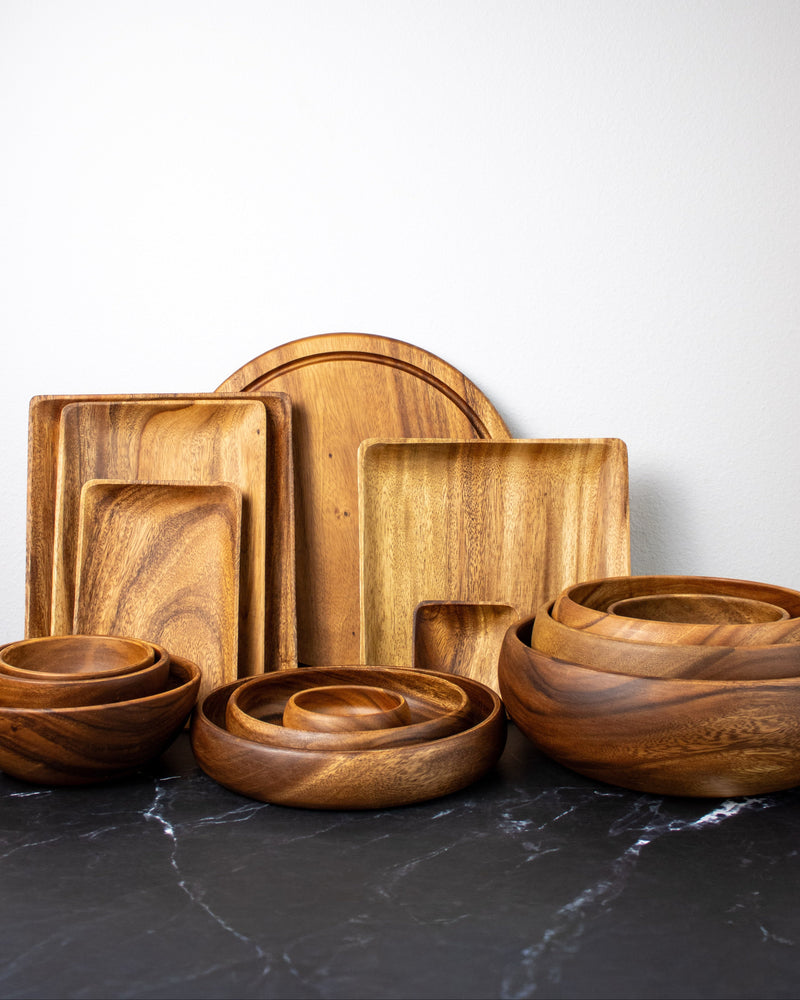
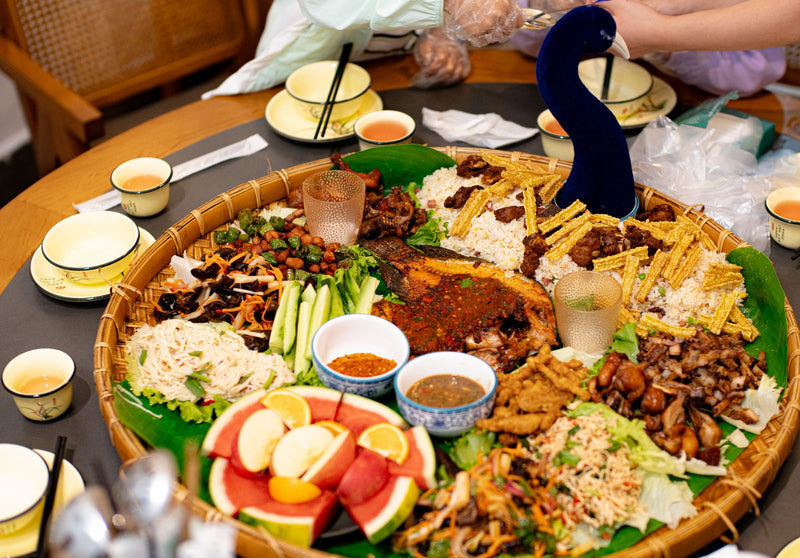
You already know you want a coordinated wooden hosting set. You have seen the photos, you understand why ceramic plates skid around on a boodle fight setup, and you have a vague sense that acacia is the right wood. The question that stalls you at checkout is sizing. Mini, Family, or Royal. Six guests or twelve. The set you grew up watching your mom pull out for Noche Buena, or the smaller one that lives within reach for a Tuesday merienda.
This guide walks through how to choose by the way you actually host, not by the largest possible scenario your imagination conjures. We will go through what a Filipino hosting set typically contains, how to size by guest count, how to size by hosting frequency, what occasion type does to the math, and a three-question filter that lands you on a decision. By the end you should know which set fits the way kainan happens in your kitchen, and which one is overkill.
What a Filipino Hosting Set Actually Includes
A Filipino hosting set is not a dinner set with a Filipino label slapped on it. The composition is different because the eating is different. When the table is set for kainan, the food does not arrive plated. It arrives in serving vessels meant to be passed, scooped from, and revisited. The set has to support that flow.
The anatomy of a complete set
Most hosting sets are built around four categories of pieces. First, a large centerpiece platter or board, which holds the rice or the boodle fight spread. Second, serving bowls of varying depth for ulam with sauce (sinigang, kare-kare, adobo) and ulam that stays dry (lechon, inihaw, lumpia). Third, individual plates for each guest, deeper than a standard Western dinner plate so that the inevitable sabaw does not run off the edge. Fourth, sawsawan dishes, the small wooden cups that sit at each place setting for suka, patis, toyomansi, or whatever dip the meal calls for.
Utensils sometimes come bundled, sometimes not. Sets oriented toward kamayan eating often skip the cutlery entirely, since the hands do the work and the platter sets the tone. Sets oriented toward a more formal handaan include wooden serving spoons and forks so that you are not reaching across the table with your personal utensils.
Why Filipino hosting needs different pieces than Western dinner sets
A standard Western dinner service for six gives you six dinner plates, six salad plates, six soup bowls, and maybe a serving platter. That math fails immediately at a Filipino table. You will have three or four ulam, which means three or four serving bowls, not one. You will have rice, which means a dedicated platter or large bowl that lives at the center of the table for the whole meal. You will have sawsawan, which means six or eight tiny dishes that a Western set simply does not include.
The other quiet difference is depth. Western dinner plates are flat because Western food is plated. Filipino plates need a lip because you are scooping rice and sabaw onto your own plate from communal bowls, and a flat plate turns dinner into a cleanup job. Hosting sets designed for kainan account for this without being asked.
How acacia became the default wood for hosting pieces
Acacia is the wood that ended up doing the work for a few practical reasons. It is dense enough to handle hot serving bowls without warping. The grain is closed enough that suka and patis do not soak in and stain. It is grown across the Philippines and Southeast Asia, so the supply chain is local rather than imported teak from elsewhere. And the color, that warm honey-to-chocolate range with visible grain, photographs beautifully on a styled table and ages well over years of use.
Mango and bamboo show up in hosting sets too, but acacia is the one that has settled in as the default. If you want a longer comparison, our breakdown of acacia versus mango wood and acacia versus bamboo goes deeper into why density and grain matter for serving pieces that live a long life on a working table.
Sizing by Guest Count
This is the core matrix, the part most people came here for. Three set sizes, three guest count ranges, and a shortcut for when you are torn between two of them.
Mini (2 to 4 guests): intimate kainan, weeknight family meals, condo dwellers
The Mini set is built for the size of meal that happens most days but rarely gets photographed. A small household eating together. A couple who hosts one set of in-laws at a time. A condo dweller whose largest realistic dinner is the four-top that fits the dining nook. The pieces are scaled down so that a single platter holds enough rice for four without dominating a compact table, and the serving bowls are sized for one or two ulam rather than five.
The other place the Mini set shines is the intimate Sunday lunch where you do not want to wash a Royal set's worth of dishes for a meal that did not need it. If your hosting style leans toward small and recurring rather than large and seasonal, this is the set that will be in rotation week after week. Our deeper writeup on the Mini Hosting Set for small gatherings covers the exact piece count and dimensions.

Built for two-to-four kainan
The Mini Hosting Set keeps everything you need for a small shared meal within reach, without taking over a condo kitchen.
Shop the Mini Hosting Set →Family (6 to 8 guests): standard handaan, monthly salu-salo, in-laws over
The Family set is the size that fits the way most Filipino households actually host. Six to eight guests is the standard handaan, the size of a Sunday lunch with the in-laws and a few cousins, the size of a monthly salu-salo with the same friend group that has been rotating houses for years. The centerpiece platter is large enough to anchor a boodle fight for six on banana leaves, the serving bowls multiply to handle three or four ulam comfortably, and the sawsawan count matches the seating.
This is the size we recommend for most first-time buyers who are not absolutely sure. It scales down (host four, no problem) more gracefully than it scales up (hosting twelve with a Family set leaves you scrambling for extra bowls). The Mini cannot really stretch to eight, but the Family can absolutely handle five.
Royal (10 to 14 guests): fiesta, Noche Buena, baptism receptions, milestone birthdays
The Royal set is for the gatherings that mark the calendar. Noche Buena with all the titos and titas. A baptism reception held at the house. A milestone birthday where the cousins drive in from three provinces or three states. A barrio fiesta scaled down to a backyard. The platter is large enough to be the visual center of a long table, the serving bowls are sized so that twelve people can serve themselves twice without the bowl running empty mid-meal, and the piece count is generous enough that you are not playing dish-rotation Tetris between courses.
If you host fewer than four big gatherings a year, the Royal set will sit in storage most of the time. That is not a flaw, that is the deal you accept for owning something that performs when the calendar calls for it.
Decision shortcut: count your largest realistic gathering, not your average
Here is the bias most people fall into when sizing a hosting set. They count their average meal, decide they only need a Mini, then end up renting or borrowing extra pieces three times a year when the gathering doubles. Hosting sets are bought once and used for a decade or more. Size for your largest realistic gathering of a typical year, not the average Tuesday and not the wildest one-time scenario.
"Realistic" is doing work in that sentence. If you have hosted a 14-person fiesta exactly once in five years, that is not your sizing target. If you do Noche Buena for twelve every December and that is non-negotiable, the Royal set is your sizing target even if eleven months of the year you only need the Mini.
Sizing by Lifestyle (how often you host)
Guest count is only half the picture. How often the set comes out of the cabinet matters just as much, because frequency changes which trade-offs you can live with.
The occasional host (3 to 4 times a year)
If you host a few times a year and they are mostly the big ones (Noche Buena, a summer reunion, one birthday handaan), do not be tempted to "rent or borrow." Borrowing means the set you eat off of is whatever your tita has in her cabinet, which is rarely a coordinated set and almost never wood. Buy the right size once. For this profile, the right size is usually a Royal, because the few times you host are the times that earn the bigger set its place in the cabinet.
The monthly host
Hosting once a month is the sweet spot where the Family set really pays for itself. The pieces wear in (acacia develops a softer surface and a deeper color with use), the muscle memory of setting the table becomes automatic, and the set never sits long enough to feel ceremonial. Wear-in is different from wear-out, and a properly cared for acacia hosting set used monthly will look better at year ten than it did at year one.
The weekly host (extended family lives nearby)
If extended family lives within driving distance and you are the one whose house everyone gravitates to, you are a weekly host whether you call yourself that or not. A Family set that gets pulled out every Sunday earns its keep faster than almost any other piece of tableware you own. The pieces become familiar in the hands of the same six to eight people, the cleanup becomes a shared ritual, and the set takes on the patina of a kitchen that gets used. This is the case we describe in detail in our piece on the Family Hosting Set explained.

The set most households actually need
The Family Hosting Set is sized for the six-to-eight-guest handaan that anchors most Filipino kitchens, weekly or monthly.
Shop the Family Hosting Set →Apartment vs. house storage realities
Storage is the constraint nobody mentions on a product page. A Royal set is real estate. The centerpiece platter alone is large enough that it does not fit in a standard kitchen cabinet, which means a dedicated shelf, a sideboard, or a vertical rack against a wall. If you are in a Manila condo or a one-bedroom apartment in Daly City, this matters more than the guest count math. A set you cannot store is a set you will not use, and the better choice is often a Family set you actually pull out, rather than a Royal set that lives in a closet because it does not fit anywhere convenient.
House dwellers with a real dining sideboard or a pantry can ignore this constraint. Everyone else should measure their cabinet before committing.
Sizing by Occasion Type
The shape of the gathering changes which pieces matter most. A boodle fight does not have the same vessel needs as a multi-ulam handaan, and a merienda has its own logic entirely.
Boodle fight setups (flat surface area, not bowl depth)
A boodle fight is about horizontal real estate. The food is laid out directly on banana leaves over a long flat surface, the rice is mounded down the center, and the ulam is arranged in clusters that everyone reaches across. The piece that does the most work here is the large platter or the long serving board, not the bowls. If your main hosting mode is boodle fight, prioritize sets that include a generous centerpiece platter (or pair a smaller set with a separate long board).
The bowls still earn their keep for sawsawan and for any ulam that is too saucy to ride on the leaf without flooding the rice, but the platter is the headline piece. For a deeper walkthrough of the platter-led setup, the Royal Hosting Set explained covers why the Royal set's larger centerpiece is the natural fit for full-scale boodle fights.
Multi-ulam handaan (many bowls plus a centerpiece platter)
A traditional Sunday handaan reverses the boodle fight math. You have four or five ulam, each in its own bowl. You have rice on the centerpiece platter. You have sawsawan at every place. The bowls are doing more work than the platter, and the count matters more than any single piece's size. This is where the Family set's piece count tends to fit better than its raw guest count would suggest, because four serving bowls plus the rice platter handles a five-ulam menu comfortably for six to eight people.
If you are hosting more than four ulam regularly, look at whether the set's bowl count is keeping up. Some sets are platter-heavy and bowl-light, which is fine for boodle fight households and a mismatch for handaan households.
Merienda and pasalubong-style gatherings
Merienda is where the Mini set quietly shines. An afternoon spread of bibingka, puto, suman, and a pot of tsokolate or kapeng barako does not need serving bowls deep enough to hold sinigang. It needs small plates, small platters for the rice cakes and pasalubong, and the visual warmth that wood gives to a simple snack table. The Mini set, or a few standalone pieces, often handles merienda better than the larger sets do. The Royal set in particular tends to overwhelm a merienda spread, the way a banquet table overwhelms a coffee date.
Mixed-occasion households: when to layer two sets together
If your hosting style alternates between weekly merienda for four and seasonal Noche Buena for twelve, the honest answer is sometimes two sets. A Mini for the weekly rotation, a Family or Royal for the seasonal ones. This sounds excessive until you do the math: two sets used for their intended use cases outlast one set used for everything, because nothing gets stressed, scratched, or over-washed.
For most households this is a phased purchase. Buy the larger of the two first (since it covers the high-stakes occasions), then add a Mini later for the weekly default. The other order works too if budget or storage calls for it.
How to Decide and What to Buy First
If you are still torn, run through the three-question filter below. It is the shortest path to a decision that you will not regret a year in.
The three-question filter
- What is the largest realistic gathering you host in a typical year? Not the wildest scenario, not the average. The largest one that actually happens. If the answer is 4, you are in Mini territory. If the answer is 7, Family. If the answer is 12, Royal.
- How often does that largest gathering happen? If it is twice a year and the rest of your hosting is for four, you are still buying for the twelve, but you should be honest that the set will be in storage most of the year.
- Where will the set live when you are not using it? Measure your largest available cabinet shelf or sideboard. If the centerpiece platter of the Royal set does not fit, the Family set is the answer, even if your gathering math points larger. The set you cannot store is the set you will not enjoy.
Starting with the Family set and scaling up vs. starting Mini and adding
Two reasonable phased paths exist. Path one: start with the Family set, add a Royal centerpiece platter or extra bowls later if seasonal hosting grows. Path two: start with the Mini, add a Family set later as your hosting frequency increases. Path one is the right call for households that already host monthly. Path two is the right call for households still figuring out their hosting cadence (newlyweds, new homeowners, recent diaspora arrivals settling into their kitchen).
The path that almost never works is starting with the Royal because it looks impressive and then discovering it is too much set for your actual life. The Royal earns its keep when it gets used. It does not earn its keep sitting pretty.
Care commitment by set size (real talk)
More pieces mean more wash time. A Royal set after a 12-person Noche Buena is real cleanup work, even with help. Acacia hosting sets cannot go in the dishwasher (heat and prolonged water exposure are how wood warps and cracks), which means everything gets hand-washed, dried promptly, and re-oiled every couple of months. For the Mini set this is a 15-minute affair. For the Family it is half an hour. For the Royal after a big meal it is genuinely an hour or more of careful washing.
None of this is meant to scare anyone off the larger sets. It is meant to be honest about the trade-off. If hand-washing 30+ pieces after a big meal sounds like the price you pay for hosting Noche Buena properly, the Royal is right for you. If it sounds like dread, size down.
When a hosting set is the right pasalubong or housewarming gift
A hosting set is one of the strongest gifts you can give for a Filipino wedding, housewarming, or 50th wedding anniversary, because it is the kind of object the recipient probably would not buy for themselves at full size but will use for the rest of their hosting life. For a couple just moving in together, the Family set hits the right note. For a milestone gift (parents' anniversary, a new home for an established family), the Royal is the moment to go bigger. The Mini works as a smaller gesture, a pasalubong-scale gift for a friend's condo or a Christmas gift to a sibling who entertains on a smaller scale.
One gifting note worth flagging. Acacia is heavy, especially at Royal scale. If you are shipping the gift internationally (a common case for Filipino-American buyers sending sets home, or vice versa), factor in shipping weight before committing to the larger set as a surprise.

The set for the gatherings that mark the calendar
The Royal Hosting Set is built for Noche Buena, fiesta, baptism receptions, and the milestone birthdays that fill the long table.
Shop the Royal Hosting Set →Frequently Asked Questions
What is a Filipino hosting set and how is it different from a regular dinner set?
A Filipino hosting set is built around shared eating rather than individual plating. It includes a centerpiece platter for rice, multiple serving bowls for ulam, sawsawan dishes at each place, and deeper-than-standard individual plates. A Western dinner set gives you matched plates and bowls for the same dish at each seat, which does not fit the way a handaan or kainan actually flows.
How many people does the Family Hosting Set serve?
The Family Hosting Set is sized for 6 to 8 guests comfortably. It can stretch down to four without feeling oversized and can accommodate up to about nine if your menu is on the lighter side. For gatherings that consistently exceed eight, the Royal set is the better fit.
Can I mix and match pieces from the Mini, Family, and Royal sets?
Yes. All three sets are made from the same acacia stock with the same finish, so the wood tone and grain character coordinate visually even when piece sizes differ. Many households layer a Mini set for daily use with a Family or Royal set for hosting, and the pieces look intentional on the table together.
Is acacia wood safe for hot Filipino dishes like sinigang or kare-kare?
Acacia is safe for hot foods because its density and closed grain keep heat from penetrating quickly and prevent sauces from soaking in. Sinigang, kare-kare, and other saucy ulam can be served directly from acacia bowls without staining or warping, as long as the bowls are hand-washed and dried promptly afterward rather than left to soak.
Should first-time hosts buy the Mini or the Family set?
For most first-time hosts, the Family set is the better starting point because it scales down to small gatherings more gracefully than the Mini scales up to large ones. If your largest realistic gathering is four people or fewer, or if you live in a condo with tight storage, the Mini is the right call.
Is a hosting set a good housewarming or wedding gift?
Yes, and it is one of the gifts most likely to be used for decades rather than stored. The Family set is the default choice for housewarmings and weddings because it suits the hosting cadence of a new household. For milestone gifts to established families, the Royal set is the appropriate scale.