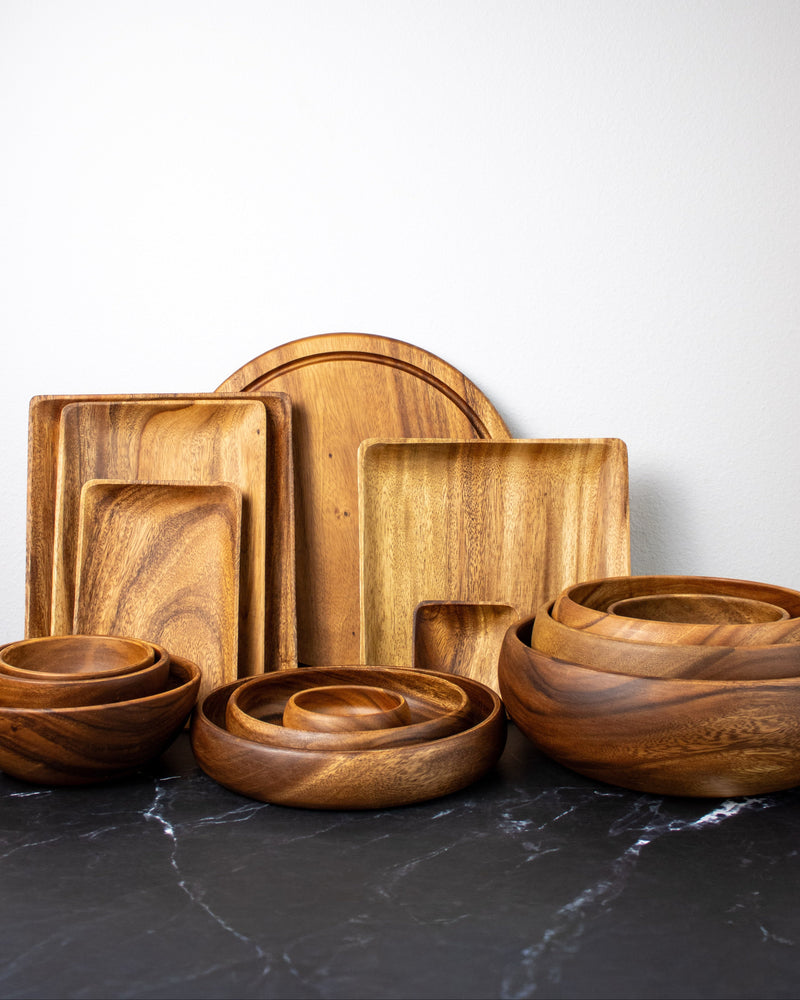
The short answer (and why it matters)
You are standing at the sink after a long salu-salo, looking at a stack of acacia bowls, and the dishwasher is right there. The question is honest and the answer is short. No, acacia wood does not belong in the dishwasher. Not on the top rack, not on the gentle cycle, not "just this once." The wash itself is fast, the damage is slow, and by the time you can see it, you have already lost the piece.
No, acacia wood is not dishwasher safe
This is the bold, no-asterisks verdict. Solid acacia, oiled acacia, lacquered acacia, salad-bowl-finish acacia, all the same answer. Wood is a porous, living material even after it has been milled and oiled, and the dishwasher is engineered to do three things that wood cannot survive: cook it, drown it, and strip it. A single cycle will not always crack a piece, but every cycle costs you grain integrity, color, and lifespan. Pieces that should serve a family for a decade get tired in a year.
What actually happens inside the dishwasher
A standard home dishwasher runs a wash cycle at roughly 130 to 140 degrees Fahrenheit and a sanitize cycle that pushes 150 to 160 degrees. That water is jetted at the surface for 45 to 90 minutes, then a heated dry cycle bakes the load at 140 to 170 degrees for another 30 minutes or so. For ceramic and stainless steel this is fine. For acacia, you are pressure-cooking the cell walls, swelling the grain, and then flash-drying the same grain in a hot box. The wood goes through a freeze-thaw cycle, except with heat.
Why this rule applies to all hardwood tableware
It is tempting to think acacia is the problem because it is sold as "tropical" hardwood and feels softer than teak or hard maple. It is not. The dishwasher destroys mango, teak, walnut, olive, beech, birch, and bamboo just as efficiently. Bamboo is technically a grass and behaves a little differently, but the answer is still no. If you read the back of any wooden bowl, board, or utensil from a reputable maker anywhere in the world, the care line is identical: hand-wash only, do not soak, do not put in the dishwasher, do not microwave. This is not brand caution. It is the wood telling you what it needs.

The everyday plates that earn the hand-wash
The Ina plate set is built for daily kainan, which means it sees water, soap, and a soft sponge most nights of the week. The 60 seconds of care is the trade for plates you will still be using in ten years.
Shop the Ina Plate Set →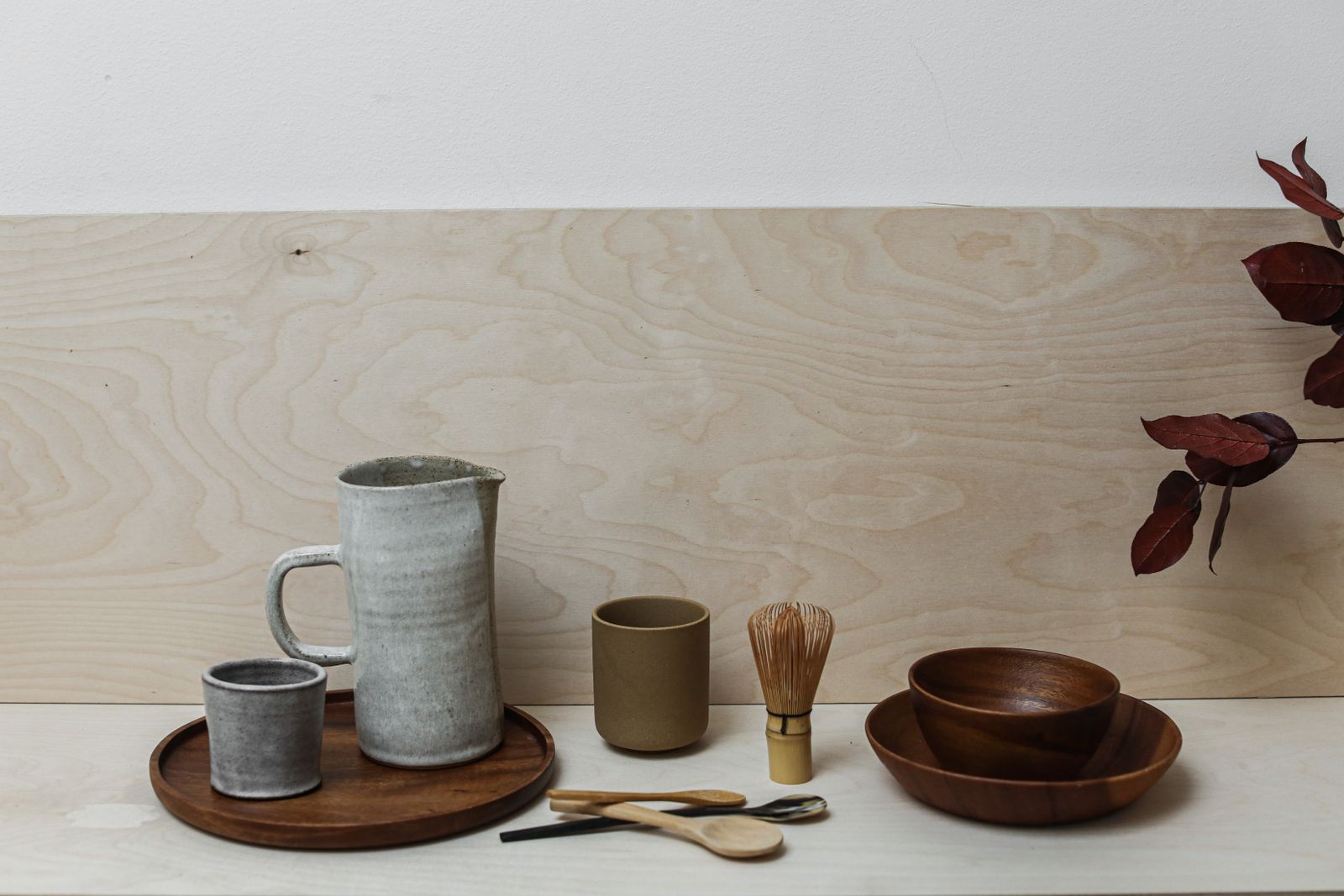
What the dishwasher does to acacia
You can think of acacia as a tightly woven mat of long, dense fibers held together by the wood's own natural oils and the finishing oil applied at the workshop. The dishwasher attacks all three layers at once. Here is what each part of the cycle is doing to the piece.
The heat cycle and grain expansion
Heat makes wood move. The hotter the water, the faster the outer fibers swell while the inner core stays comparatively cool. This differential expansion is what cracks lumber when you dry it too fast, and it is exactly what happens in a 160-degree wash. On a thick board you might only see a hairline check near the rim. On a thinner bowl, the rim can warp out of round in a single cycle. Once a piece is out of round, it never sits flat on the table again.
Prolonged water saturation and warping
Even at room temperature, wood does not like to sit in water for more than a few minutes. The dishwasher keeps acacia drenched and pressure-blasted for the better part of an hour. Water moves into the end grain (the cut ends of the wood fibers, usually at the base of a bowl or the edge of a board) far faster than into the face grain. The base swells, the rim contracts, and the piece distorts. With boards, this shows up as a cup or a bow. With bowls, the pedestal can split away from the body.
Detergent strips the natural oils that protect the wood
Dishwasher detergent is not the same chemistry as dish soap. It is alkaline, enzyme-driven, and engineered to break down fats and proteins. The food-safe mineral oil, beeswax, or coconut oil finish on your acacia is, from the detergent's point of view, just another fat to dissolve. After one dishwasher cycle, the surface is bare. After three, the wood itself is starting to give up its own resinous oils. This is why dishwashered acacia goes pale and dusty-looking even before it cracks. The protective layer is simply gone.
Visible damage timeline: first wash, fifth wash, tenth wash
Owners often ask, in the bargaining way of people who have just done something they regret, whether one accidental cycle is really that bad. Here is the honest timeline.
- After the first cycle: the surface looks dry and chalky. The color shifts from warm honey to pale tan. The wood feels rough where it used to be smooth. This is recoverable.
- After three to five cycles: the grain starts to lift, giving the surface a fuzzy texture. Hairline cracks appear at the rim and around any handles. The piece no longer sits perfectly flat. Recoverable with sanding and oiling, but the color shift is permanent.
- After ten cycles: cracks travel deeper into the body. Joints loosen on glued pieces. Pedestals can detach. At this point, you are looking at a display piece, not a serving piece.
The 60-second hand-wash method
The reason the dishwasher is so tempting is that hand-washing sounds like a chore. It is not. Acacia is one of the easiest materials in your kitchen to clean, because food does not stick to it the way it sticks to a non-stick pan that has lost its coating. Here is the method, step by step, and it really does take about a minute per piece.
Warm (not hot) water and mild dish soap
Use warm tap water and a small drop of any standard dish soap, the kind you use for glassware. Skip the heavy degreaser formulas and anything labeled "antibacterial," which usually means a higher pH. Bring the water temperature to comfortable, not steaming. Hot water swells the grain just like the dishwasher does, only slower.
Soft sponge, not the scrubby side
The softer side of a kitchen sponge or a cotton dishcloth is all you need. Stay off the green scour pad, off the steel wool, off the bristle brush. Even a light pass with an abrasive will lift the grain and dull the finish. If something is genuinely stuck, the next section has the fix.
Rinse quickly, never soak
Rinse with warm water and move on. Do not fill a bowl with water and leave it in the sink while you do the rest of the dishes. Do not leave a board face-down in a wet sink while you load the dishwasher with the ceramics. The total contact time between acacia and water should be measured in seconds, not minutes. This is the most important rule in the whole article.
Towel dry immediately, then air-dry upright
Dry the piece all the way around with a clean cotton or linen towel, including the base. Then stand it upright on a dish rack or on its edge against the backsplash so air can move on both faces. Lay-flat drying traps moisture against the down-facing side and you end up with one face that dries faster than the other, which is how boards cup overnight.
The single biggest mistake: leaving it wet in the sink
If you remember nothing else from this guide, remember this. The wash itself is not what kills acacia in most households. It is the hour, or three hours, or overnight, that the piece spends sitting in a puddle of dishwater after the meal. The grain drinks the water in slowly, the wood swells, and the piece warps as it dries on the rack the next morning. Wash it, dry it, put it away. Sixty seconds, then you are done.
For deeper conditioning and stain removal beyond the daily wash, our full care guide walks through the monthly oil routine and what to do about red wine, turmeric, and stubborn patis stains.

Bowls built for sinigang, not for the rinse cycle
The Ama bowl set is sized for hot soups and rice meals at the family table. The wood handles a steaming serving of sinigang or arroz caldo with no trouble, but a dishwasher cycle is a different conversation.
Shop the Ama Bowl Set →When your acacia has already been through the dishwasher
If you are reading this with one already-dishwashered bowl in your hand, take a breath. The piece is probably not lost. Acacia is forgiving in ways that ceramic and glass are not, because you can put oil back into wood. Here is how to assess and rescue.
Assess the damage (cracks, fuzzy grain, dull color, warping)
Look at the piece in good daylight, near a window. You are checking for four things, in this order: cracks (especially at the rim and the end grain), fuzzy or lifted grain, color shift from warm to pale, and warping (does it rock when you put it on a flat surface?). Mild fuzz and dullness are cosmetic. Hairline cracks under an inch are usually stable. Warping is the toughest call, and depends on how much.
Salvageable: re-oiling with food-grade mineral oil
For dull, dry, slightly fuzzy acacia, the rescue is straightforward. Get a bottle of food-grade mineral oil from the grocery or pharmacy (sometimes labeled "butcher block oil" or "cutting board oil"). Pour a small amount on a clean cotton rag. Wipe the entire surface, inside and out, going with the grain. Let it sit for 20 to 30 minutes so the wood drinks it in. Wipe off the excess with a clean part of the rag. Repeat the next day if the wood still looks thirsty. Most pieces come back to about 85 to 90 percent of their original color and feel.
Not salvageable: when cracks reach the rim or splinters lift
If a crack travels all the way through the rim of a bowl or splits a board across the grain, the piece is no longer safe for food. The cracks trap food and water, which is a hygiene problem and a structural one. Splinters that lift away from the surface are the same story. At that point, retire the piece. A heavily cracked bowl can still live as a fruit display or a key bowl by the front door, but it should not see food.
The light sanding rescue for fuzzy grain
For grain that has gone fuzzy after a wash or two, a light sanding will bring back the smooth feel. Use 220-grit sandpaper or higher (320 is even better) and sand with the grain, not across it. Two or three minutes of gentle work is enough. Wipe off the dust with a barely damp cloth, let it dry completely (a full day), then oil as described above. The piece will look and feel close to new. If you also have questions about whether reheating leftovers in the same bowl is fine, the short answer there is also no, and no, the microwave is out too, for related reasons.
Choosing acacia that lasts (and building the right habits)
The dishwasher question is really a buying question in disguise. If you have to wash acacia by hand, you want acacia worth that hand-wash. The good news is that the difference between a 2-year piece and a 20-year piece is visible at the shelf if you know what you are looking at.
What to look for: solid wood, food-safe finish, thick walls
Three things to check before you buy. First, solid acacia, not veneer over MDF. You can usually tell by the weight and by looking at the end grain (the cut edge): solid pieces show continuous wood grain on the edge, veneer shows a different material underneath. Second, a food-safe finish. Reputable makers will say so, and it is usually mineral oil, beeswax, or a food-grade salad bowl finish. Third, thick walls. A bowl with walls under 6 millimeters will warp fastest. Thicker walls survive a wider range of household conditions. For background on what "food-safe" actually means in this context, our piece on food safety basics covers the standards and what to watch for.
Pieces that get used vs pieces that get displayed
It helps to be honest with yourself about how a piece will live. A pasalubong bowl that sits on a console table once a week is a different object than the rice bowl that goes on the table every night. The everyday pieces are the ones worth investing in, because they are the ones earning their wood. Display pieces can be lighter, thinner, more decorative. Workhorse pieces should be heavier, thicker, and finished simply.
Building the kainan reflex: wash by hand right after the meal
This is the habit that keeps acacia alive in a busy household. After kainan, before the kids run off and before you sit down for coffee, the wood pieces come off the table first. They get rinsed, soaped, rinsed, dried, and stood up. Ceramic and stainless can wait. Wood cannot. Once the reflex is built, it stops feeling like a chore and becomes part of the meal closing itself. Plates first, wood always first among the plates.
When to re-oil (every 4 to 6 weeks for active pieces)
Active pieces (daily plates, weekly serving bowls, the cutting board you use most nights) want a light oiling every 4 to 6 weeks. Display pieces can go several months. The way to tell, regardless of schedule, is to look at the surface in side light. If the wood looks dry, chalky, or thirsty, it is. A 15-minute oiling that same day will keep the piece healthy for another month. Skipping it is what builds up to the dull, brittle wood that cracks at the first hot wash.

A board set worth the 60 seconds of care
The Pamilya board set is built for the kind of long, generous table that calls for a boodle fight or a Sunday roast. The wood rewards the hand-wash with decades of service.
Shop the Pamilya Board Set →Frequently asked questions
Is any wooden tableware dishwasher safe?
No. Not acacia, not teak, not maple, not bamboo, not olive wood. A few mass-market brands print "top-rack dishwasher safe" on their cheaper pieces, but what that actually means is "it will survive a few cycles before it fails." Reputable makers across every wood species recommend hand-wash only.
What happens if I accidentally put my acacia bowl in the dishwasher once?
The bowl is probably not ruined. Expect it to come out dry, dull, and slightly fuzzy to the touch. Let it air-dry for a full day, sand lightly with 320-grit paper if the grain has lifted, and oil it with food-grade mineral oil. Most one-cycle accidents recover most of the way.
Can I use hot water to hand-wash acacia?
Use warm water, not hot. Hot tap water (above 110 degrees Fahrenheit) will swell the grain and dull the finish faster than warm water will. The temperature you would use for washing your own hands is also the right temperature for washing acacia.
How often should I oil my acacia pieces?
Every 4 to 6 weeks for pieces in active rotation, and any time the wood looks chalky or dry. Display pieces can stretch to every few months. Use food-grade mineral oil or a dedicated cutting board oil. A small bottle lasts a household over a year.
Will dish soap damage acacia wood?
A small amount of mild dish soap is fine, and recommended, for cleaning. The problem is not the soap itself but soaking the wood in soapy water or using harsh degreasers. A drop on a soft sponge, a quick wash, a quick rinse, a dry. That is the whole protocol.
Can I soak acacia wood to remove stuck food?
No. Soaking is the fastest way to warp a bowl or split a board. If something is stuck, sprinkle coarse salt on the spot, rub gently with a damp sponge or half a lemon, then rinse and dry. The salt acts as a mild abrasive without scratching the surface.