Before Any of It Ships, There Is a Workshop in Betis
A workshop in Betis, Pampanga, does not announce itself. It sits between houses on a street where the tricycles pass slowly because there are children who play in the road. The gate is a metal roll-down painted green, and behind it there is a courtyard with a sheet of galvanized iron for a roof and a floor of packed dirt covered in curls of shaved wood. The first thing you notice, before you notice anything visual, is the smell. Fresh acacia has a scent that sits between hay and cut grass, with a faint sweetness underneath, and when a chisel is working through a knot it deepens into something warmer, closer to cinnamon. You smell that before you see the carver.
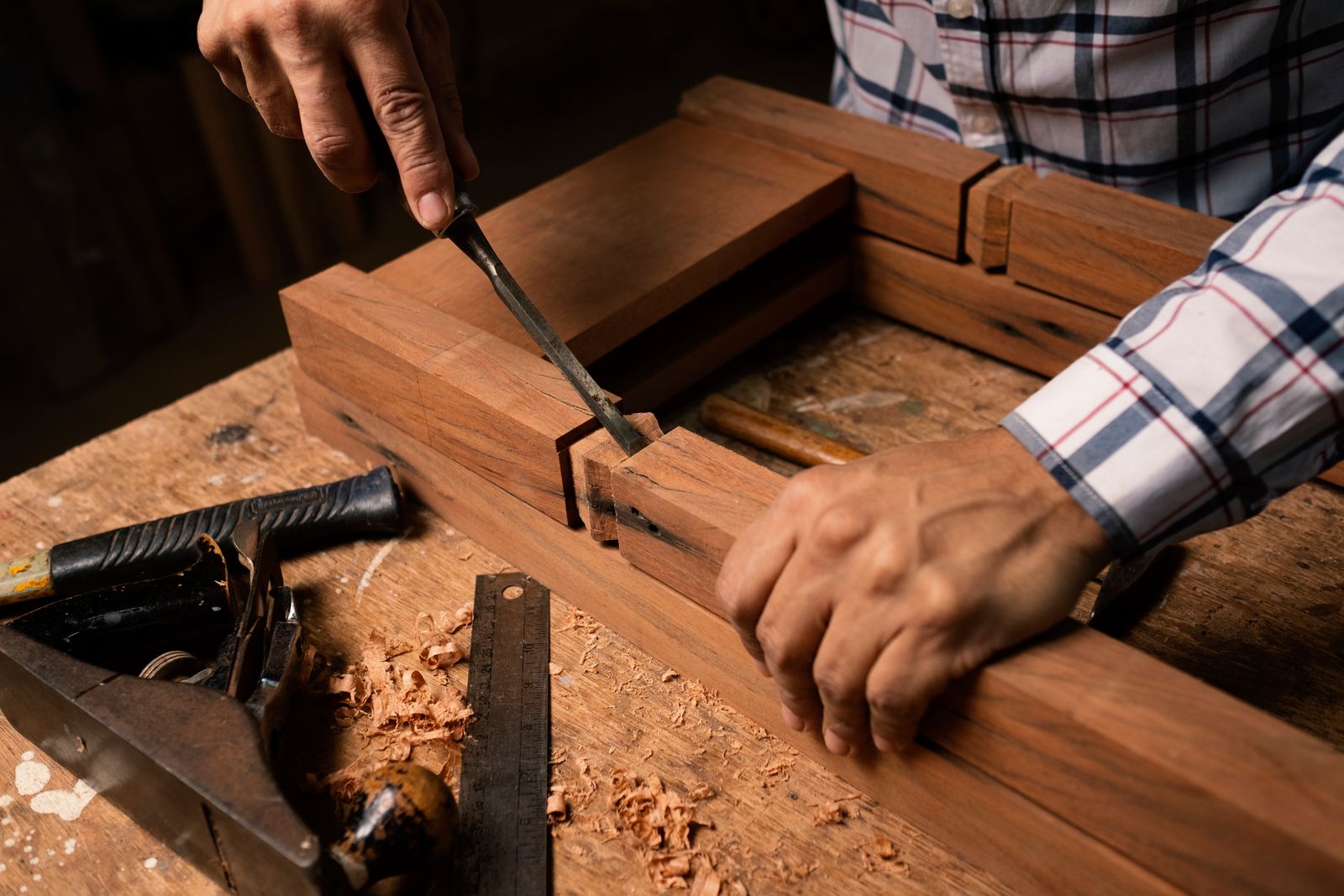
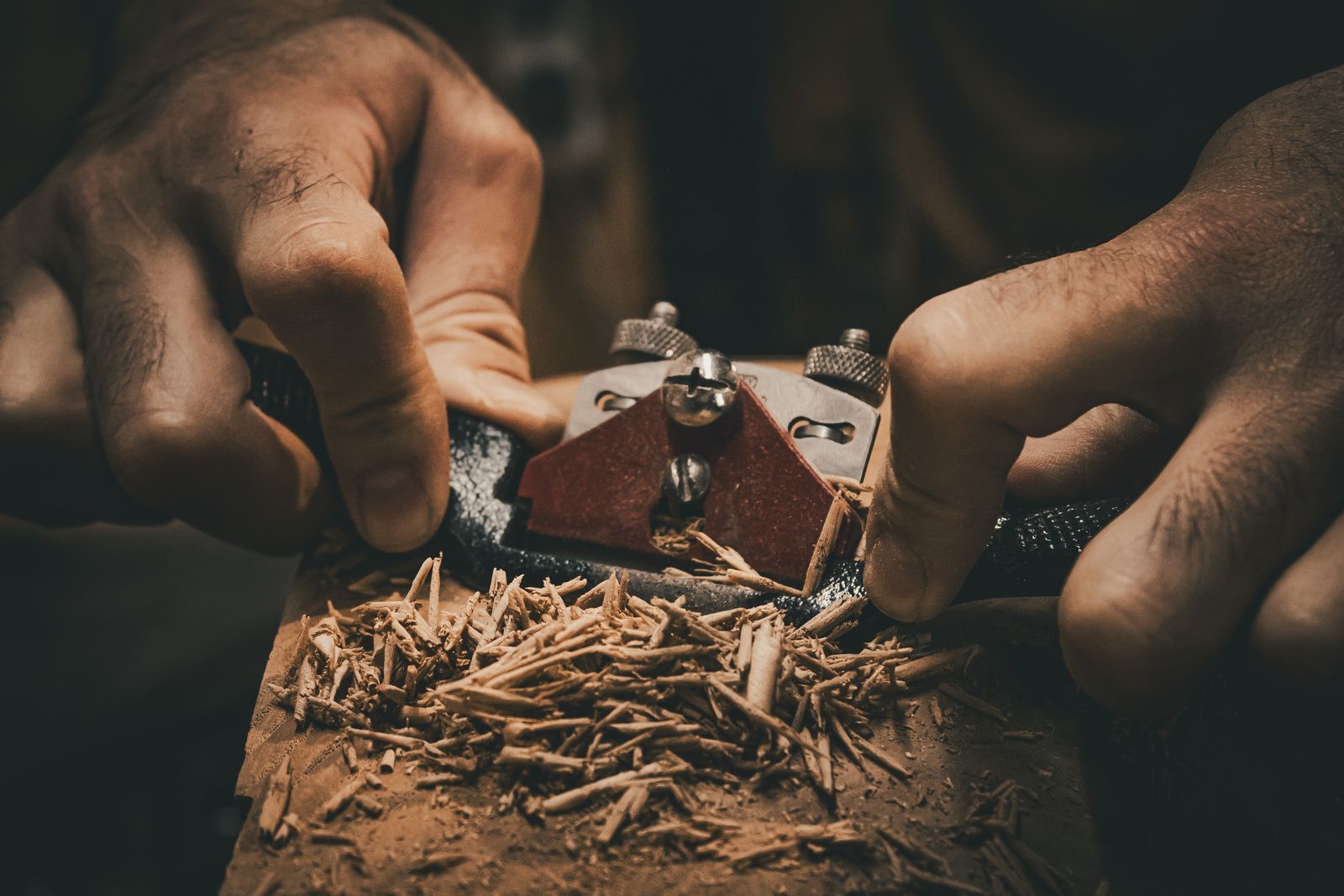
The carver is usually sitting. Not standing at a bench, the way you might imagine. Sitting on a low stool, or sometimes crosslegged on a wooden pallet, with the piece he is working on balanced between his knees. His hands move slowly because the wood asks him to move slowly. Acacia has a curly grain, tight in places, loose in others, and if he rushes the chisel it splits. So he does not rush. He rests the blade against the wood, listens for the give, and applies pressure only when the fiber tells him it will accept the cut.
There is a radio going somewhere in the back. Usually it is on an AM station that plays balladeers between long stretches of talk. Someone is boiling water for coffee on a two-burner stove near the far wall. A cousin walks in with a plastic bag of pandesal and drops it on the workbench without comment. Everyone will eat later. Nobody is in a hurry.
This is where our pieces begin. Not in a factory. Not on a conveyor belt. Not in a room with fluorescent lights and productivity targets taped to the door. In a courtyard workshop with a green gate, in a town most Manila people cannot find without asking directions twice. If you have already read our longer piece on the journey from tree to table, you have some sense of the mechanical arc. What that piece does not tell you is the human one. Who cuts. Who dries. Who decides the piece is ready. That story lives here, and it is the story we most want you to know.
What Direct Sourcing Actually Cuts Out
The phrase "direct from the artisan" gets used loosely in tableware marketing, so it is worth spelling out what it means when we say it. It does not mean we occasionally visit the workshop. It does not mean we license a design from a carver and then subcontract production to whoever bids lowest. It means the person who shaped the piece you own is the same person we paid, on the same week the piece was finished, without a broker sitting in between us.
To understand why that matters, it helps to see the chain that direct sourcing removes. In a typical export arrangement, the carver sells to a village consolidator who pays low and pays late. The consolidator sells to a Manila trading house that handles the export paperwork. The trading house sells to an overseas importer who warehouses stock. The importer sells to a wholesaler who sells to a retail brand that puts the piece in a catalog. Each layer takes a margin. Each margin has to come from somewhere. It comes from the carver, who gets paid the smallest amount, the earliest, and the least reliably.
There is another cost that most buyers never see. Each middleman has an incentive to standardize. A trading house that has to fulfill a bulk export order does not want variation in grain, in tone, in weight. It wants pieces that look identical because identical pieces move faster through customs and warehousing. So the carver, over time, gets asked to file down what is distinctive about acacia. The dark ribbons of heartwood get treated as flaws to be sanded out. The gentle asymmetries of a hand-turned bowl get corrected toward machine roundness. The wood, still wood, starts to look less like wood.
Cutting the chain does more than raise the carver's share of the price. It changes what the carver is allowed to make. When there is no broker between us and Betis, there is no one asking the workshop to smooth the character out of the wood. The heartwood ribbons stay. The gentle wobble on the underside of a large plate stays. The single stubborn dark knot near the rim of a bowl stays, because the person who worked around it did not have to answer to a warehouse manager who preferred a uniform stock photo.
You can read our fuller argument about why standardization is bad for wood in the piece on how acacia becomes tableware. The short version is that acacia is a living material with two colors in its trunk and a grain that never repeats. Every layer of intermediation is a layer of pressure to pretend otherwise. Direct sourcing is the way we buy ourselves the freedom to stop pretending.
A Partnership Is Not a Purchase Order
A supplier relationship, in the ordinary industrial sense, is a spreadsheet. Prices, lead times, minimum order quantities, quality tolerances, penalty clauses. The relationship works if the numbers work. When the numbers stop working, the relationship ends.
What we have with the workshops in Betis is not that. It is closer to a family arrangement than a commercial one, and it took years to build it that way. The first orders we placed were small. Ten pieces. Twenty. Enough for us to see how the workshop worked, enough for the workshop to see how we paid. We did not walk in on the first day and ask for exclusivity. We did not ask for volume discounts. We did not sit down with a contract that specified what would happen if delivery slipped. We asked what a fair price was, and when we got the answer, we paid it, and then we came back and asked again the next season, when the price of raw acacia had moved, and we paid the new number without arguing.
Trust, in a Filipino artisan context, is not a rhetorical concept. It is measured in specific behaviors. Do you pay on time. Do you pay in full. Do you show up when you said you would show up. Do you notice when someone in the workshop has been sick and ask how they are. Do you accept that the piece which took three weeks longer than promised took three weeks longer because the wood was not ready, and not because the carver was lazy. If those behaviors are consistent for long enough, the workshop stops treating you like a client and starts treating you like a person they cook lunch for when you visit. That is the threshold. That is the only threshold that matters.
"Trust is not a rhetorical concept. It is measured in whether you paid on time, whether you noticed when someone was sick, and whether you accepted that the wood was not ready when you were."
The partnership also means that decisions run in both directions. When a workshop tells us that a particular design puts too much strain on the grain and cannot be produced without waste, we retire the design. When a carver has an idea for a new form, we make room for it in the range. When a season's rain has soaked a batch of logs and drying will take an extra month, we push our shipping calendar back and communicate that to customers, instead of pressuring the workshop to accelerate. The alternative, the one most brands take, is to treat the workshop as an interchangeable input and go find a cheaper workshop when this one becomes inconvenient. We do not do that, and the reason we do not is boring but load-bearing. We do not do it because the workshop is not interchangeable. The people are the piece.
Why It Had to Be Pampanga, and Why It Had to Be Betis
If you ask a Filipino where the best woodcarvers in the country are, the answer comes back without hesitation. Pampanga. If you ask which town in Pampanga, the answer is Betis. This is not a marketing claim we invented. It is common knowledge in the country, and it has been common knowledge for centuries.
The reason is history, and the history is churches. When the Spanish colonial religious orders needed altarpieces, santos, choir stalls, and pulpits for the churches they were building across Luzon, they went to Betis. The town's carvers had inherited the woodworking tradition from precolonial Kapampangan artisans, and they refined it under the enormous, sustained demand of ecclesiastical commissions. A santo carved in Betis in the seventeenth century still stands in a cathedral somewhere. That kind of continuity is not decorative. It shapes how a carver in Betis today holds a chisel, because he learned from someone who learned from someone whose lineage runs unbroken back to those altarpieces.
That deep bench of skill did not go away when the churches stopped commissioning at scale. It moved sideways. The carvers turned to furniture, to household pieces, to serving ware. Betis became, quietly, the workshop town for the Philippine dining table. Most Filipinos who own a decent wooden serving board own it because someone in Betis made it, even if the store that sold it did not say so.
Pampanga also matters for a food reason. The province is the country's culinary capital. Kapampangan cooking is famously dense, generous, and technique-forward, and Kapampangan cooks have been feeding large gatherings for as long as anyone can remember. If a wooden serving piece has to hold a boodle fight spread or a fiesta table, and hold it in the province where boodle fights and fiesta tables set the national standard, the piece had better be good. The pressure is local. The audience is expert. The carvers work in a province that would notice, immediately, if the piece was too small, too shallow, or too shy for the food.
We wrote a whole separate piece on this called Pampanga, the craft capital of the Philippines, because the region's role in Philippine craft is bigger than any one workshop or brand. What matters here is only this. If we had sourced from anywhere else, we would have been sourcing from a shorter lineage, a smaller bench, and a less exacting food culture. There is no equivalent. There is only Betis.
What "Fair" Looks Like When Nobody Is Watching
The word "fair," in the vocabulary of ethical sourcing, has been worn thin. It appears on packaging and product pages so often that it has come to mean, in practice, "we would like you to feel good about buying this." What it means on the ground, in a workshop in Betis, is more specific and more boring, and worth naming.
Fair, for us, starts with when the money moves. Carvers do not get paid net-30 or net-60. They get paid when the piece is finished, in cash or immediate transfer, before the truck leaves the courtyard. If a carver needs money to buy raw wood for the next batch before the current batch has shipped, we advance it. We do not treat the workshop as an unpaid supplier of working capital for our business. That is standard behavior for brands that are trying to smooth their own cash flow at the expense of people who cannot afford to smooth theirs. It is not fair, and we do not do it.
Fair also means the price moves when the raw material price moves. Acacia is not priced in a static market. Wet season affects supply. Fuel costs affect delivery. A single storm can push the cost of a large log up by twenty percent. When that happens, we do not hold the workshop to last quarter's price. We renegotiate up. We have never, in the years we have worked with Betis, held a workshop to a price when the wood underneath it got more expensive. The workshop knows that. That knowledge is what keeps them coming back, and what keeps them putting our orders at the top of the queue when they are busy.
Fair means the workshop keeps its rest days. Sunday is not a production day. Fiesta week is not a production day. The days after a family funeral are not production days. We plan around those, not against them. If a birthday, a christening, a wake, or a harvest requires the workshop to slow down, we slow the ship date down too. There is no version of our production calendar that treats a family event in Betis as a customer service problem in Manila.
Fair, finally, means we do not ask the workshop to do work that damages them physically. Certain finishes require chemicals no small workshop should be handling without industrial ventilation. We do not use those finishes, and we do not order pieces that require them. Certain woods are sanded to a dust that is bad to breathe. We choose grades and pieces that minimize the exposure. Our longer piece on whether acacia is sustainable discusses the ecological side of this. The human side is not separate from it. A worker whose lungs are protected is part of the same environmental practice as a tree that gets replanted.
None of this is fair-trade certified in the formal, paper-bearing sense. Certification, for a workshop of this size, would cost more than the workshop earns in a quarter, and the auditing regime is designed for industrial-scale suppliers, not for a courtyard operation with six or eight regular hands. What we can do instead is behave, consistently, the way certification is supposed to force people to behave, and be checked on it by the only auditor whose judgment finally matters. The carver, watching what we do when nothing is at stake for us.
The Three Sets, and the Hands Behind Them
Every piece we sell was made by somebody. It is worth naming, without naming, who those somebodies are, because a piece of wood in a customer's kitchen carries the traces of the person who shaped it whether or not the customer knows it.
The Royal Hosting Set is the largest and most ambitious piece in our range. It requires the master hand in the workshop, the carver who has been at this for decades and knows how to size a serving board for a boodle fight without the underside cupping over time. That carver decides the batch. He inspects the logs when they arrive. He rejects the ones with hidden checks in the grain. When a board that will become part of a Royal Hosting Set leaves the workshop, it has passed under his hands at least twice, and usually three times. If the piece is right, it is right because he said so. If the piece needed another week of drying, that decision was his too. We built the shipping calendar around him, not the other way around.
The Family Hosting Set is the workshop's most consistent everyday piece. It sits in the sweet spot of Kapampangan household hosting, the six-to-eight seat gathering that happens most Sunday afternoons in a working Filipino home. The pieces are made in a rhythm that matches the workshop's own family life. When one carver's daughter has a school event, another carver takes over the sanding for a week. When the harvest keeps the workshop shorthanded, we let the batch run slow. The set costs what it costs because that rhythm is protected. If we had squeezed the timeline to make the piece cheaper, the piece would be worse, and the workshop would be poorer.
The Gorosin Bowl Set is where the workshop's turners shine. Bowl-turning is a different skill from board-carving, and the workshop keeps a separate bench for it. The turner works with the grain running vertically and shapes the interior with a curved gouge, watching the depth by feel. The set gets its name from the deep-golden heartwood ribbons that come through when the outer sapwood is cut back, and the turner is proud of those ribbons in a way that would sound corny if he said it out loud, so he does not. He just lets the piece show them.
We could have written this piece as a supplier list, with names and photos. We chose not to, for now, because the workshop asked us not to. Betis has been burned in the past by brands that named individual carvers, drove customer interest to those carvers, and then poached them onto lower-paid piecework arrangements elsewhere. Anonymity, in this specific commercial ecosystem, is a form of protection for the artisan, not a lack of transparency on our part. If that changes, if the workshop ever decides that being named would help them more than it costs them, we will name them, and we will do it in a longer piece than this one. The people are the piece. That is the only line worth keeping.