The Province That Kept Its Hands Working
Manila makes deals. Cebu makes music. Pampanga makes things. Ask any Filipino where the best woodcarvers work, or the santos that dress the churches during Holy Week, or the retablo behind the altar of a small provincial chapel that somehow still looks freshly gilded, and the answer keeps circling back to the same province north of the capital. Pampanga has been called the craft capital of the Philippines for as long as anyone can remember, and the reputation is not a slogan. It is inventory. You can trace it in the church interiors of Bulacan and Nueva Ecija, in the furniture that has outlived three generations of families in Makati, in the parol frames of San Fernando that get commissioned by Filipino embassies half a world away.
What makes a province a craft capital is not one workshop and not one dynasty. It is critical mass. It is a density of hands who know how to do things, living close enough to one another that a young carver can walk down the road to the shop of an older carver and ask about a chisel angle without making an appointment. That density is what Pampanga has, and it has it in a way that is genuinely hard to reproduce anywhere else in the archipelago. Skill lives next door to more skill. A cabinetmaker's shop shares a wall with a metalworker who shares a wall with a santo carver who shares a wall with the tailor who dresses the santo. The province did not decide to become a craft capital. It became one because too many people, in too small a space, were already good at making things, for too many centuries, to be anything else.
The people you can thank for that are the Kapampangan. Kapampangan hands and Kapampangan patience. Kapampangan pride, which is not a small thing, and which shows up in the finish of a piece long after the client has left the shop.
A Land Built for Making
Before there was a craft, there was a floodplain. Pampanga sits on some of the most fertile land in Luzon, laid down over thousands of years by the Pampanga River and its tributaries as they drain the Central Plain into Manila Bay. The name of the province itself comes from "pampang," the riverbank. This is where the story has to start, because the shape of the land explains why the hands are where they are.
Fertile land grows surplus food. Surplus food frees people from farming for parts of the year. Freed labor does what freed labor has always done, everywhere in the world. It picks up tools and starts making things that a subsistence economy cannot afford to make. Furniture. Devotional carvings. Ironwork. Elaborate meals that take four days to prepare. Pampanga's craft culture and its cuisine grew from the same root, and both are indebted to the same rivers.
Then, in June of 1991, the ground itself decided to remind everyone who was really in charge. Mount Pinatubo erupted with a force the Philippines had not seen in living memory. Lahar buried entire barangays. Fields that had grown palay for centuries went silent under gray ash. Craft towns lost roofs, tools, order books, apprentices. For a long time after, it was not obvious that any of it was coming back.
What is quietly remarkable, thirty-five years later, is how much of it did. The workshops rebuilt. The kilns relit. The chisels came back out. Not all at once, and not without loss. Some family shops closed for good. Some masters died before they could pass the last piece of what they knew. But the Kapampangan reflex, the one that says the answer to a bad year is more work and better work, held. If you want to understand why Pampanga craft has a certain seriousness to it, a refusal to cut corners even on pieces nobody will inspect, part of the answer is that this generation of makers grew up watching their parents rebuild after Pinatubo. They know what a workshop can lose. They know what it takes to get it back.

The Betis Bloodline
If you want to see where Pampanga woodworking learned to speak, you go to Betis. It is a district of Guagua, half an hour from San Fernando, and for at least three hundred years it has been the woodcarving capital of the province that is the craft capital of the country. That is not an accolade you inherit lightly. Betis earned it the slow way.
The proof is on the ceiling of the Saint James the Apostle Parish Church, the mother church of the district, which locals call Betis Church and which the National Museum has declared a National Cultural Treasure. Walk in and look up. The trompe-l'oeil ceiling paintings get most of the tourist attention, but the woodwork is what tells you where you are. The retablo. The pulpit. The joinery of the pews. Every carved surface in that church was done by Betis hands, and every generation of Betis carvers since has grown up with that ceiling as their measuring stick. Nobody says it out loud, but everyone in the trade knows. If your carving cannot stand next to what is in that church, you have more work to do.
"In Betis, you do not learn woodwork in a school. You learn it by being next to someone who is already doing it, until your hands catch up."
The workshops of Betis have historically produced everything from ecclesiastical furniture for churches nationwide to the four-poster beds and narra dining tables that furnish the ancestral homes of old Manila families. The bloodline is literal in most cases. A shop is named for the grandfather who founded it, run by the son who inherited it, and staffed by grandsons who started sanding at ten years old because their playground was a workshop floor. There is no formal apprenticeship program because the neighborhood itself is the apprenticeship program. A child growing up in Betis absorbs the vocabulary of the craft the way children elsewhere absorb slang, before anyone has bothered to teach it.
This is the tradition that acacia woodwork sits inside of. When we write about how a raw acacia log becomes tableware, we are describing a process that Betis-trained hands understood long before acacia became the wood of the moment. The species is newer to the shortlist. The knowledge of how to read a log and coax a form out of it is not. That is old Kapampangan literacy. Our Royal hosting set carries that literacy in its edges. The chamfers, the balance of the platter in the hand, the finish that shows the grain without shouting about it, all of it is a small inheritance from a much bigger tradition.
Where the Food and the Craft Share a Kitchen
There is a joke among Kapampangan that goes something like this. Ask a Kapampangan whether they are prouder of their carvers or their cooks and they will look at you as if you have asked them to choose between their left and right hand. The two are the same hand. They belong to the same culture. They were shaped by the same floodplain, the same church calendar, the same instinct to make ordinary occasions elaborate.
Pampanga is the culinary capital of the Philippines. This is not disputed among Filipinos, and the province has UNESCO recognition on its side. San Fernando was named a UNESCO Creative City of Gastronomy in 2023, joining a small global list. But what outsiders often miss is that the culinary capital and the craft capital are the same province because they answer to the same appetite. A Kapampangan cook who spends four days preparing morcon does not want to serve it on any old plate. A carver whose grandfather panelled the church retablo does not want to see his platter used for takeout containers. The two crafts hold each other to standards. Neither one lets the other get lazy.
You can see this most clearly at a fiesta, which is where the food and the craft show up on the same table and you cannot tell where one ends and the other begins. A Kapampangan fiesta spread features dishes that took days to prepare, laid across serving pieces that took weeks to make, in a house that took a lifetime of small commissions to furnish. This is why we wrote a whole piece on Kapampangan dishes on acacia, because the pairing is not decorative. It is native. Sisig belongs on a wooden platter that can take heat. Kare-kare belongs in a wide, shallow bowl that lets the peanut sauce pool without spilling. The Family hosting set was designed with exactly this pairing in mind. The dishes and the surfaces that hold them have been evolving together in Pampanga for centuries. Our job is not to invent that pairing. Our job is to keep making pieces that deserve to be inside it.
The connection runs in the other direction too. The reason Pampanga craft has an intuitive sense of scale, of how much food a serving piece should hold and how many hands should be able to reach into it, is that the makers grew up at tables where those decisions were being made three times a day. A carver who has never hosted a boodle fight will guess at the dimensions of a serving board. A Kapampangan carver already knows. This is why the province produces tableware that feels correct in the hand before you have consciously registered why. The design intelligence lives in the culture, not the drawing.
Inside a Workday
The workshop opens early. Kapampangan mornings are cool enough that the wood behaves better before the heat arrives, and the older carvers have been keeping this schedule so long that their bodies wake them without alarms. By six thirty the first cuts are being made. By seven the shop smells the way it will smell all day. Warm acacia, a little sawdust in the air, the faint sweetness of the finish oil in the far corner where the last batch is drying.
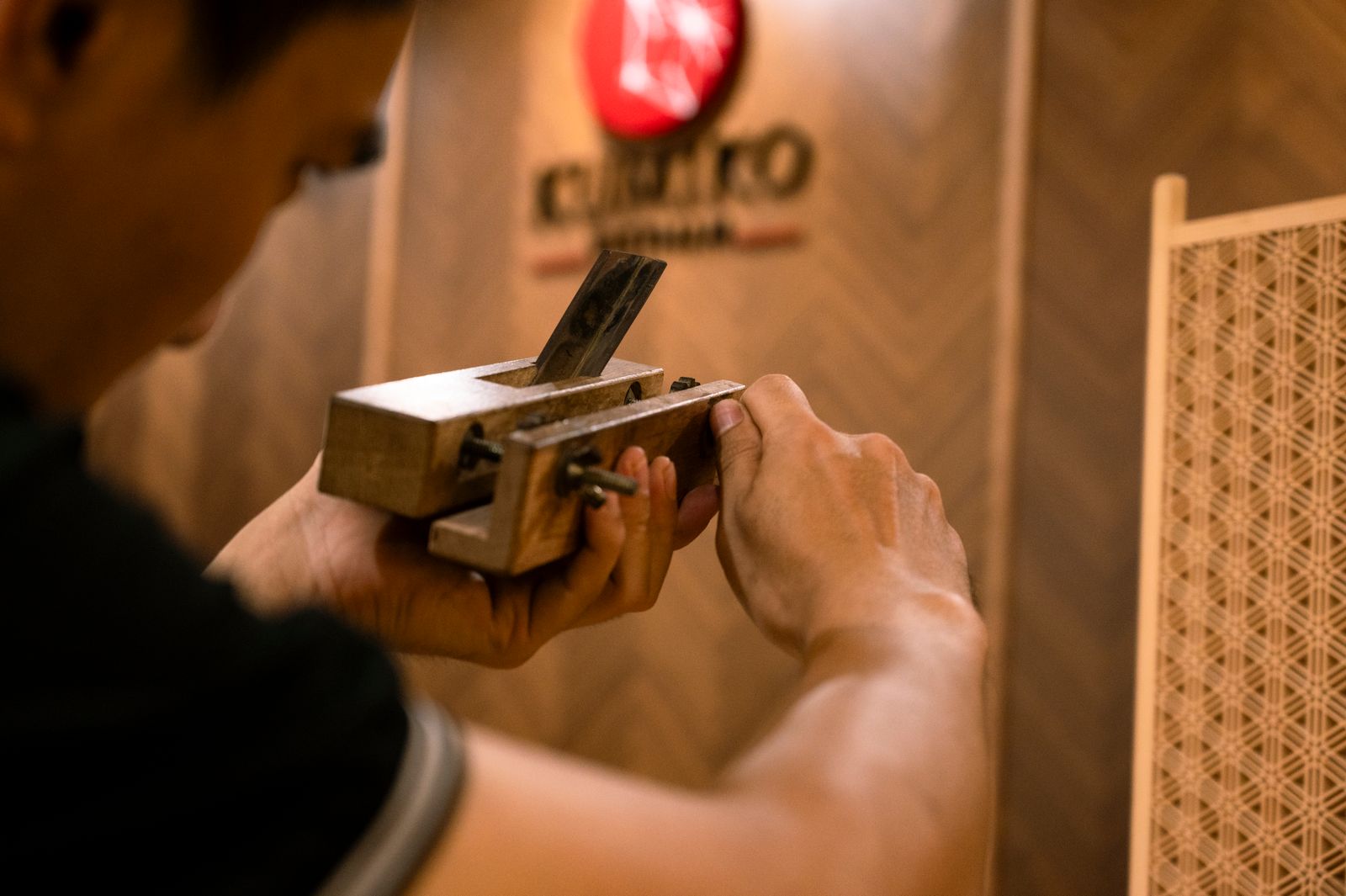
A workday in the workshop moves in stages the way a kitchen does. Somebody is at the log end of the process, reading a slab, deciding where the piece is hidden inside it. Somebody else is at the rough shaping station, taking the slab down to a form. Further along, someone is sanding a bowl that was rough two days ago and is now beginning to look like an object you would want to hold. At the end of the line, the finisher works alone with a rag and the last coats of food-safe finish, doing the quiet work that decides whether a piece feels like a product or an heirloom. Nobody rushes the finisher. The finisher is why the piece will still look good in fifteen years.
Lunch is a small salu-salo. Rice, one ulam, sometimes two, and whoever is not on a delicate cut sits down together. This is not staged. This is what work looks like in a Filipino craft shop and it is how work has looked here for a very long time. The Filipino grammar of eating together does not stop at the front gate of a workshop. It walks in with the workers.
What visitors sometimes expect to see, and what they never see, is drama. A workshop that produces pieces at this level of finish is a quiet place. The loudest thing in the room is usually the belt sander, and even it gets throttled back when someone in the corner is doing detail work that needs concentration. The pace is deliberate. Nobody is being timed. A bowl that needs one more pass gets one more pass, even if the order is technically ready to ship. This is what people mean when they say Kapampangan craft has a conscience. It shows up as the extra pass that no client would have known about if it had been skipped.
The Gorosin bowls get their own bench because their form is unforgiving. A bowl that has to sit in the middle of a table and hold enough for the next person who walks in cannot afford a lopsided rim or a lazy interior curve. The Gorosin bowl set is worked and reworked at that bench until each piece sits flat, weighs right in two hands, and shows the grain the way the grain wants to be shown. Then it goes to the finisher, who does not care what the schedule says.
Why the Workshop Stays
The obvious question, in a country that has watched most of its heritage industries move to Manila and then abroad, is why the workshop is still in Pampanga. Rent is cheaper in the provinces, yes. Logistics is easier near the airport, no. There are honest reasons a business person would choose to move a woodworking operation out. The reasons for staying are less commercial and more essential, and they are worth naming.
The first reason is the people. A Kapampangan carver who has been in the trade for twenty years is not portable. His skill is embedded in a network of other carvers, of tool sharpeners who know his preferences, of suppliers who know which slabs to set aside for him. Move him to a facility in Bulacan or Laguna and half of what makes his work good stays behind. Craft this good is a local ecosystem, not a set of hands.
The second reason is the wood. Pampanga sits inside the practical supply radius for the acacia the workshop uses. Where acacia comes from in the Philippines is a story we tell in more detail elsewhere, but the short version is that acacia trees, mostly rain tree, have been planted throughout Central and Northern Luzon for over a century as shade trees along roads, in old haciendas, on the edges of towns. When one comes down, whether from age, from a storm, or from a planned removal, the timber flows through a network of local suppliers who know which shops will treat it well. A Pampanga workshop is at the center of that network. A workshop elsewhere is at the edge of it.
The third reason is the standard. Every carver in the workshop is measured, whether anyone says it out loud or not, against the retablo of the Betis church and against the woodwork of the family shops that surround them. That standard is a Pampanga inheritance. You cannot pack it into a truck. You cannot rebuild it at a new address. The workshop stays because the standard stays, and the standard stays because Betis stays, and Betis stays because the church is still there and the bloodline is still there and the chisels are still being sharpened by the same hands that were sharpening them when the workshop was built.
A craft capital is a place where the memory of good work is dense enough to hold new work to account. That is what Pampanga is. That is what it has been since long before any of us started making tableware, and it is what it will be long after. The workshop is here because this is where the work is judged. Everything else, the wood, the tools, the orders, the clients, is downstream of that.
You can taste the same instinct in the food. You can see it in the churches. You can hear it in how Kapampangan talk about their own province, which is not humble in the international sense and does not need to be. When your hands have been this good for this long, you stop apologising for saying so. You just keep working, and you let the pieces walk out of the shop to speak for themselves.