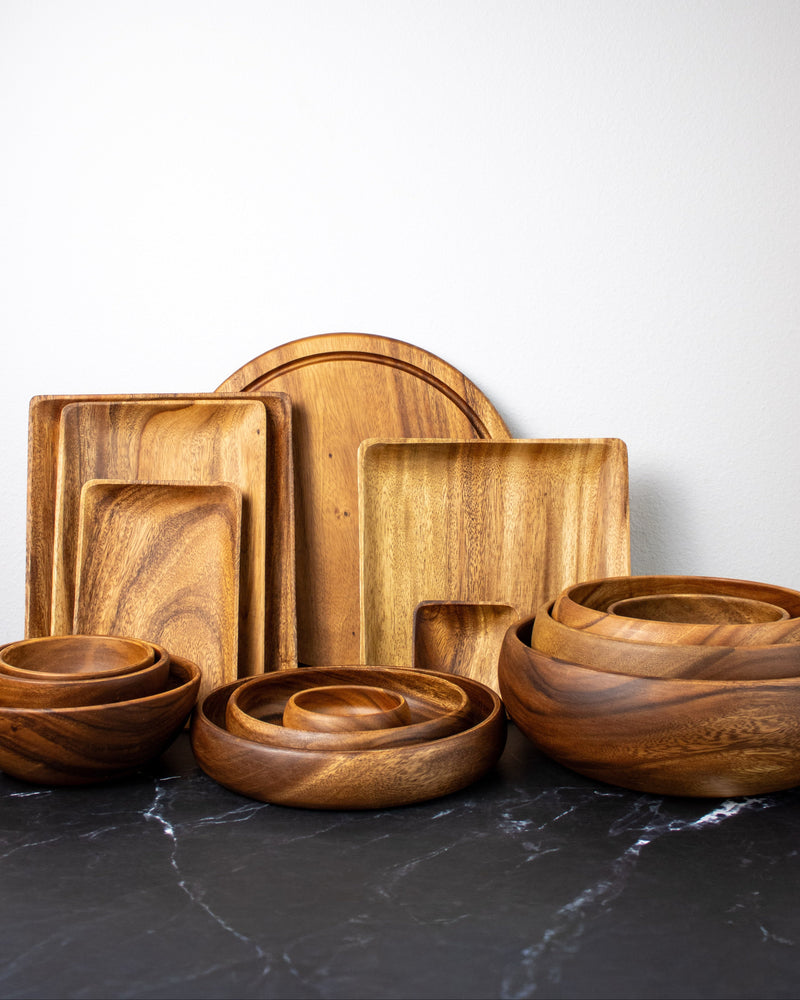
Why shelf storage decides how long your acacia lasts
Most households think of shelf storage as the neutral middle of an acacia piece's life. The interesting moments, we assume, are the wash, the meal, the occasional oiling. The shelf is where the piece rests. In reality the shelf is where it either quietly ages well or quietly fails, and the difference is decided in the first hour after the piece was last used. A bowl that was still slightly cool from the rinse when it went up, on a shelf without much airflow, in a Manila kitchen at 75% relative humidity, is not resting. It is fermenting a small microclimate against its own underside.
Ask any craftsman what actually kills wooden tableware in this country and the answer will surprise you. It is almost never a knife slip, a rough guest, or a dishwasher accident. It is a shelf that was chosen for looks rather than airflow, a plate that was stacked one minute too soon, or a beautiful cabinet that keeps humidity in as effectively as it keeps dust out. The good news is that shelf-storage failures are the most preventable failures in the whole care cycle, because they compound slowly. You have time to notice and correct them.
What "storage failure" actually looks like
The pattern is consistent. A hairline crack that appears along the rim of a plate stored flat on a lacquered shelf. A faint musky smell inside a deep bowl put away in a closed cabinet. A subtle warp on a serving board that spent the rainy season flat against a wall. A dulled, chalky patch on the underside of a piece that was always the bottom of the stack. None of these show up in the first week. They surface at three months, six months, sometimes a year. By the time you notice, the piece has been quietly telling you for a while.
The Manila context, and why generic advice misses it
Most storage guidance you find online is written for kitchens in Northern Europe or the American Midwest, where indoor relative humidity sits around 40 to 55% for most of the year. Metro Manila averages 70 to 85%, and higher during the habagat months from June through September. Wood is hygroscopic, meaning it constantly absorbs and releases moisture until it matches the air around it. What "safe storage" looks like changes completely at these humidity levels. A shelf strategy that works beautifully in a dry climate becomes a mould incubator here, and the reverse is also true: our climate is also why traditional Filipino tableware was almost never stored in sealed cabinets. Our ancestors used open shelves and hanging racks for good reason.
Prep every piece before it touches the shelf
No shelf, no matter how well-designed, can rescue a piece that was put away wrong. The prep is the whole game. Three checks, in order, decide whether a piece is ready to be stored: dryness, temperature, and finish. Skip any one of them and the shelf becomes the problem within days.
Dryness check: the towel is not the last step
Towel-drying a piece is the beginning of the dryness process, not the end. Even a piece that feels bone-dry to the touch will still be releasing surface moisture for the next ten to fifteen minutes as the last of the rinse water evaporates from the pores. Standing the piece upright on edge, on a rack or draining tray, gives both faces air at once and finishes the job the towel started. Only a piece that has stood on edge for at least ten minutes after the towel is ready for the shelf.
A simple test: press the back of your hand against the underside for two seconds. If it feels even a hair cooler than the air around it, the piece is still evaporating and needs longer. Warm, matching room temperature, is the target. This one check prevents about 70% of the storage-related failures we ever see. It is covered in more detail in our daily acacia care checklist, which we recommend pinning inside a cupboard door for the first month.
Finish check: is the piece thirsty?
A finished acacia piece should bead water on the surface, not absorb it. If you can see a wet patch darken the wood and stay dark for more than a few seconds after a rinse, the finish has thinned and the piece is thirsty. Storing a thirsty piece is safe for a week or two, but not for a season. Before any long stretch on the shelf, especially through habagat, give thirsty pieces a light oil rub with food-grade mineral oil or a mineral oil and beeswax blend, then let them rest on edge for a full 24 hours before shelving. This is the same seasoning discipline described in our guide to seasoning a new acacia bowl, applied to older pieces heading into rest.
A pre-shelf checklist you can do in 30 seconds
- Bone dry on both faces, confirmed by hand-back-of-hand temperature match with the room.
- No lingering food smell, especially inside deep bowls where suka or patis may have gone into the pores.
- Water beads, not soaks, when you flick a drop on the surface. If it soaks, oil first.
- No fresh hairline lines at the rim under a strong light. Fresh cracks widen faster on the shelf than in use.
- No damp spots on the base from where the piece stood while drying. Rotate it 90 degrees and let it finish on edge.

The bowl that earns its shelf spot
The Ama bowl is the piece most likely to be in nightly rotation, and the one that most rewards a considered storage habit. Generous for family sinigang, honest for a solo serving of arroz caldo.
Shop the Ama Bowl →The shelf itself: location, humidity, airflow, and light
Once your pieces are prepped, the shelf's job is simple: keep them at stable humidity, out of direct heat, out of direct sun, and with air moving on at least one side. The three most common Filipino kitchen shelves each have a specific weakness, and the fix in each case is small.
The closed cabinet above the stove
This is the single worst place in a Manila kitchen to store acacia. It combines every problem at once: rising heat from the stove baking the underside of the cabinet, no airflow when the doors are closed, and a slow drift of frying oil vapour that settles as a sticky film on any wooden surface. Pieces stored here dry out on top, get sticky on the sides, and warp along the base. If this is currently your acacia shelf, move it. Anywhere else is better.
The open shelf on an outside wall
Outside walls in the Philippines run cooler than interior walls, especially at night, and that temperature difference causes condensation on any surface in direct contact with the wall. A plate leaned against an outside wall on an open shelf can pick up enough overnight condensation to encourage mould on its back within a week. The fix is simple: keep at least 3cm of clear air between any piece and the wall, and never lean flat pieces against the wall itself. A small wire plate stand or a wooden dowel row keeps things off the surface and lets air move behind them.
The lower shelf near the floor
Floors in Filipino homes tend to be tile or polished concrete, which hold cool overnight and release it slowly into the morning air. That cool draft pools on the lowest shelves, which is where humidity is also highest. This is workable, but not for pieces you are trying to preserve. Reserve lower shelves for everyday rice bowls that get used daily and turn over quickly. Anything you want to keep in reserve, or any oiled piece resting between rotations, belongs at chest height or above.
What good actually looks like
The ideal acacia shelf in a Filipino home has three properties: it sits at chest height or above, on an interior wall away from windows and stoves, with at least one open side to encourage airflow. It has no plastic liner underneath the pieces (a bare wood or unglazed ceramic surface is best; sealed lacquer traps moisture at the base). It receives no direct afternoon sun, which fades the wood colour and dries the finish unevenly. And it is checked, briefly, once a month for dust and any pieces that have shifted position.
How to arrange and space pieces on the shelf
Arrangement is where personal preference meets physics. You can arrange acacia in many beautiful ways, but a few rules cannot be broken without paying for it later. All of them come back to one principle: wood needs air.
Spacing: the 2cm rule
Every piece on the shelf should have at least 2cm of clear air around it on every side that is not being stacked. That includes the sides, the back (from the wall), and the front (from the shelf edge, so the piece is not exposed to sudden temperature swings when the door is opened). Cramming pieces edge to edge for the sake of storage capacity is the most common reason wooden tableware in Manila homes ages unevenly, with the interior pieces looking chalky and the exterior ones staying supple. Air is not a luxury for wood. It is part of the finish.
Stacking: when it works and when it hurts
Same-shape, same-size pieces can be stacked, up to three pieces high, if all of the following are true: both pieces are fully dry, both pieces are at room temperature, and the stack has clear air on all sides. Do not stack pieces of different shapes (a bowl inside a plate, for example), because the point contact concentrates stress on a small area of the rim and eventually leaves a mark or a dip.
Never place a paper towel, cloth napkin, or coffee filter between stacked pieces "for protection." This is one of the most common mistakes we see and it comes from good instincts pointed the wrong way. Fabric and paper hold ambient moisture, and once trapped between two wooden surfaces they release it back into the wood in a slow, uneven way that encourages mould on the piece below. If you feel strongly about a separator, use a small self-adhesive felt pad on the underside of each piece. That is the correct answer.
Vertical vs. horizontal, plates vs. bowls
Plates should be stored vertically on edge whenever the shelf allows, in a dish rack or slotted holder. This exposes both faces to air at once and prevents the slow flattening warp that comes from years of a plate lying only on its base. Bowls, by contrast, should be stored upright and open, not inverted. An inverted bowl traps humid air inside its concave interior, and that pocket becomes the last place on the shelf to dry after a humid morning. Upright and open lets the interior breathe.
Serving boards, especially heavy end-grain ones, need to be stored on edge or hanging, never lying flat. Flat storage over months creates a subtle bow along the length as the top and bottom faces dry at different rates. Standing the board on its short edge, or hanging it by a leather loop, keeps both faces exposed to the same air.

A set that stacks beautifully and stores gracefully
The Gorosin bowl set is designed as a nested family of same-shape pieces, which means it stacks safely in threes and stores in a footprint smaller than most single serving bowls.
Shop the Gorosin Bowl Set →Long-term storage vs. everyday rotation
Not every acacia piece in your kitchen needs the same shelf strategy. A rice bowl used every night has different needs from a special-occasion serving platter that comes out three times a year. Confusing the two, in either direction, is why one always ages faster than the other. The everyday piece gets under-cared-for on a rotation shelf, while the special piece gets slowly starved of moisture in a display cabinet.
Everyday rotation: the "warm shelf"
Pieces in nightly or weekly rotation belong on what we call a warm shelf: chest height, open front, close to where the family eats, and generously spaced. These pieces are being oiled by every meal, in a small way, from the natural oils in food. They need less separate oiling but more airflow, because they cycle through wet-and-dry more often. The rotation is itself a form of preservation. A bowl used four times a week ages slower than a bowl used twice a month, as long as the wash-and-dry rhythm is right.
Occasional-use display: the "quiet shelf"
Pasalubong pieces, engraved wedding gifts, heirloom platters, and any piece you use only for fiestas belong on a quiet shelf. This shelf can be higher, further from the kitchen, and behind glass, as long as the glass allows airflow (a plate rack or open-front vitrina is ideal). Quiet-shelf pieces need less checking but more oiling, because they miss the small daily conditioning that everyday pieces receive at meals. A monthly light rub with food-grade mineral oil, and a full oil-and-rest treatment every quarter, keeps them from ever getting thirsty enough to crack. Our guide to displaying wooden tableware at home covers the quiet shelf in more depth, especially for pieces that double as decor.
Seasonal storage: putting pieces away for months
Occasionally you will need to put pieces away completely, for renovation, for a long trip, or because a Christmas or New Year set only comes out once. For any storage stretch longer than four weeks, the discipline changes. Give every piece a full oil-and-rest before storage. Wrap each piece loosely in unbleached cotton (never plastic, never newspaper), leaving the ends of the wrap open so air can still reach the wood. Store the wrapped pieces in a wooden or cardboard box, not a plastic tub. Place a small silica gel packet in the box if your storage room runs above 75% humidity. Check the box once a quarter, briefly, for smell and weight. A box that has grown noticeably heavier has taken on moisture and the pieces should be unwrapped, aired for a day, and repacked.
Bringing shelved pieces back into service
A piece coming off the shelf after months of rest is not the same piece that went up. It has adjusted to the air around it, taken on or shed some moisture, and may have gone a shade lighter or darker depending on the light it caught. Waking it up with a short reawakening prevents the shock that a sudden return to hot rice or a full rinse would otherwise cause. This step takes ten minutes and saves you from the most avoidable failure of all: a piece that survived the shelf perfectly, then cracked the first time it met sinigang.
The four-step reawakening
- Wipe with a dry cotton cloth, both faces, to remove dust and any bloom from the finish. Do not rinse yet.
- Do a water-bead test on a small area. If water beads, proceed to step 3. If water soaks in, apply a light coat of food-grade mineral oil and let the piece rest for 24 hours, then test again.
- Rinse with room-temperature water, not hot, and dry immediately with a cotton towel. Stand on edge for 15 minutes.
- Serve something room-temperature first, not something scalding. A fruit salad, cold cuts, or a bread board is a gentler first assignment than a bowl of piping hot sinigang. After one full room-temperature use, the piece is fully back in rotation.
Signs a shelved piece needs more than a reawakening
Most pieces come off the shelf in good shape. Occasionally one will show damage that accumulated quietly during storage, and it is worth catching before you serve on it. Look for a dulled, chalky underside (thirst, fixable with oil), a fresh hairline at the rim (arrestable with beeswax if caught early), a musky smell inside a deep bowl (surface mould, treatable with a coarse salt scrub and full re-oiling), or a visible bow along a board (partially recoverable by clamping between two flat surfaces for a week with regular oiling in between). If you find any of these, our companion piece on the nine acacia care mistakes everyone makes walks through the specific fix for each.
The rhythm that keeps a shelf healthy for years
The whole shelf strategy comes down to a small set of habits that repeat: prep every piece before it goes up, give it air on the shelf, separate everyday and quiet pieces onto different shelves, and reawaken any piece that has been resting for a while. None of it is difficult. All of it is small. A shelf that follows this rhythm keeps acacia looking almost new for decades, which is the whole reason for choosing it in the first place. Wood that has been well-shelved is wood that gets passed down.

Plates worth shelving well
The Ina plate set stores upright and on edge in almost any dish rack, which is exactly how plates want to live between meals. Same-shape stacking, honest weight, generous rim.
Shop the Ina Plate Set →Frequently Asked Questions
How long can I keep an acacia piece on a shelf without using it?
Indefinitely, if the shelf conditions are right and the piece was properly prepped before storage. We have seen pieces come out of ten-year quiet-shelf rest in beautiful condition. The variable is not time but airflow, humidity, and oil schedule. A well-oiled piece on an airy shelf will outlast a poorly-oiled piece in daily use.
Do I need to oil pieces before storing them?
For anything longer than a few weeks, yes. Give the piece a light coat of food-grade mineral oil or a mineral oil and beeswax blend, let it rest on edge for 24 hours, then shelve. This provides a moisture-stable finish that protects against the small humidity swings of the storage environment.
Can I store acacia in a plastic bin or airtight box?
No. Plastic and airtight containers trap moisture and prevent the small, continuous air exchange that wood needs to stay stable. Use a wooden or cardboard box for seasonal storage, wrap each piece loosely in unbleached cotton, and add a silica gel packet only if the storage room is above 75% relative humidity.
What if my shelf is in a humid room without aircon?
Most Filipino kitchens are exactly this. The fix is airflow, not dehumidification. An open shelf on an interior wall at chest height, with 2cm of space around each piece, handles Manila humidity well for everyday storage. For long-term rest of special pieces, add a silica gel packet inside the storage box and check it quarterly.
Is it OK to stack bowls of the same size?
Yes, up to three pieces high, if both pieces are fully dry and at room temperature. Do not place paper towels or cloth between stacked pieces, because fabric traps moisture. If you want separation, use small self-adhesive felt pads on the underside of each piece.
How do I know a shelved piece has gone bad?
Four warning signs: a chalky, dulled underside (thirst), a musky smell inside a deep bowl (surface mould), a fresh hairline at the rim (drying crack), or a visible bow along a board (uneven moisture loss). Catch any of these early and most are fixable. Ignore them for another season and some become permanent.