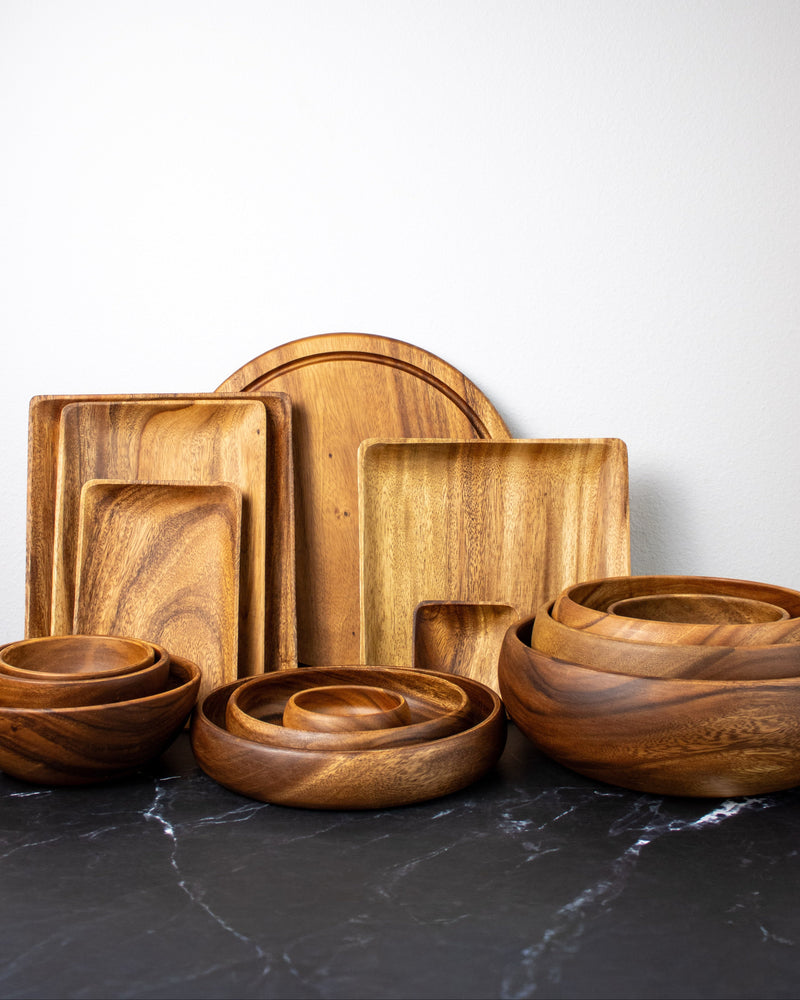
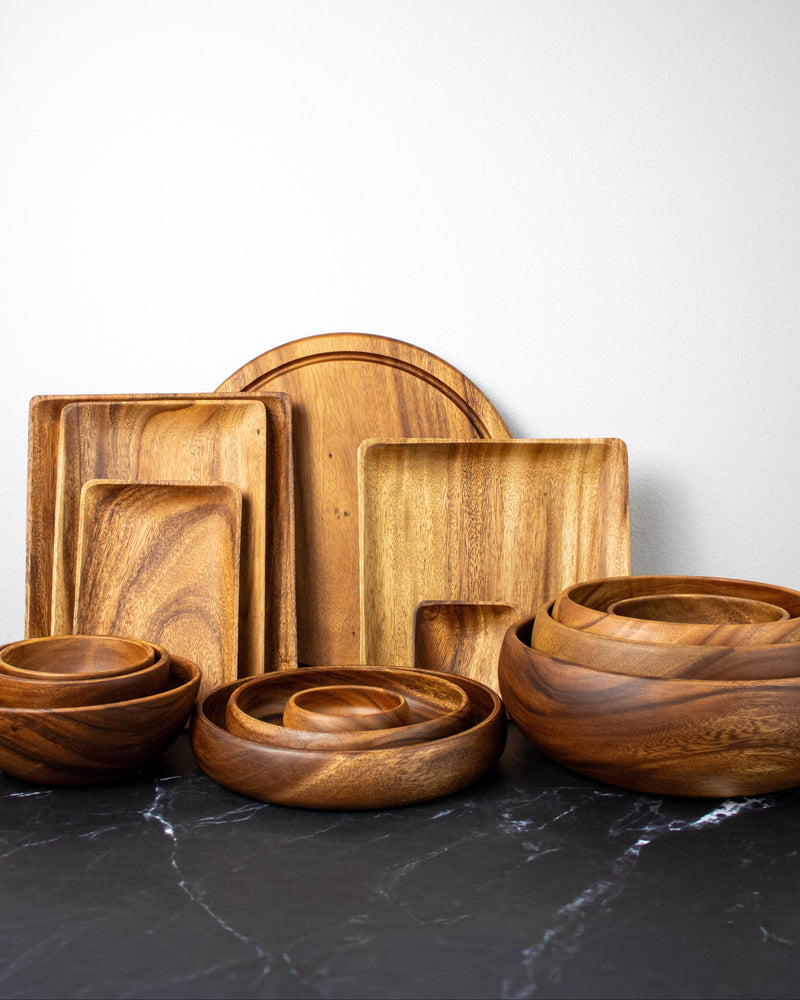
Look up the next time you walk through any Philippine plaza outside the city. The tree throwing the widest shade, the one with branches like an open umbrella over the basketball court and the sari sari store benches, is probably an acacia. It is the tree that taught generations how to take a siesta. It is also, very likely, the same tree species sitting on your table now, sanded smooth, holding rice.
The story of where acacia wood comes from is not a warehouse story. It is a town story. It starts with a tree most Filipinos would recognize from childhood, follows a slow growth cycle measured in decades, and ends in a workshop in Pampanga or Cebu where it gets turned into the bowl you eat from. Worth knowing, if the piece is going to live with you.
The Tree That Shaded the Plaza
Before acacia became furniture, it was canopy. Drive any provincial road from Pangasinan down to Batangas and you pass under acacia. They were planted along streets and old hacienda driveways more than a century ago, and the ones still standing have grown into massive things, trunks two or three arm-spans around, crowns wide enough to shade a jeepney terminal.
Ask anyone who grew up sa probinsya and the acacia is the tree of certain memories. Lunch under the tree on the way home from harvest. Courting on the bench under the tree. The siesta after, when the heat of the day made any other tree feel useless. The acacia closes its leaves at dusk and reopens them at first light, a quiet rhythm that older folks used to read like a clock.
It is also, practically speaking, a wood that wanted to be made into things. Mature acacia gives a dense, heavy, close-grained timber that holds an edge, takes a finish, and resists the kind of warping that ruins a board after one wet season. The same tree that gave shade gives bowls. That is not coincidence, that is fit.
Not One Tree, But a Family
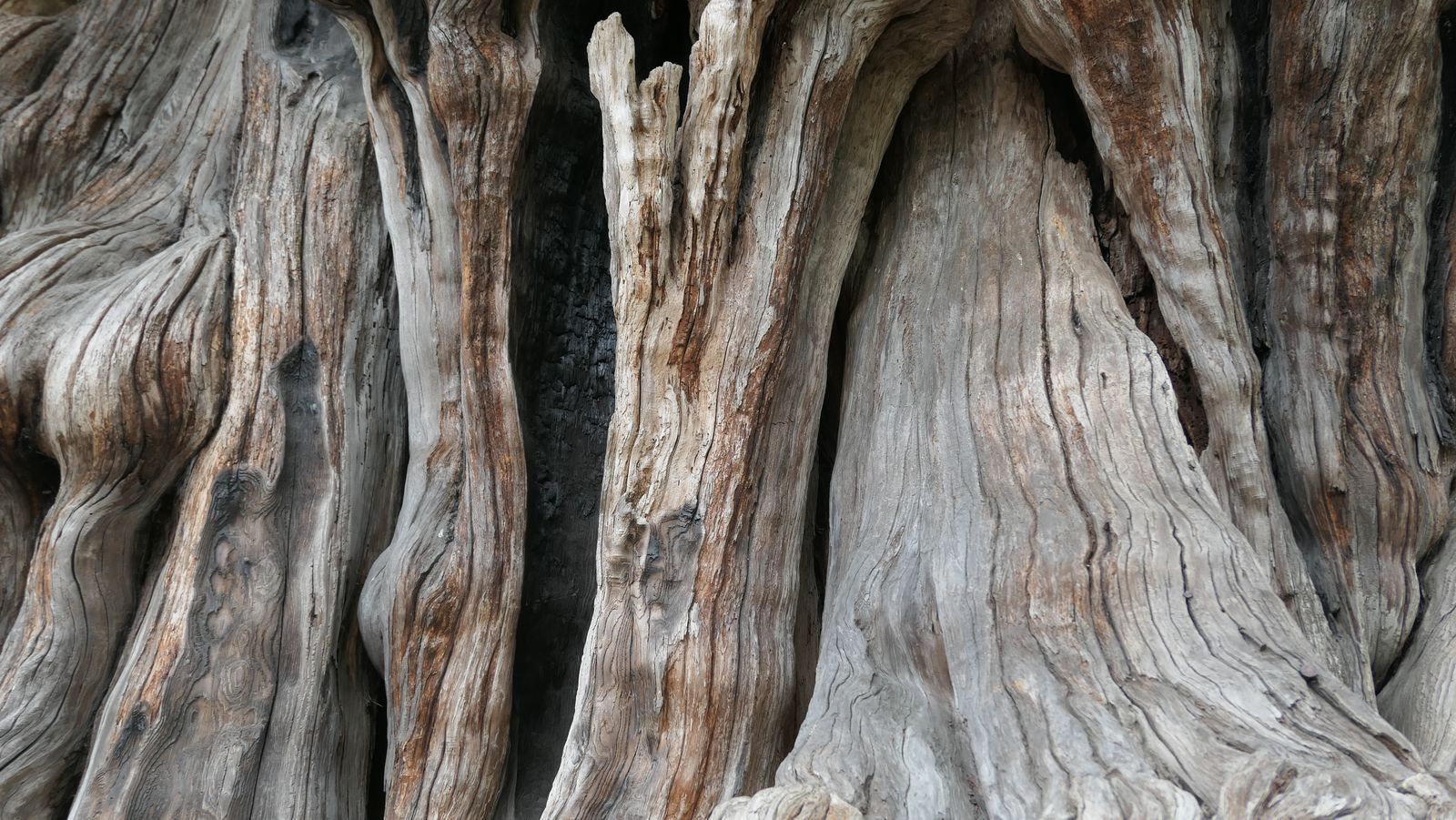
When we say acacia in the Philippines, we usually mean one specific tree: Samanea saman, the rain tree. That is the big, umbrella-shaped one in the plaza. There is a botanical asterisk worth mentioning. Samanea saman was once classified under the Acacia genus and has since been moved out of it. Scientifically, it is no longer a true Acacia. In the trade, the kitchen, and everyday speech, it is still acacia, and that is what nearly every Filipino tableware maker means when they label a piece.
There are also two cousins worth knowing. Acacia mangium and Acacia auriculiformis are true Acacia species, planted in commercial plantations across Mindanao and parts of the Visayas for pulp and timber. They grow faster than rain tree and are common in reforestation contracts. You will sometimes see their wood in lower-cost mass-produced bowls and boards.
The serving pieces in most Filipino heritage tableware, the kind meant to outlast a couple of decades and earn its scratches honestly, are almost always Samanea saman. It is the slower wood, the denser one, the one that came from a tree you might have actually sat under.
How Acacia Came to the Philippines
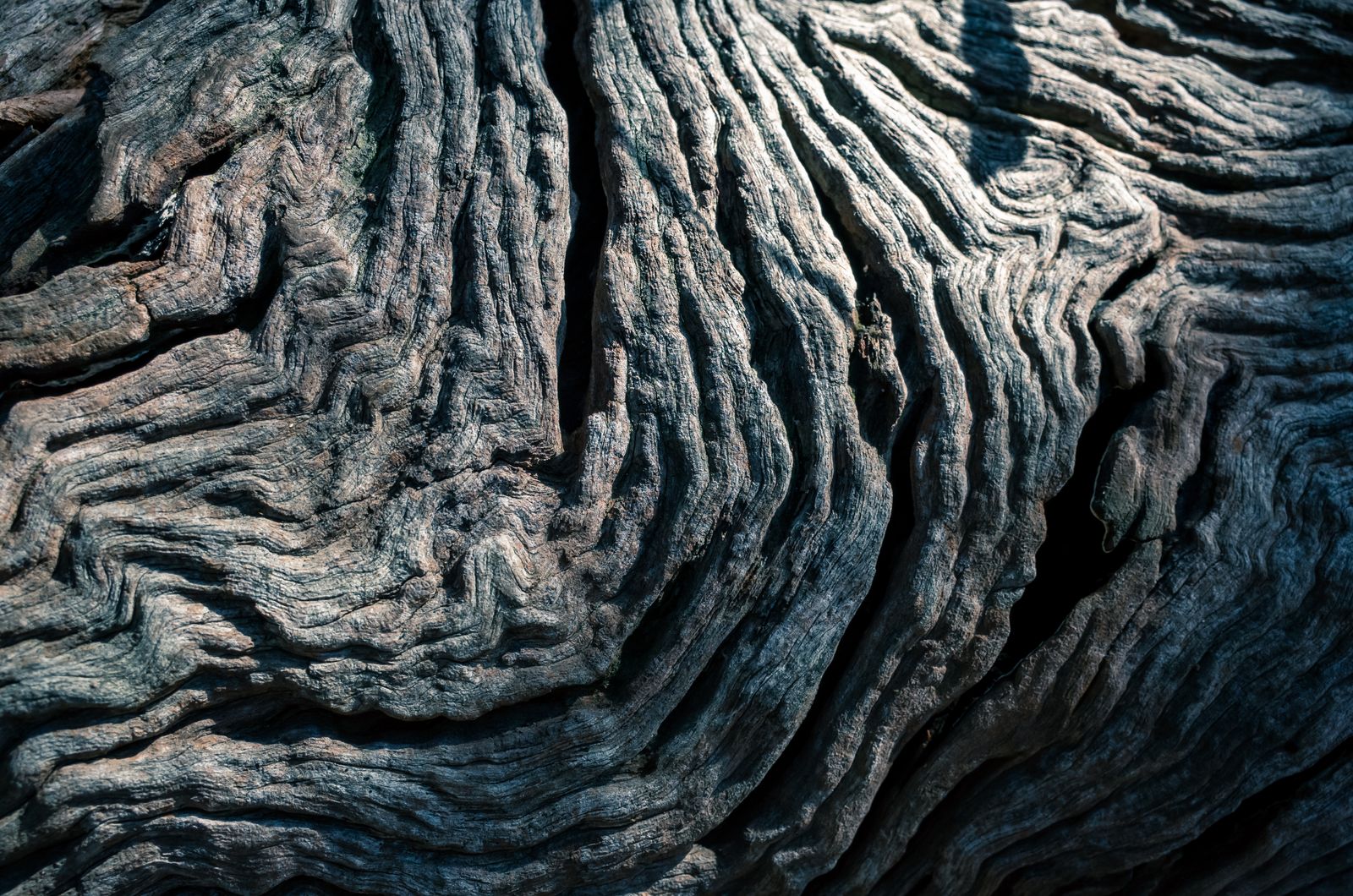
Acacia is not originally Filipino. Samanea saman is native to Central and South America, and the version we know was introduced to the Philippines in the late 1800s, brought in for shade and ornamental planting along streets and estates. It naturalized fast. The climate suited it, the soils suited it, and within a generation or two it had spread along town roads and provincial highways from Ilocos down through Mindanao.
The American period accelerated the planting. New schools, new municipal halls, new public parks: all of them got acacia along the perimeter, the way another country might plant oaks. By the time anyone born after the war was old enough to notice, the acacia was already part of the landscape. Nobody asked where it came from. It was just there, throwing shade.
That is how a foreign tree becomes a local one. Not through a decree but through a hundred years of people sitting under it, courting under it, sleeping under it. The acacia became Filipino the same way pancit became Filipino, the way the word "kape" became Filipino. Long enough to belong.
"The wood remembers the tree. You can see it in the grain when you cut a board the right way. That swirl, that dark streak, that is where a big branch used to be. You are working with the tree's history, not raw material."
The Harvest Cycle, the Slow Part
An acacia tree takes its time. From sapling to a trunk wide enough to be milled into furniture-grade slabs, you are looking at fifteen to twenty-five years, sometimes longer for the largest plaza specimens. That length is the reason responsible acacia harvest is structured in cycles, not in clear-cuts. You take the mature trees, you leave the younger ones to grow into their place, and you wait.
A large share of the acacia used in Filipino tableware comes from legal salvage. Old roadside trees that have outlived their usefulness as shade and become a hazard during typhoons. Storm-fallen giants brought down by Yolanda or one of the other named storms that have come through since. Trees that local government units have cleared for road widening. The trunk does not go to waste. It goes to a mill, then to a workshop, then eventually to a table.
This matters because acacia, the rain tree variety, is not a plantation crop in the way mangium is. It cannot be farmed in five-year cycles. Every Samanea saman bowl on a Filipino table was once a tree that lived through several presidencies. If you want a longer look at how that supply chain actually works and what the sustainability tradeoffs are, we wrote a closer piece on whether acacia is a sustainable choice in is acacia sustainable. It is the honest version, not the marketing version.
From Trunk to Workshop in Pampanga and Cebu
Once a trunk reaches a mill, the work shifts from agriculture to craft. The two regions where most Filipino acacia tableware is finished are Pampanga, north of Manila, and Cebu, in the central Visayas. Both have furniture and woodworking traditions that go back generations, and both have workshops that can move from rough lumber to finished piece without the wood ever leaving the country.
The process is slower than most buyers imagine. A slab is air-dried for weeks, sometimes months, to bring the moisture content down to where it will not split later. Then it is cut to rough size, mounted on a lathe for bowls or run through saws and planers for plates and boards. A bowl gets turned by hand on a spinning chuck, the maker shaping it down with a chisel while it rotates, watching the grain emerge. A board gets cut, jointed, sanded by hand through progressively finer grits until the surface feels like skin.
The finish is the last and most important step. Food-safe finishing for acacia in the Philippines usually means a mineral oil and beeswax blend, applied warm, wiped in, left overnight, repeated. No varnish, no plastic coating. The wood stays open enough to be cared for at home with the same oil. If you want the full walk-through of that workshop side, from rough slab to finished piece, we covered it in how acacia becomes tableware.
What a Pampanga workshop looks like
A typical Pampanga workshop is a covered shed with a concrete floor, a few lathes lined up against one wall, racks of drying timber along another. The makers are usually older, in their fifties and sixties, trained by fathers and uncles who did the same work. The pieces that come out of these workshops, including a heavier serving board like the Pamilya board set, are turned and finished by the same pair of hands from start to end. There is no assembly line. There is one person, one piece, one day.
Why the Grain Looks the Way It Looks on Your Bowl
Pull an acacia bowl off the shelf and look at the surface. You will see streaks of warm caramel running into dark chocolate brown, sometimes with a pale cream band along one edge. That is not a design choice. That is the tree.
Wood from any tree has two parts that matter for color. The heartwood, the dense inner core, is the dark one. It is the older wood, packed with extractives, and it is what gives acacia its rich brown tones. The sapwood, the outer ring closer to the bark, is the pale one, almost cream colored when fresh. When a maker mills a slab from a trunk, both end up on the same board. The dark, the light, and the streaky transition in between are all from one piece of one tree.
This is why no two acacia bowls match, and why we do not pretend otherwise. A serving piece like the Gorosin bowl set arrives with grain that no photograph could promise in advance. The dark river of heartwood that runs across one of the bowls came from the part of the trunk that grew closest to the pith. The light edges came from closer to the bark. They are siblings, not copies.
The same logic applies to plates. A set like the Ina plate set shows a quieter grain pattern because plates are cut flatter and from outer slabs, but the variation is still there if you look. We sometimes get a question about whether the streaks are stain or finish. They are not. The finish is clear oil. The color comes from the tree.
If you ever want to spend some time scrolling through what that variation actually looks like across a real set, our acacia bowls collection is the easiest place to see grain side by side. For the broader picture, including how to care for the wood once it is in your kitchen, the complete acacia wood guide is the hub we point people to.
The provenance story matters because it changes how a piece sits in your kitchen. A bowl from a generic warehouse is a thing you own. A bowl from a tree that grew for twenty years in a Philippine plaza, was milled by a family business in Pampanga, and was turned by hand by a maker who has been doing this work since the eighties, is a thing you live with. Same bowl. Different weight.