

The Word for a Full Table: What Salu-Salo Means
Before salu-salo was a noun for a gathering, it was a verb you did with your hands. The root, "salo," means to catch. To cup your palms under something falling and keep it from hitting the ground. To share a single plate of food and eat from it together, so that no one is alone at the bowl. The word holds both motions at once. You catch what is offered. You share what you caught.
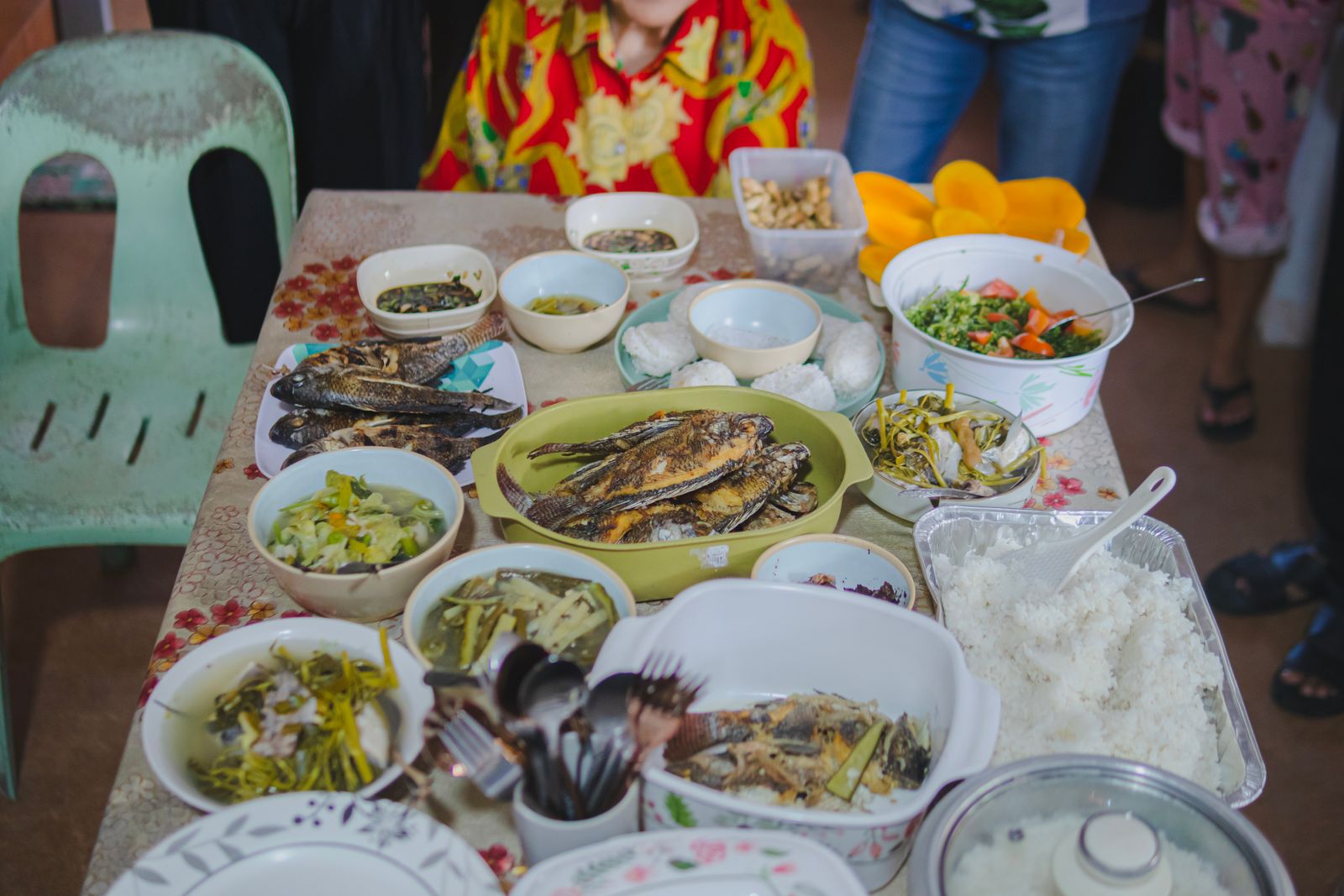
That is why, when a Filipino home calls a meal a salu-salo, the word is doing more than naming the event. It is naming the posture. Plates set close together. A pot of rice that is allowed to outlast the appetite. Chairs pulled in even after the table looked full, because someone arrived, and arriving is reason enough to set another place.
There is a small habit in most Filipino kitchens that gives the whole philosophy away. The rice cooker is almost never sized to the household. It is sized one or two cups bigger than the household needs, every single day, for no announced reason. Ask a tita why and she will shrug and say, "baka may dumating." In case someone comes. Not a specific someone. Just someone. The rice is not extra. The rice is the door, propped open in cooked form, waiting.
A salu-salo, then, is not only the planned feast at a christening or a birthday or a homecoming. It is also the Tuesday lunch that turned into a gathering because two cousins dropped by on the way back from the market and stayed, and the adobo stretched, and someone ran out for more pan de sal. The word does not distinguish between the planned and the accidental. In Filipino hospitality, the distinction is barely meaningful. A meal becomes a salu-salo the moment a second hand reaches into it.
This is the first thing the word teaches. The table does not start full. It becomes full because people keep arriving and the people already seated keep making room.
Pakikisalo: To Join the Meal, Not Just Be Served
If salu-salo is the shape of the table, pakikisalo is the act of stepping into it. The prefix "paki" turns "salo" into something you do with someone. To join in the catching. To take part in the sharing, not as an observer, not as a guest being served, but as one more pair of hands around the same bowl.
Filipino psychologist Virgilio Enriquez, who built the framework of Sikolohiyang Pilipino, placed pakikisalo on a ladder of social interaction that begins at polite distance and climbs, rung by rung, toward kapwa: the recognition that the other person is, in some essential sense, one of your own. Pakikisalo sits high on that ladder. It is not small talk. It is not a transaction. It is the moment a host stops being a host and a guest stops being a guest because they are now eating the same food off the same surface and reaching for the same bowl of sawsawan.
"To eat together is to stop being a guest."
The everyday gateway into pakikisalo is two words you have heard a thousand times if you have ever stood near a Filipino at lunchtime: "kain tayo." Let us eat. Said without preamble, often without making eye contact, sometimes hollered over a shoulder to a neighbor walking past the gate. It is not a formal invitation. It is a reflex. The food is on the table, so the invitation is on the table. To not extend it would feel like leaving a sentence unfinished.
What is often missed by outsiders is that "kain tayo" is genuinely offered, and the acceptance of it is genuinely meaningful. The polite Filipino response is to demur once, twice, maybe three times, and then sit down. Refusing outright is not rude in the abstract, but it does decline something specific. It declines the offer to become, for the length of one meal, kapwa.
This is why feeding a visitor in a Filipino home rarely feels like service in the hospitality-industry sense. The host is not performing a role for a customer. The host is widening the circle. The food is the seam where the widening happens.
One Spread, Many Hands: The Shape of Communal Eating
Walk into a Filipino salu-salo and the first thing you will notice is geometry. The food is in the middle. Bowls of sinigang, a platter of lechon kawali, a mound of garlic rice on a wide wooden board, sawsawan in small dishes tucked between the bigger ones. The plates of the people eating are smaller than the plates of the food. The center of the table is heavier than the edges. That is not a styling choice. That is the practice telling you what it values.
Western fine dining puts the food in front of the eater, portioned, plated, complete. The act of eating is a solitary transaction with a chef who has already decided how much you get. Filipino communal eating reverses the geometry. The chef, often a lola or a tita, sends the food to the center. The eaters decide, in real time, how much they take, when to take more, when to push the dish toward someone who has not had any yet. The meal is a negotiation, not a delivery.
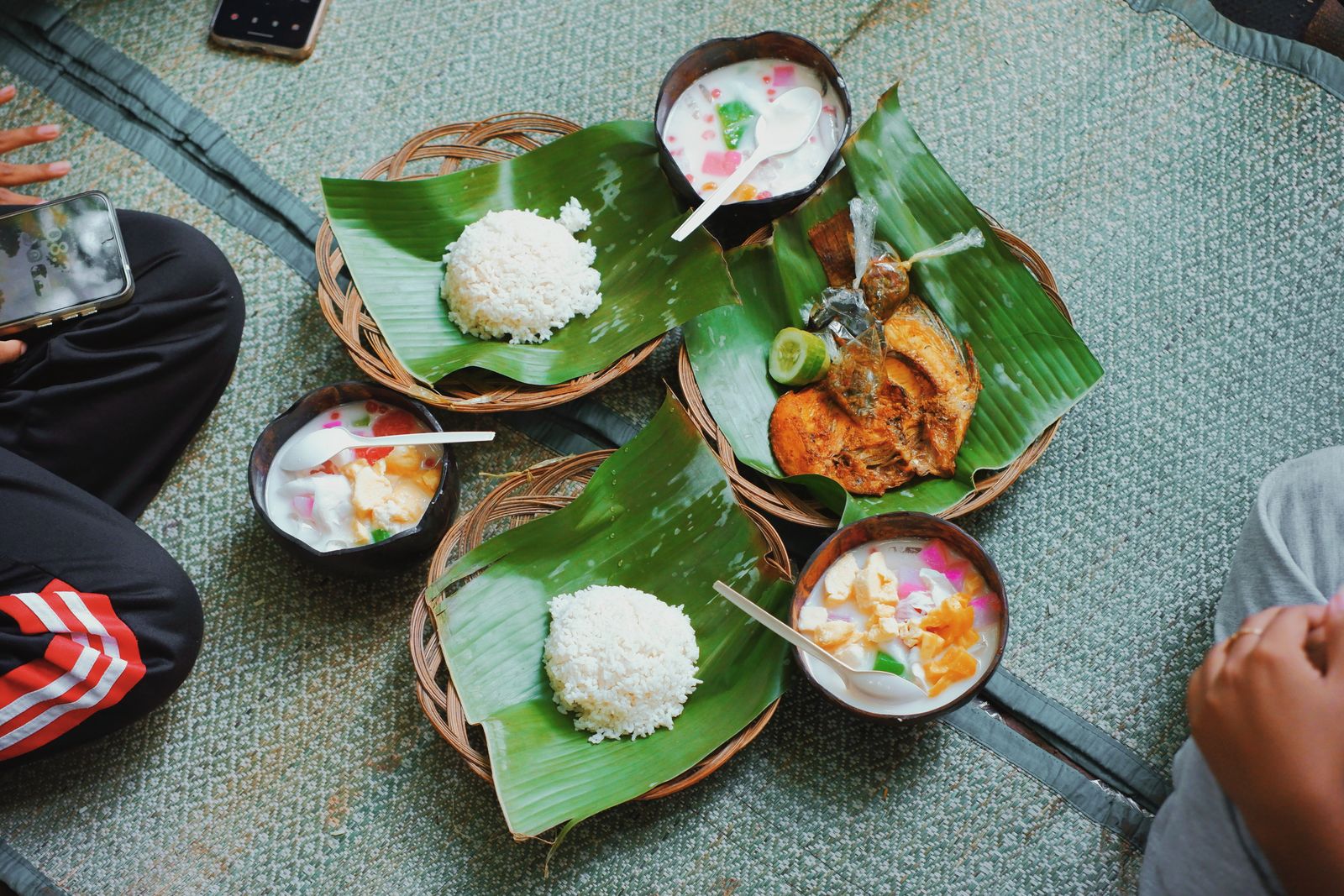
That negotiation lives on a continuum. On the quiet end is the everyday family table, where two ulam and a pot of rice are enough and the salu-salo is so familiar nobody calls it that. In the middle sits the handaan, the prepared spread for a birthday or a homecoming, where the dishes multiply and the relatives arrive in waves. At the loud, bright end is the fiesta, where whole neighborhoods cook for whole neighborhoods, and at the loudest, brightest end is the boodle fight, where the plates disappear entirely and the food is laid directly onto banana leaves so that nothing stands between the hands and the meal.
The whole continuum is salu-salo. The boodle fight is not a separate tradition. It is salu-salo with the architecture stripped down to its bones, so you can see what the bones were doing all along.
This is also where the surface starts to matter. A round dining table with eight individual placemats trains the hand to stay in its own square. A long wooden board, a wide shallow bowl, a platter built to be reached over, all train the hand to travel. The pieces shape the gathering. Pass food around a tight grid and the meal stays polite. Lay food across a generous shared surface and the meal becomes a conversation between hands. This is one of the reasons our Gorosin bowl set was designed at the size it was. Not so each person could have one of their own, but so the bowl in the middle could hold enough for the next person who walked in, and the next, and the next.
You can read more about how those surfaces evolved in the broader landscape of Filipino dining traditions, where the connection between the form of the tableware and the practice of communal eating is older and more deliberate than it looks.
Hospitality as Loob, Not Performance
There is a Tagalog word that the language of hotel marketing has no real translation for: loob. Literally, the inside. Spiritually, the inner self, the disposition, the moral interior of a person. Filipino hospitality, properly understood, does not flow from a script. It flows from loob. It is what a generous interior looks like when it is set in motion by the arrival of another person.
This is why the gestures of Filipino hospitality can look, to an outside eye, almost excessive. The lola who refills the rice on your plate without asking, because she has decided you have not had enough. The tito who keeps pushing the platter of lechon toward you long after you have said you are full. The cousin who insists you take home a Tupperware of leftovers that is larger than the meal you just ate. None of this is performance. None of it is the family putting on a show. It is loob doing what loob does. It is the inside pouring outward through food.
"You do not host a salu-salo. You start one, and it grows."
Feeding, in this frame, is not the obligation of the host. It is the medium of care. A Filipino grandmother who is worried about you will not say she is worried about you. She will fry you another piece of fish. A father who is proud of his daughter will not deliver a speech. He will reserve the best part of the lechon, the cheek with the most crackling, and he will put it on her plate without comment. The food is the sentence. The food is also the punctuation.
This is the same impulse that powers pasalubong, the gift you bring back from somewhere. Pasalubong is not a souvenir in the tourist sense. It is loob reaching across the distance of a trip. Whoever you were thinking about while you were away gets a small edible proof that you were thinking. The salu-salo, in other words, does not end when the meal ends. The salu-salo follows you to the airport, into the bag, across the ocean, into someone else's kitchen. It is a long meal with intermissions.
The everyday version of this is the heirloom plate. The wide, slightly worn wooden serving piece that lola used for her kare-kare and that gets brought out, decades later, for the apo's first big handaan. The plate is not just an object. The plate is a vehicle for loob across generations, which is part of why we think about pieces like the Ina plate set as future heirlooms rather than current products. The food that will get served on them has not been cooked yet. The meals they will witness are still being scheduled. The loob they will carry belongs to a generation that has not been born.
If you want to see how the food itself does this work, the older dishes are the most fluent at it. Adobo, kare-kare, sinigang, kaldereta, the slow, generous, ladle-friendly dishes that were built to be shared from a single pot. We wrote a longer piece on the Filipino dishes that wooden tableware was practically designed for, and almost all of them have one thing in common. They were not invented to be plated. They were invented to be served.
Salu-Salo Across Oceans
The hardest test of any cultural practice is what survives the diaspora. The Overseas Filipino Worker, the second-generation Fil-Am cousin, the auntie who has been in Dubai for twenty years, the family in Vancouver where the youngest grandchild has never set foot in the Philippines. Salu-salo, somehow, makes the trip. Not unchanged, but unmistakable.
The diaspora kitchen tends to be smaller than the Manila kitchen. The condo in Dubai is not the lola's house in Pampanga. The two-bedroom in Daly City is not the family compound in Iloilo. The dining table seats six on a good day. The freezer is constantly running out of room. And yet, by some quiet feat of geometry, the spread still spreads. The pancit fits. The lumpia fits. The lechon, if there is a lechon, fits. The salu-salo expands to the size of the room that is hosting it.
What gets adapted is the architecture. What does not get adapted is the principle. The principle is that food, on a Filipino table, is for sharing, and the table is for joining, and a guest who eats from the same bowl as you is no longer, strictly speaking, a guest. So the Filipino diaspora invents workarounds. The potluck salu-salo where four families bring four ulam. The condo-sized boodle fight on the living-room floor because the dining table cannot stretch. The Sunday spread that runs from noon to night, with people drifting in after church and people drifting out before the late shift.
One thing the diaspora has done is given the wooden serving piece a second life. In the Philippines, a wide acacia bowl might be one of many serving pieces in a household kitchen, easy to take for granted. Abroad, the same bowl becomes the centerpiece. It is the object that says, without saying, that this small apartment in a foreign city is still, somehow, a Filipino table. The bowl is the flag. It is also the inheritance. It is the thing the youngest child will ask for, one day, after the grandparents are gone.
This is what makes the question of materials less precious than it sounds. The bowl is not load-bearing because it is acacia. The bowl is load-bearing because it has held two decades of sinigang and three Christmas Eves and one wedding rehearsal dinner and at least one reconciliation. The wood is the witness. The wood is also the proof that the salu-salo was here, in this kitchen, in this country, in this generation that emigrated and still set the table the way their mothers did.
Diaspora salu-salo is not a smaller version of the Manila original. It is the same practice, dressed in the clothes of a new climate. The dishes are the same. The reflex is the same. The "kain tayo" is the same. Even the leftover Tupperware, pressed into your hands as you are putting on your coat to go home, is the same.
Setting a Table Made for Joining
If you have read this far, it is probably because some version of this practice already lives in your kitchen. You may not have called it salu-salo. You may not have known that the warm reflex you have around feeding people had a Tagalog name and a place in a fifty-year-old framework of Filipino social psychology. But the reflex is there, and now you have language for it, which is its own kind of homecoming.
The practical question, once you have the language, is what to do with the table. Not in a styling-for-Instagram sense. In a does-this-surface-help-or-hinder-the-practice sense.
A salu-salo table does not need to be expensive, ornate, or matched. It does need to be honest about its purpose. The serving pieces should be sized for sharing, not portioning. The bowl in the middle should be deep enough to hold enough for the unexpected arrival. The board should be wide enough that the lechon does not have to be carved off-stage and re-plated. The everyday plates should be small enough that people are encouraged to come back for seconds, because seconds are when the conversation actually starts.
This is also why so many Filipino households end up keeping a few specific pieces of wooden tableware in rotation. Acacia in particular has the right size, the right warmth, and the right willingness to be passed across a table without sounding like cutlery on porcelain. A wide acacia bowl absorbs the noise of communal eating. A long acacia board lays out a salu-salo without imposing a grid. The pieces do not get in the way. That is the highest compliment you can pay a serving piece in a Filipino kitchen.
The most common question we get from younger Filipinos starting their first households, whether in Quezon City or in Toronto, is how to begin. Which pieces matter. What earns its keep on a small table. We built our family hosting set with exactly that question in mind. Not as a complete dining set, because no salu-salo is ever really complete, but as the working core. The bowl that will hold the kare-kare. The board that will carry the inihaw. The pieces that will, over years, accumulate the marks of the meals they witnessed and become the heirloom the next generation asks for by name.
The point is not the set. The point is the table the set makes possible. A table where the food is in the middle. A table where "kain tayo" is reflexive. A table where the rice cooker is one cup too big, just in case. A table where the visitor stops being a visitor by the second helping. A table where loob has somewhere to land.
That is the inheritance. Not the wooden bowl, exactly. The practice of catching what is offered and sharing what you caught. Salu-salo and pakikisalo are not finally about food. They are about the social architecture that food lets us build. The bowl is the scaffolding. The meal is the building. The people who keep arriving are the reason the building stands.
Set the table for joining, and the joining tends to happen. Set it for portioning, and the portioning tends to happen instead. Filipino hospitality, in its quiet, ungimmicky way, has been making this decision for centuries. The least we can do, as the next ones at the table, is make it on purpose.