Adobo is the dish that shows up more often than any other on a Filipino table. It is on Tuesday nights, in packed lunches, at handaan, in balikbayan boxes, and at fiesta tables that stretch the length of a driveway. Because it is everywhere, the question of how to serve it does not usually get asked. It just gets answered by habit. But the habit is worth examining. The way an adobo is set on the table shapes how it is eaten, how the sauce reaches the rice, and how the meal reads to whoever is joining you at it. This guide is about the two modes adobo lives in at Filipino tables, the daily kainan and the heirloom spread, and the wooden vessels that carry each one well.
The Two Modes of Adobo, and Why the Table Follows the Sauce
Adobo is not one dish. It is a category of dishes that share a technique, braising meat in vinegar, soy or salt, garlic, bay, and peppercorns, and then reducing the liquid to a coating. Within that category, every household has its version, and every region has its accent. What matters for the table is not the recipe. It is the sauce. The volume, the color, and the texture of the sauce decide the shape of the vessel it belongs in. Everything else follows from that.
The two modes
On any given week, adobo will appear in a Filipino home in one of two modes. The first is the daily kainan mode: a single plate or shallow bowl per person, the meat spooned over rice, a small dish of extra vinegar on the side. The second is the heirloom mode: a large batch cooked to feed twelve or twenty, served in a wide serving bowl or ladled onto a boodle spread as one of several ulam. The two modes need different vessels, different quantities, and different table logic. A guide that treats them as the same misses what makes adobo the workhorse of the Filipino table.
Why wood carries adobo well
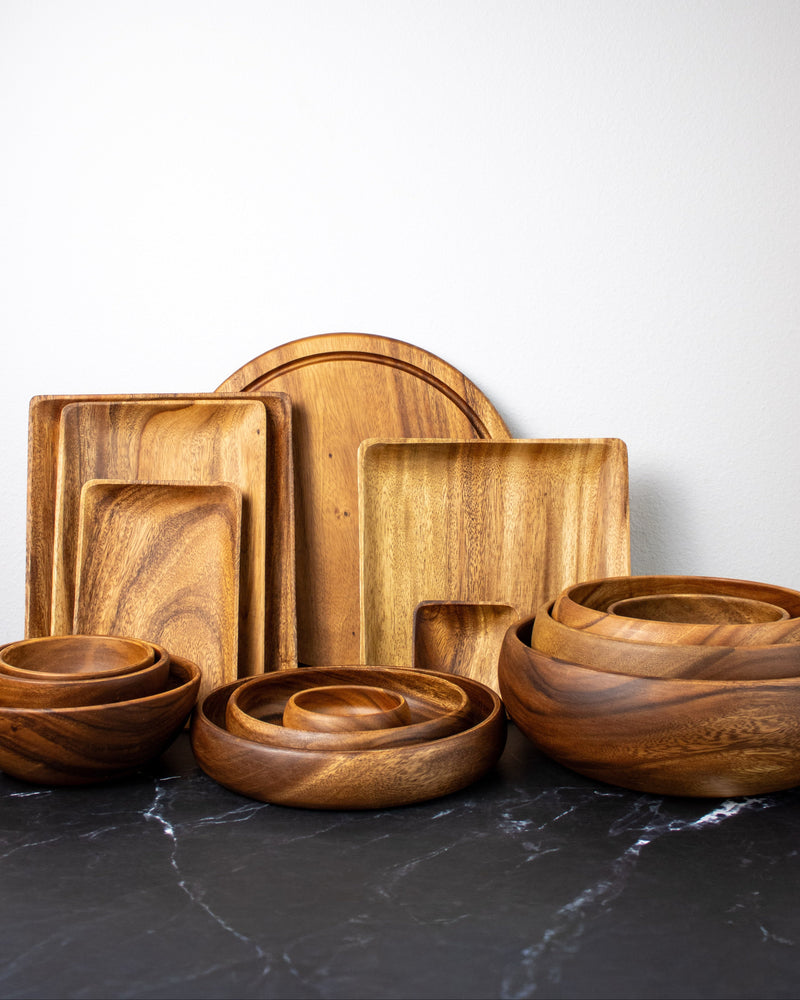
Adobo's palette is soy-brown, garlic-gold, bay-green flecks, and vinegar shine. Ceramic tends to flatten this palette into something colder than the dish actually is. Wood reads in the same warm register as the sauce. The acacia grain sits behind a piece of pork with the same tone as the reduction pooled around it, and the meal ends up looking like itself instead of a food-styled version of itself. The pairing logic is not decorative. It is why adobo has always looked right on a wooden surface, from the palayok resting on a wooden board to the modern shallow bowl on a weeknight table. For a wider look at how Filipino dishes pair with wood by shape and sauce, our companion piece on Filipino dishes and the wooden vessels that suit them walks through ten of the most common cases.
The Everyday Adobo Table: Weeknight Kainan
The daily adobo is the one most Filipino households know best. It is the leftover from Sunday that becomes Monday lunch, the quick batch the yaya cooks on a Wednesday, the batch a lolo makes on a Saturday morning and then leaves on the stove all day because adobo is better after resting. The weeknight table for adobo is small, quiet, and built around three pieces per person.
The three-piece setup
The everyday adobo table is: one shallow bowl or wide-rim plate for the meat and its sauce, one flatter plate or plate-section for rice, and one small dish for extra suka with siling labuyo or crushed garlic. Some households combine the first two into a single wide bowl with the rice on one side and the meat spooned over the middle. Both work. The reason to separate them is that not everyone wants sauce on their rice from the first bite, and separating gives each person control over how much reduction ends up on the grain. The reason to combine them is efficiency, especially for a table of two, and the small pleasure of watching the sauce find the rice on its own.
Plating for one, two, or four
For a solo dinner, one wide acacia bowl covers everything. Rice on one side, adobo on the other, sawsawan in a tiny dish tucked beside it. For a pair, two matching bowls, or two plates and a small shared bowl for the meat so both eaters can serve themselves. For four, the logic shifts slightly. Instead of pre-plating individual servings, cook the batch a little larger, bring the pot or a shared serving bowl to the table, and let each person take what they want. This is the transition point where the daily table starts to behave like a family table, and the pieces you own should support that transition without ceremony.
Rice is not a side, it is the frame
The rice does more work than people give it credit for on an adobo plate. It absorbs the sauce, it slows the vinegar's edge, it gives the pork somewhere to sit. Undersizing the rice serving is one of the more common weeknight mistakes. For an average adobo dinner, plate rice first, mound it slightly higher on one side, then set the adobo down beside it so the sauce runs into the mound rather than around it. The plate reads as a meal from the first look, not as a plate with pork and a scoop of rice next to it.

The plate for the weeknight rotation
The Anak plate set is sized for the everyday adobo dinner, with enough rim to hold rice on one side and the meat on the other.
Shop the Anak plate set →
The Heirloom Adobo: Fiestas, Salu-Salo, and the Kamayan Spread
The other mode of adobo is the one that shows up when the household is expecting company. It is the batch cooked in the largest kaldero the kitchen owns, simmered longer, seasoned bolder, and set on a table that has already been extended with the extension leaf. This is the adobo of the salu-salo, the fiesta, the reunion, and the balikbayan homecoming. The vessels change, the quantity changes, and the eating format shifts from individual plating to a shared spread.
Adobo as one of many ulam
At a salu-salo, adobo is rarely the only main. It sits alongside lechon, pancit, kare-kare, lumpia, and rice, and it plays a specific role: the anchor ulam that everyone already knows they love. Because it is anchor rather than centerpiece, the serving bowl for a shared adobo should be substantial without dominating the table. A wide, deep wooden bowl with a four to five centimeter wall, placed roughly central, is the right shape. It should hold enough for a table of eight to twelve to return for seconds, and it should let people spoon the sauce out cleanly without chasing the last of it up the side. The reasoning behind serving several ulam this way, the shared bowls, the pass-around rhythm, the deliberate abundance, is rooted in what our piece on salu-salo and pakikisalo calls the shared-meal ethic. Adobo fits it because it holds well, reheats well, and gets better as the meal goes on.
Adobo on a boodle spread
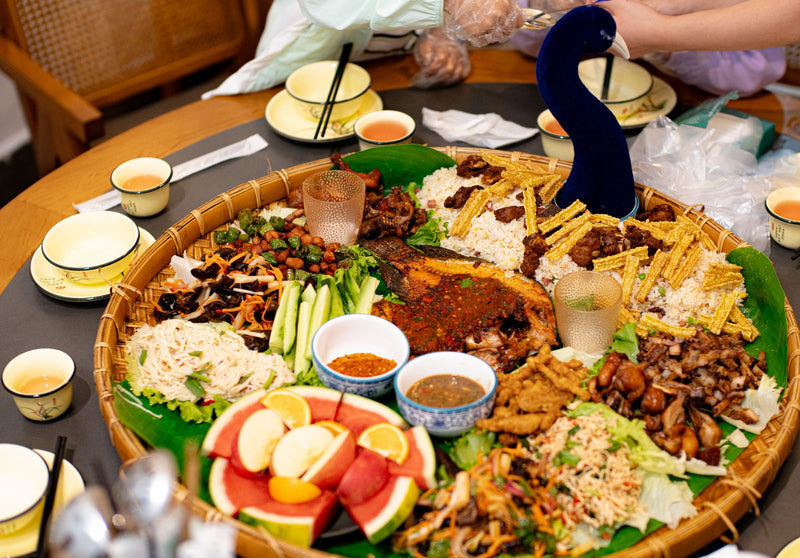
When the table becomes a full kamayan, adobo takes a different position. The sinangag or steamed rice becomes the bed, banana leaf goes down over the long board, and the ulam are placed directly on the leaf around and over the rice. Adobo, because it is saucy, is one of the dishes that should not go directly on the leaf. Ladle it into a smaller inner bowl and set the bowl within the spread, or portion the meat onto the leaf and keep the sauce in a separate ladle-friendly bowl beside the rice. For the full mechanics of setting a spread this way, our walkthrough on how to host a boodle fight at home covers the layout in detail. The specific adobo instruction is: dry meat can lay on the leaf, sauce always in a vessel.
Cooking bigger without the sauce breaking
A common mistake at the heirloom scale is to double or triple the household recipe without reducing the sauce to the same viscosity. The result is a thin, over-saucy adobo that pools rather than clings. The vessel cannot fix an under-reduced sauce. Cook the big batch to the same coating point as a small one, even if it takes an extra thirty minutes. The serving bowl or spread will reward the effort.

For the salu-salo table
The Family Hosting Set covers the pieces the heirloom adobo asks for, the shared bowl, the plates, and the boards to place around it.
Shop the Family Hosting Set →Regional Adobo and How the Vessel Changes
Adobo is not a single recipe. Every region and many households have their own variation, and each variation shifts the ideal serving piece. The changes are mostly about sauce volume, color, and how the dish is meant to be eaten. Here are the four most common variations, and how the table should adjust for each.
Classic soy-vinegar adobo (Manok, Baboy)
The version most people know outside the Philippines is the Tagalog-region soy-vinegar adobo of chicken or pork, sometimes both. The sauce is dark, reduced to a lacquer, and clingy. The right vessel is a shallow wooden bowl with a two to three centimeter wall. Not a soup bowl. Not a flat plate. The wall keeps the reduction where you want it, and the shallow shape shows the meat above the sauce line instead of drowning it.
Adobo sa gata
Adobo sa gata replaces or supplements the vinegar-soy reduction with coconut milk, most common in Bicol and parts of the southern Tagalog region. It produces significantly more sauce, and the sauce is lighter, thicker, and paler. A deeper bowl is called for here, closer to a proper serving bowl than the shallow lacquer-bowl of the classic version. The color story is also different. The pale coconut cream reads warm against darker acacia; a lighter piece of wood makes the sauce look chalky. Reach for a deeper piece of the darker acacia if you have the choice.
Adobong puti
The white adobo, sometimes called the original adobo, uses vinegar without soy. The result is pale, garlic-forward, and much brighter on the palate than the soy version. The visual story here is entirely about contrast between the pale meat and the wood beneath it, which means the vessel should be as plain as possible: no rim decoration, no dark-glazed inner surface, no elaborate shape. A simple wide bowl or shallow bowl with visible grain lets the wood do the work of the contrast. This is the version where wood most obviously beats ceramic.
Bicol-spicy and adobong pusit
Adobos with chili (a Bicol trait) and squid adobos (adobong pusit) are darker and often oilier. The chili oil sits on top of the sauce, and squid ink, if present, gives the whole dish a near-black tone. Both benefit from a deep bowl to keep the oil layer contained, and both stain more aggressively than the classic version. If you are serving adobong pusit on a wooden board or into a wooden bowl, wash within the hour. Squid ink dries fast and is one of the few things that will genuinely mark wood if left to sit.
Choosing the Right Serving Pieces for the Way You Cook Adobo
If you cook adobo often, and most households do, the pieces you own should reflect the way you cook it, not a generic set of tableware. The single most useful question to ask is: what does your adobo look like when it is done? The answer tells you what to buy.
Bowl over plate for the reduced sauce
A properly reduced classic adobo does not need a soup bowl, but it does need a wall. A wide, shallow bowl of the pasta-bowl proportion, roughly twenty to twenty-four centimeters wide with a two to three centimeter wall, is the correct piece. It holds the sauce, gives rice a place to sit alongside, and reads as a proper plated dish rather than a stew.
Boards for adobo flakes and dry adobos
If your household makes adobo flakes, the shredded and re-fried version popular at breakfast, or you cook your adobo down until the meat is almost dry, a board becomes the right vessel instead of a bowl. Flakes go on a small board or wide plate, garlic-fried rice beside them, egg on top or beside. The board's flatness serves the same crisp-preserving purpose it does for lechon kawali or lumpia.
The sawsawan dish nobody talks about
Every adobo dinner benefits from a small dish of extra vinegar, sometimes plain suka, sometimes suka with siling labuyo and crushed garlic. This piece gets overlooked in most sets and it is the one people end up improvising with a random ramekin. Own two or three small wooden or ceramic dishes for the sawsawan role. They cost almost nothing to acquire and they finish the table setting properly. For the household putting the full picture together in one buy, our chooser on choosing the right Filipino hosting set walks through the sizing gradient from weeknight to full handaan.

The bowl the adobo asks for
The Gorosin bowl set is the shallow-walled acacia shape that classic adobo needs, wide enough for the rice beside it and deep enough to hold the reduction.
Shop the Gorosin bowl set →Caring for Wood After Adobo
Adobo is one of the friendlier dishes to wooden tableware, but it does ask for a specific washing habit. Soy and vinegar are both aggressive if left to sit, and turmeric or atsuete (in the versions that use them) can leave a faint tint. None of this is a reason to avoid serving adobo on wood. It is a reason to develop a fifteen-minute post-meal wash rhythm.
The one-hour wash rule
Wash any wooden bowl or board that held adobo within an hour of the meal ending. Warm water, mild dish soap, a soft sponge across the grain, and a full drying with a clean cloth before the piece is put away. Do not soak. Wood absorbs water when it sits in it, and a soaked bowl will develop stress cracks within a few cycles. Wipe, wash, dry, put away. The whole routine takes a couple of minutes per piece.
Soy stains and how to prevent them
Dark soy sauce is the most common source of visible staining on lighter acacia. It stains only when it dries on the surface. As long as the bowl is washed while the sauce is still liquid, there is no meaningful stain risk. If a mark does appear (from a serving bowl that sat overnight, for instance), a paste of baking soda and water scrubbed gently across the grain lifts most of it. Rinse, dry, and re-oil with food-safe mineral oil.
Turmeric and atsuete in regional versions
Some regional adobos, especially those served at fiestas, use atsuete or turmeric to deepen the color. These are aggressive natural dyes. If you know you are cooking a dyed version, line the wooden serving bowl with banana leaf, or accept the faint patina as part of the piece's life. Wood that has served adobo for years takes on a slight warmth that ceramics cannot match, and that patina is not damage. It is history.
Long-term care and re-oiling
Every three to four months for a piece in weekly rotation, or twice a year for a piece used less often, wipe the wood with food-safe mineral oil and let it sit overnight. This restores what regular washing takes out and keeps the grain from drying out. A well-cared-for acacia bowl serving weekly adobo will last decades, and it will look better at year ten than it did in the first month.
Frequently Asked Questions
Should adobo be served in a bowl or on a plate?
A shallow bowl, in almost every case. Classic soy-vinegar adobo has enough sauce to run off a flat plate, and a soup bowl is too deep for the reduction. The right shape is a wide, shallow bowl with a two to three centimeter wall. The one exception is adobo flakes or a very dry adobo, which can sit on a board or flat plate like any other fried dish.
Can you serve adobo directly on wood?
Yes. Well-finished acacia is fully food-safe for adobo and does not need a liner for the classic version. The wash rule is the only meaningful constraint: hand-wash within an hour, do not soak, dry thoroughly. Line with banana leaf if you are serving a version heavy in atsuete or turmeric and you want to protect a lighter piece of wood from tinting.
How do I keep soy sauce from staining a wooden bowl?
Wash the bowl while the sauce is still liquid. Soy stains only when it dries on the surface. If a mark appears, a paste of baking soda and water gently scrubbed across the grain lifts most of it. Rinse, dry, and re-oil with food-safe mineral oil.
What size serving bowl do I need for a family adobo?
For a family of four, a shared serving bowl of roughly twenty-four to twenty-eight centimeters across, with a five centimeter wall, is comfortable. For eight to twelve, scale to a wider bowl around thirty to thirty-five centimeters, or use two medium bowls set at opposite ends of the table so nobody has to reach.
Does adobo taste better after resting, and does that change how I serve it?
Yes. Adobo improves with a rest of several hours to overnight because the vinegar and soy finish integrating and the meat re-absorbs the sauce. If you are serving next-day adobo, reheat gently on the stove, not in the microwave. A reheated adobo often reduces slightly further and gets stickier, which makes the shallow bowl even more appropriate as the vessel.
Is wood safe for hot adobo straight off the stove?
Yes, at the temperatures adobo reaches after a brief rest in the pan. Well-cured acacia comfortably handles serving-temperature dishes, and adobo does not need to be scorching to be eaten well. Let the pot rest for two or three minutes before ladling into a wooden serving bowl, and the wood will hold up without issue.