Kare-kare is one of those dishes where presentation does heavy lifting. The flavors are unmistakable. Beef shank or oxtail simmered until the meat slips off the bone, vegetables that each bring their own bite, a peanut sauce that carries the weight of the whole thing. But served carelessly, on the wrong surface, it can look like a brown mound that no one quite knows how to approach. Plating well is not about fanciness. It is about letting the dish look the way it tastes.
This guide is for cooks who have already made kare-kare a few times and want it to land well at the table, whether you are feeding two people on a Tuesday or laying out a full Sunday spread. Most of what follows assumes acacia plates, because the wood does specific things to a brown peanut sauce that ceramic does not. If you are working with what you have, the principles still apply.
Why kare-kare deserves a plate, not just a bowl
For decades, restaurants have served kare-kare in deep clay pots or pasong-style bowls, which keeps the sauce hot and the photographer happy. At home, this works against you. A bowl drowns the components. You end up fishing for the oxtail, the pechay collapses into the sauce, and the dish reads as one texture instead of several. A flat-rim plate forces the cook to think about arrangement, which is where the dish gets to actually look like itself.
The dish is heavier than it looks
Oxtail or beef shank, tripe if your family insists on it, sitaw and pechay and talong, sometimes puso ng saging, and a peanut sauce that has been thickened with toasted rice or peanut butter. That is a lot of weight in a single serving. A wide rim gives you room to spread it. The visual is half the appetite, especially when guests are getting introduced to the dish for the first time.
A flat-ish surface lets you arrange instead of drown
The trick most home cooks miss is that the sauce should hold the components in place, not submerge them. A plate with a slight lip, between half an inch and three quarters of an inch, contains the sauce without pooling it. The protein sits at the back, vegetables fan around it, rice anchors one side. Nothing slides off, but nothing gets buried either.
The case for wood vs ceramic for this specific dish
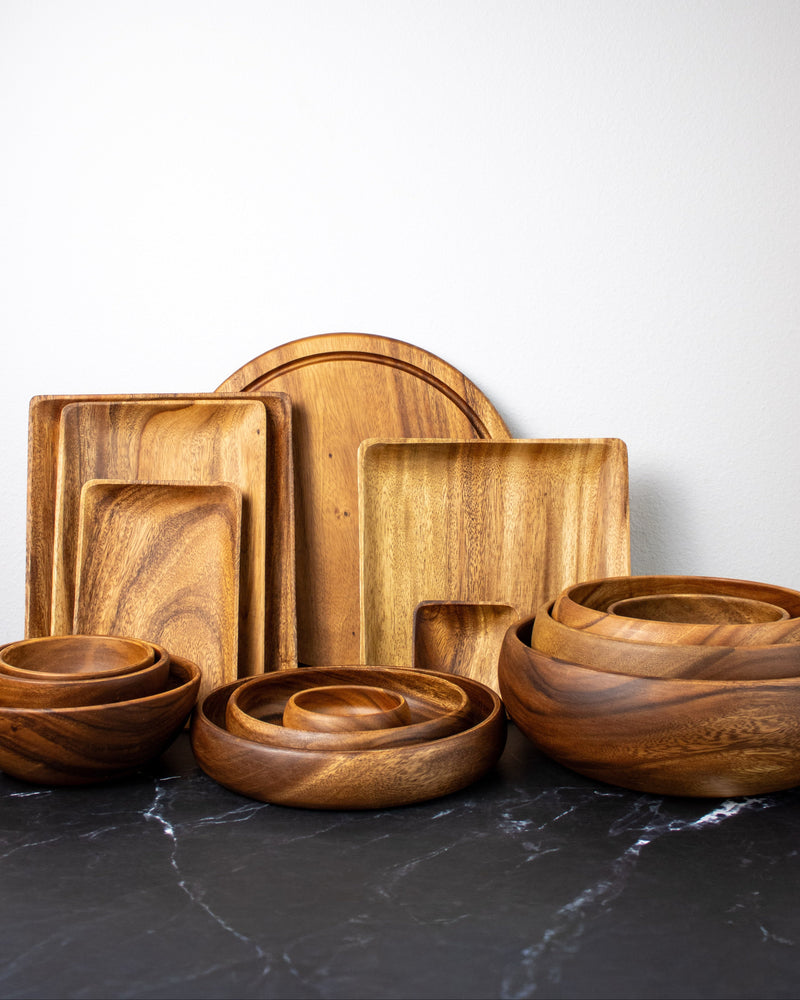
Ceramic is the default because it is what most kitchens own. For kare-kare, it is not the strongest choice. Bright white plates flatten the sauce color. The rust-orange annatto reads as muddy beige under most kitchen lighting. Dark ceramic helps, but it also tends to be glossy, which throws glare into photos and makes the meal look slick rather than rustic. Acacia sits in a sweet spot. Warm-toned, matte, food-safe, and visually closer to the cooking surfaces and serving boards used in Filipino home kitchens for generations. There is a longer write-up on which dishes wood flatters most in our piece on Filipino dishes that suit wooden tableware, kare-kare lands near the top of that list for visual reasons alone.

Flat-rim plates that hold sauce without pooling
The Chenoweth set is built for stew-and-sauce dishes like kare-kare, with a rim shallow enough to arrange components but deep enough that nothing runs off.
Shop the Chenoweth Plate Set →A quick recipe note, so we are plating the same dish
This article is not a recipe. There are hundreds of kare-kare recipes online and your lola's version is probably better than any of them. But because plating depends on what is on the plate, a few quick notes on what we are assuming.
The non-negotiables
Oxtail or beef shank, simmered for at least three hours until the connective tissue has surrendered. Peanut sauce thickened with ground toasted peanuts, peanut butter, or toasted rice powder, depending on the household. Annatto, either as oil or as seeds steeped in broth, for the signature rust color. Without annatto, the dish reads brown-on-brown and plating becomes much harder.
The vegetables that earn their spot
Pechay (or bok choy, if pechay is hard to find), sitaw cut into two-inch lengths, talong (eggplant) sliced into rounds or wedges, puso ng saging (banana heart) if you can get it fresh. Some families add string beans only. Some add okra. We will not relitigate this. Whatever your version, the plating logic stays the same, arrange by color so the plate does not flatten into one tone.
Why bagoong is a separate vessel, never on the plate
Bagoong alamang (sauteed shrimp paste) is the counterweight to the peanut sauce. Salty, funky, and intense enough that a teaspoon goes a long way. It should never sit on the plate. Spooning it directly onto the kare-kare overpowers the dish and looks muddy. Always serve it in a small wooden bowl or shallow dish to the side, so each diner can add it in the proportion they like. This is non-negotiable.
A note on consistency
The sauce should coat a spoon, not pool around it. If it runs off, reduce it longer or add more peanut butter. If it sits in stiff mounds, thin it with the simmering broth. A sauce that is too thin will spread across the plate and bleed into the rice. A sauce that is too thick will look pasty and refuse to drape over the vegetables. Aim for a slow, lazy drip when lifted off a spoon.
How acacia amplifies the peanut sauce visual
This part is worth knowing even if you end up plating on ceramic. Understanding why dark, warm-toned wood works for kare-kare helps you make the dish look better on any surface.
Warm wood grain against rust-orange annatto sauce
Acacia ranges from honey blond at the sapwood to deep coffee brown at the heart, with grain lines that carry both tones. The rust-orange of a well-made kare-kare sauce reads as a warmer, brighter cousin of that grain. The eye picks it up immediately. On white ceramic, the same sauce reads several shades duller because there is no warmth around it to anchor the color.
Matte surface absorbs glare
Properly finished acacia, sealed with food-safe mineral oil or beeswax, has a soft matte sheen. It does not throw kitchen light back at the camera. The sauce reads as the color it actually is, not as a hot specular highlight. For anyone who has tried to photograph a glossy Pinoy stew under overhead lighting, this matters.
The contrast ceramic flattens
Brown-sauce dishes (kare-kare, adobo, mechado, kaldereta, paksiw) suffer on white plates. The contrast is too high, the sauce shows every imperfection, and the rim of white visible around the food makes the portion look smaller than it is. Wood absorbs the dish into a broader warm field, so the eye sees abundance rather than a contained mound.
Why darker plates flatter brown-sauce dishes generally
This is not unique to acacia. Slate, dark stoneware, and even dark wood boards do the same job. The principle is tonal proximity. The closer the plate is in value to the dish, the more the components stand out by their highlights and shadows rather than by their silhouette against contrasting plate. Kare-kare, mostly mid-brown with bright vegetables and rust sauce, wants a warm dark plate so the bright bits sing.
Plating kare-kare, step by step
Here is how to actually do it. This assumes one individual plate, but the same logic scales for a platter.
Build the base, rice mound off-center
Pack a small ramekin or cup with hot steamed rice, invert it onto the plate at roughly the seven o'clock position. Off-center, not in the middle. Centered rice fights the kare-kare for attention. Off-center, it becomes a clear partner. Keep the mound modest, about half a cup, you can always offer seconds.
Lay the protein with sauce already on it
Pull the oxtail or shank from the pot with tongs, holding it briefly over the pot so excess sauce drips off. Place it on the plate, opposite the rice. Then spoon sauce over the protein. Do not plate the meat dry and add sauce after, the dry edge of the meat shows under the sauce and ruins the look. Sauce on first, in a thin coat, then a second pass to drape down the sides.
Arrange vegetables by color
This is the step that separates a fine plate from a forgettable one. Pull the vegetables from the pot separately. Pechay leaves go upright behind or beside the meat, green facing out. Talong rounds fan in a small arc, the purple skin visible. Sitaw lays in a loose bundle across one edge, not as a tangle. If you have puso ng saging, place a pale slice on top as a visual punctuation. The aim is three or four distinct colors on the plate, not a mixed pile.
Garnish, toasted ground peanuts and a calamansi wedge
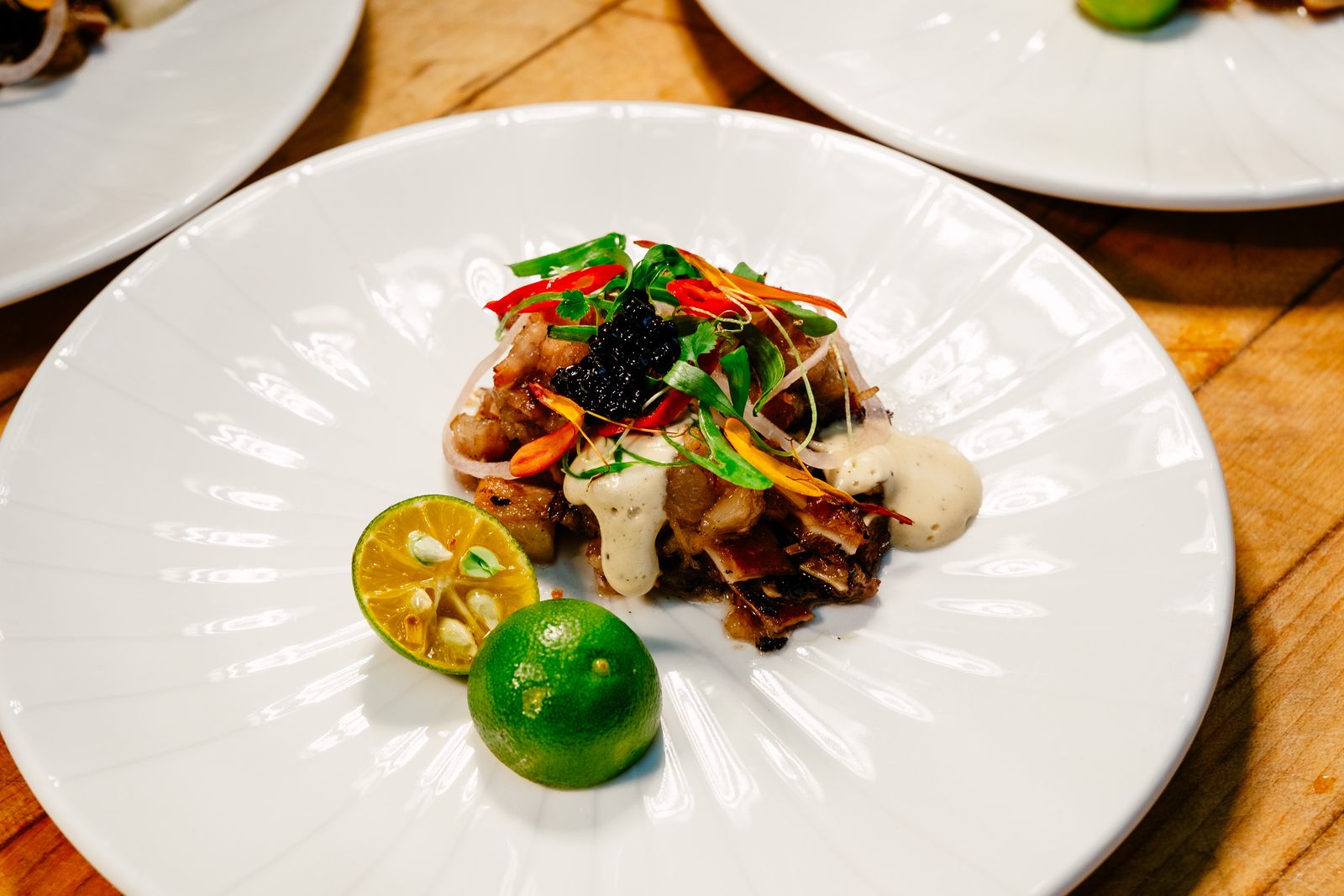
A pinch of toasted ground peanuts dusted over the sauce adds texture and a darker bronze note. One calamansi wedge tucked beside the rice, cut side facing the diner, signals brightness and gives them something to do with their hands. Skip the parsley. Kare-kare does not want parsley.
The bagoong vessel, set to the right
A small wooden bowl, two to three inches across, with a generous tablespoon of sauteed bagoong alamang, sits to the right of the plate at roughly four o'clock. This positions it for right-handed scooping with a spoon. If serving multiple guests, each diner can have their own bagoong bowl, or one shared bowl can sit between two plates. Either reads correctly.

A slightly deeper plate for family-style portions
When kare-kare is the main and you are loading more sauce per person, the Ina set's slightly deeper well gives you room without sacrificing rim space for arrangement.
Shop the Ina Plate Set →Serving for two, four, or a full handaan
How you scale plating depends on how many people are eating and how much else is on the table. The math is not the same.
Individual plating, date night or small dinner
For two to four people where kare-kare is the centerpiece, individual plates are worth the effort. One acacia plate per person, plated as described above, with a small bagoong bowl beside each. Rice on the plate. This reads intentional and restaurant-considered without crossing into stiff. Allow ten extra minutes for plating before service.
Family-style, Sunday lunch
For four to eight people, one large platter (or two side-by-side) with the kare-kare arranged for the table works better. Rice goes in a separate covered bowl. Vegetables sit grouped by type around the protein, sauce already poured. One central bagoong bowl. Diners help themselves. This is faster, more generous in feel, and closer to how the dish has always been served at home. The customs around shared plating, who serves whom, when seconds are offered, are worth knowing if you are hosting guests new to Filipino tables, our piece on Filipino dining traditions covers the rhythm in more detail.
Handaan scale, kare-kare as one of several dishes
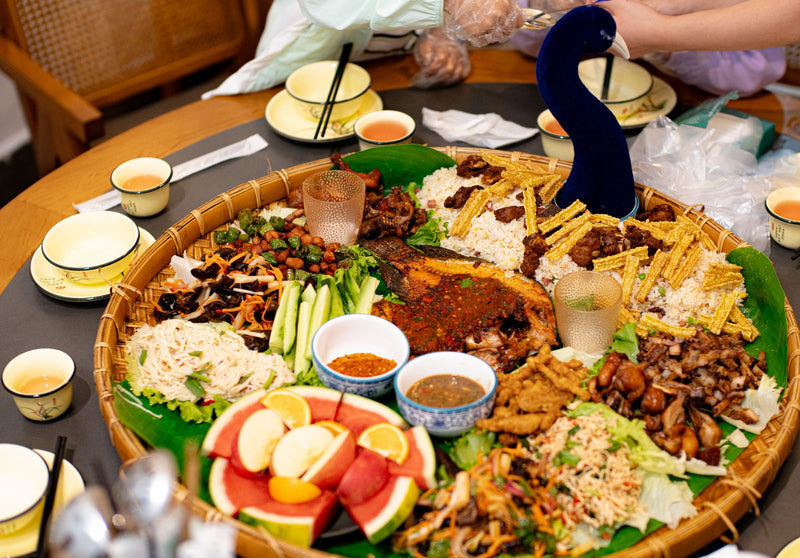
At a handaan, kare-kare is rarely alone. It sits in rotation with pancit, lumpia, lechon kawali, maybe a sinigang. Plating logic changes. Kare-kare goes on a platter with raised rim, sauce somewhat shallower than for family-style (because guests will not pile portions as deep when there are five other dishes to try), and visual contrast becomes more important because each dish needs to stand out from the next at the table. A dark plate for kare-kare and a paler plate for sinigang, for example, makes both legible from across the room. The visual interplay between brown stews and sour broths is something we wrote about in our sinigang in wooden bowls piece, the principles map directly across.
What to pair on the table
Kare-kare wants company. Sinigang na hipon for sour contrast. Pancit canton or palabok for noodle weight. Lumpiang shanghai for crispness. Atchara or pickled green papaya for sharp acidity to cut the peanut richness. Plain steamed rice always. Avoid pairing kare-kare with other heavy peanut or coconut dishes (no laing alongside, no ginataang anything), the palate will lose track.
Care after the meal
Peanut sauce and annatto are both pigmenting agents. Annatto is the same dye traditionally used to color cheese and butter, it stains. Peanut oil seeps. Neither is dangerous, but both reward prompt cleanup.
Rinse soon, do not soak
Within thirty minutes of clearing the table, rinse the plates under warm running water. A soft sponge with a small drop of mild dish soap is enough. Do not submerge. Do not leave them in a sink full of dishwater. Wood and prolonged water contact are not friends, the grain swells, the finish lifts, and over time the plate develops the dull grey patina of neglected wood.
Hand wash, towel dry, oil monthly
Standard care for any acacia piece. Hand wash, dry immediately with a clean towel, air briefly on a rack before stacking. Once a month, or whenever the wood starts to look thirsty, rub a small amount of food-grade mineral oil over the surface with a soft cloth. Beeswax-mineral oil blends work as well. Avoid olive oil and other cooking oils, they can turn rancid in the grain.
The dishwasher question
Someone always asks. The short answer is no, the long answer is in our full breakdown of whether you can put acacia wood in the dishwasher. Heat, prolonged moisture, and strong detergents are the three things wooden tableware survives least well, and a dishwasher delivers all three at once.

The bagoong and rice companion bowls
Small enough for a single serving of bagoong alamang or a personal rice portion, the Ama bowls round out the kare-kare table without crowding the main plates.
Shop the Ama Bowl Set →Frequently Asked Questions
Can I serve kare-kare directly on a wooden plate without a liner?
Yes. Properly finished food-safe acacia, sealed with mineral oil or food-grade beeswax, is rated for direct food contact under FDA guidance for wood used as a food contact surface. No liner needed. The plate handles the heat and the sauce without issue. Just rinse promptly after the meal.
Does peanut sauce stain acacia wood?
Not meaningfully, if cared for properly. Annatto is the more pigmenting component, but a quick rinse within half an hour of the meal removes nearly all of it. Long soaking is what causes staining, not the sauce itself. Monthly oiling keeps the surface sealed and resistant.
What size plate is best for individual kare-kare servings?
A ten to eleven inch flat-rim plate is the sweet spot for one serving with rice. Smaller plates crowd the components. Larger plates make the portion look stingy. The rim should be between half an inch and three quarters of an inch deep, enough to contain sauce without pooling it.
Should rice go on the same plate or a separate bowl?
For individual plating, rice goes on the same plate, off-center, mounded from a ramekin or cup. For family-style and handaan service, rice goes in a separate covered bowl or rice cooker insert, so diners can serve themselves the amount they want. Either is correct, choose by occasion.
How do I plate kare-kare for photos?
Shoot overhead at a slight angle, with the rice at seven o'clock, protein at twelve, and vegetables fanning across the right side. Use warm side lighting, not direct overhead. Wood plates absorb glare so the sauce reads true. Garnish with toasted peanuts and a calamansi wedge for color punctuation.
Is wood safe for hot kare-kare straight from the pot?
Yes. Acacia handles hot food up to typical serving temperatures without warping or releasing anything into the food. Avoid placing wooden plates directly on a stove burner or under a broiler, but transferring hot stew from pot to plate is completely fine. The plate may feel warm to the touch, which is normal.