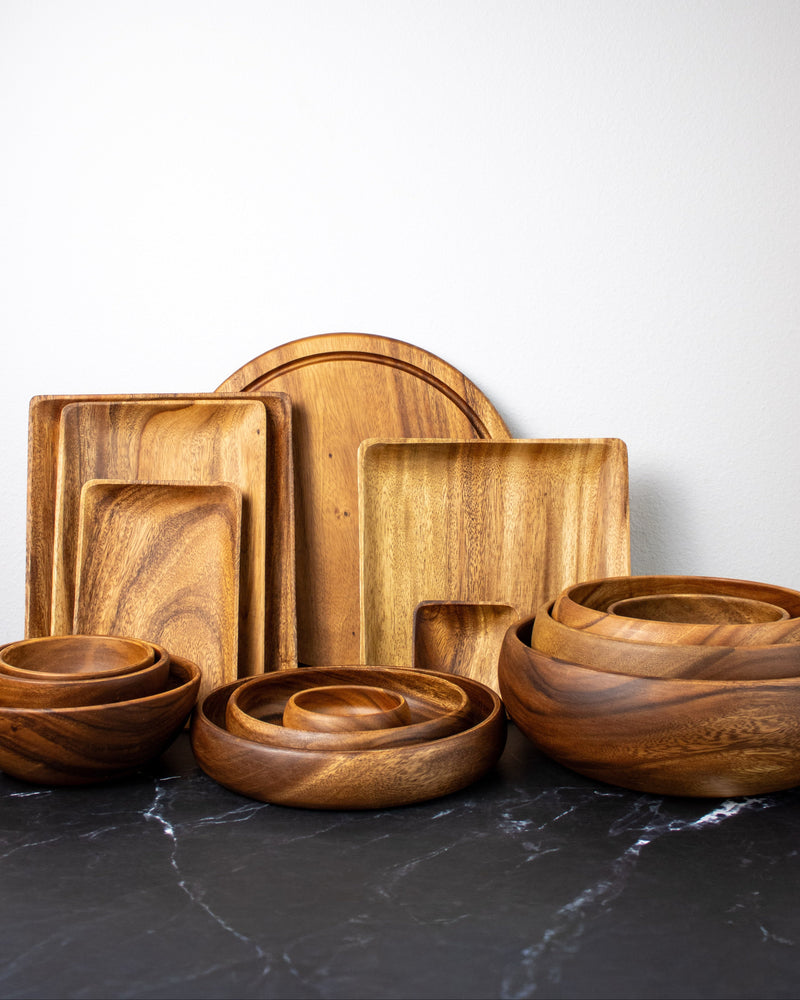
Walk into any tindahan ng kahoy in Pampanga or down a sari-sari aisle stacked with kitchenware, and you will see the same scene repeat. Acacia boards on the top shelf. Bamboo below them. Plastic at the bottom near the cash. The pricing tells you the order people reach for, but it does not tell you which board survives a year of suka, kalamansi, and twice-weekly tinadtad in a Manila kitchen with the aircon on full blast.
This guide is for the cook who has already decided wood beats plastic for everything except raw chicken, and now wants to know which wood, which grain, and which size to buy. We weighed acacia against bamboo, HDPE, and the imported maples and walnuts that arrive here at a steep markup. Climate matters. So does what you actually cook.
1. Why cutting board material matters in a Filipino kitchen
Most cutting board advice online is written for kitchens that sit at 40 percent humidity and never see vinegar stronger than balsamic. A Filipino kitchen is a different operating environment. The board has to handle moisture swings between the rainy season and tag-init, repeated acid exposure, and the kind of heavy daily chopping that goes into adobo, sinigang, kare-kare, and pancit.
The humidity factor
Wood is hygroscopic. It absorbs and releases moisture with the air around it. In Quezon City and Cebu, that air sits between 70 and 90 percent relative humidity for most of the year. Boards milled in Vermont or Hokkaido were dried to a much lower equilibrium moisture content. When they land here, they swell, then crack as they cycle between humid afternoons and air-conditioned nights. This is why an imported walnut board that cost you 8,000 pesos can split along the glue lines inside a year while the cheap acacia board your tita uses in her dirty kitchen has lasted since 2014.
Acidic ingredients we actually cook with
Filipino cooking is acid-forward. Suka in adobo and paksiw. Kalamansi squeezed over everything. Patis in nearly every braise. Sampalok for sinigang. Tamarind paste for the lazy version. A board that streaks or stains under acid is a board that will look ugly within months and harbor stuck-on flavor between dishes. Closed-grain hardwoods resist this. Open-pored woods like oak and ash do not.
Knife edge wear and what hardness means
The Janka hardness scale measures resistance to denting. Acacia clocks around 1,750 lbf. Hard maple sits near 1,450. Walnut is softer at 1,010. Bamboo varies wildly depending on species and how it was processed, but the silica content in the fibers can be tougher on knife edges than the raw hardness number suggests. For the home cook doing daily tinadtad of garlic, onion, and ginger, you want a board hard enough to resist gouges but not so hard it dulls your knife by Wednesday. Acacia and maple both sit in that sweet spot. Bamboo and end-grain teak edge toward the harsh end.
2. Acacia wood: the local hardwood standard
Acacia confusa and Acacia mangium grow across Luzon, Visayas, and Mindanao. The trees mature fast, the wood is dense, and the grain closes tightly enough to resist liquid penetration. None of this is an accident. Acacia became the default cutting board wood in the Philippines because it grew here, milled cleanly, and held up to local cooking. Imported alternatives had to overcome a steep practical disadvantage before they could compete.
Why acacia handles suka and kalamansi
The closed pore structure of acacia means vinegar and citrus juice do not soak into the fibers the way they would on oak or ash. You can chop a dozen kalamansi for sinigang na hipon, wipe the board, and see no ring or streak. Over years, the wood develops a slightly darker patina, which is desirable, not damage. Compare this to a softwood board, where acidic juices wick into the grain and lift it into a fuzz the next time you wash.
Weight, density, and what that feels like in use
Acacia is heavy. A medium board weighs about 1.5 to 2 kilos. That weight matters when you are chopping at speed. The board does not skid. You do not need a wet towel underneath to stop it sliding off the counter. The trade-off is that you will not be picking up a 50 by 30 centimeter end-grain block one-handed to dump prep into the kawa. For most home cooks, the stability outweighs the heft.
Where acacia falls short
Two honest weaknesses. First, price. A well-made acacia board costs more than the equivalent bamboo or plastic option. You are paying for density and joinery. Second, the weight already mentioned: a senior cook with weak wrists may prefer a lighter board, and there are bamboo options that solve for that at the cost of longevity.
If you want the deeper material story, our complete acacia wood guide covers the species, the harvest, and the grain structure in more detail than fits here.

The everyday acacia set, sized for Filipino prep
Three boards in graduated sizes covers garlic-and-onion mise en place, the main protein break-down, and the serving platter. One material, one care routine.
Shop the Pamilya Board Set →
3. Bamboo, plastic, and imported hardwoods compared
Acacia is the default, but it is not the only option, and being honest about the alternatives matters more than being loyal to one material. Here is what each contender actually does in a Filipino kitchen.
Bamboo: light, cheap, and limited
Bamboo boards are not solid bamboo. They are strips of bamboo glued together under pressure. The glue line is the failure point. Once moisture penetrates a seam, it spreads. Within 12 to 18 months of daily use, you will usually see seam lifting, especially around the side that sits closest to the sink. Bamboo also has high silica content, which dulls knives faster than acacia. The case for bamboo is weight, price, and the fact that it is fast-growing and replenishable. The case against it, in this climate, is durability. We compared the two side by side in our acacia vs bamboo tableware piece if you want the full breakdown.
Plastic (HDPE): the sanitation argument
HDPE plastic boards are easy to sanitize. You can run them through a dishwasher at high temperature, you can bleach them, and a cracked one is cheap to replace. Commercial kitchens use them because the food safety paperwork is simpler. UC Davis research from the 1990s by Dean Cliver actually found that wood boards inactivated bacteria more effectively than plastic in some scenarios, but the consensus food-safety position is that both work if you clean them properly. The honest home-cook recommendation is this: keep one small plastic board for raw chicken, fish, and pork, and a good wood board for everything else. That is what most working chefs do.
Imported maple, walnut, and teak
Maple is the American standard. Walnut is the prestige choice. Teak is the dense imported tropical hardwood. All three can be excellent boards. All three arrive in the Philippines with two problems: the price markup is steep, and the moisture content was tuned for temperate kitchens. A maple board kiln-dried to 8 percent equilibrium moisture will absorb humidity here and warp until it finds a new equilibrium, usually with cracks. Teak handles humidity better because it grows in tropical Asia and Africa, but a good teak board costs more than a comparable acacia one without delivering meaningfully better performance for Filipino cooking.
Quick comparison
- Acacia: hardness ~1,750 lbf, mid to premium price, excellent humidity tolerance, knife-friendly, 5 to 15 year lifespan with care.
- Bamboo: variable hardness, budget price, moderate humidity tolerance, tougher on knives, 1 to 3 year lifespan.
- HDPE plastic: not applicable to hardness, budget price, indifferent to humidity, neutral on knives, replace as it scars (usually 1 to 2 years).
- Hard maple: hardness ~1,450 lbf, premium price imported, poor humidity tolerance here, knife-friendly, lifespan limited by warping.
- Walnut: hardness ~1,010 lbf, premium price, poor humidity tolerance, very knife-friendly, lifespan limited by warping and dents.
- Teak: hardness ~1,070 lbf, premium price, good humidity tolerance, moderately knife-friendly, long lifespan if you can stomach the price.
4. End-grain vs edge-grain vs face-grain
Grain orientation is the single most misunderstood spec on a cutting board. It changes how the board feels under the knife, how long it lasts, and how much you should spend. Here is the practical version.
What the grain actually does
Picture a tree as a bundle of vertical fibers. When you cut a plank lengthwise, the fibers run along the length of the plank: that is face-grain or edge-grain depending on which face you use. When you cut a plank crosswise and stand the pieces on end, the fibers point upward like a packed bundle of pencils: that is end-grain. The knife edge slips between the fibers in end-grain rather than slicing across them, which is why end-grain feels softer and shows fewer scars over time.
End-grain: self-healing and heavy
The fibers in an end-grain board close back over knife cuts. Marks fade between uses. Your knife edge lasts longer because it is not cutting fiber, it is sliding between it. The trade-offs are weight and price. End-grain boards are made from many small blocks glued in a checkerboard, which uses more material and more labor. A good end-grain acacia board can weigh 3 to 4 kilos and cost two to three times the edge-grain equivalent.
Edge-grain: the everyday workhorse
Edge-grain shows knife marks more readily but holds up to daily chopping for a decade or more with reasonable care. It is the right answer for most Filipino home kitchens. The price-to-performance ratio is unbeaten, and the board is light enough to lift one-handed when you are scraping prep into a hot pan.
Face-grain: serving, not chopping
Face-grain boards have the widest visible grain pattern, which is why they look beautiful as serving boards for charcuterie, fruit, or kakanin. They are not built for heavy chopping. The flat face shows every knife mark and tends to develop scars that trap food. Use them for plating, not prep.

A large edge-grain board for proteins and prep
Sized for breaking down a whole chicken, a slab of liempo, or a fish that came home from the palengke wrapped in newspaper. Doubles as a serving board when guests arrive.
Shop the Pamilya Large Board →5. Choosing the right board for how you actually cook
The right board depends less on your budget and more on what you cook on a Tuesday night. Use this section as a decision filter.
The one-board kitchen
If you live alone, share a small condo kitchen, or just cook for two, one well-chosen board does almost everything. Pick a medium acacia edge-grain board in the 35 by 25 centimeter range. Big enough for a chicken break-down, small enough to fit in the dish rack, light enough to handle one-handed.
Households that cook the whole rotation weekly
If your week includes lechon kawali, sinigang, adobo, and a pancit on Sunday, you are chopping enough to justify two boards. A small board for garlic, ginger, and onion mise. A large board for protein. Keep a third plastic board for raw chicken if you want strict separation. The wood boards do everything else.
Boards that double as kamayan platters
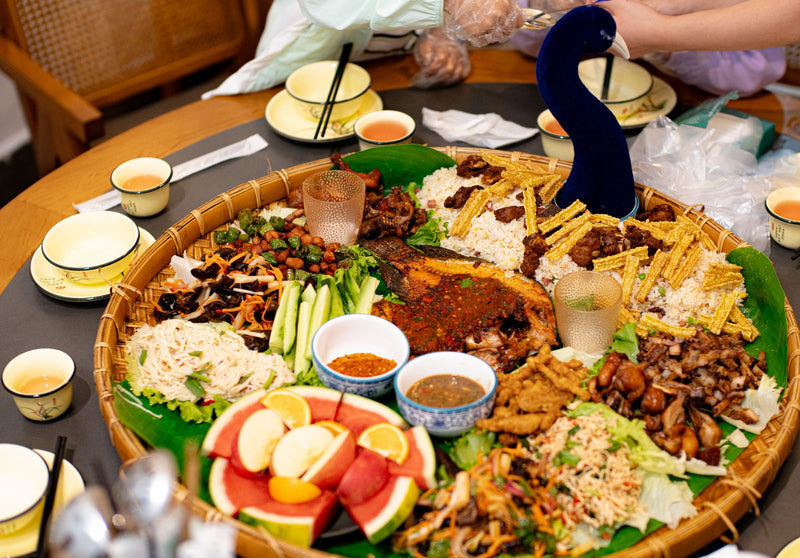
For a boodle fight or a kamayan dinner, the board stops being a tool and becomes the table itself. You want a long edge-grain or face-grain board, ideally 60 centimeters or longer, with enough surface to hold rice, lechon, grilled fish, and ensaladang talong without crowding. These boards do not need to be your daily chopper. Keep them clean and oiled for serving.
Size guide
- Small (25 by 20 cm): garlic, ginger, onion, kalamansi.
- Medium (35 by 25 cm): the do-everything board for a small household.
- Large (45 by 30 cm or bigger): protein, full meal prep, doubles as a serving board.
- Platter (60 cm and up): kamayan, boodle fight, charcuterie, kakanin spread.
Counter space is the constraint most people underestimate. Measure between your stove and your sink. A board that does not fit there will end up on the dining table, where it will get knocked, stained, and abused.

One board for the small kitchen that does everything
Medium edge-grain acacia, sized to fit between most stove and sink layouts. The pick for cooks who do not want to manage three boards.
Shop the Greg Board →6. Care, lifespan, and when to replace
A good acacia board will outlive your current refrigerator. The variable is how you treat it. Filipino kitchens demand more frequent oiling than the schedules you will read on American woodworking sites, because our humidity swings are wider.
Oiling schedule for Philippine humidity
The standard US guidance is "oil monthly." In a Manila kitchen with daily use, plan for every two to three weeks during dry season and every three to four weeks during the rainy months. Use food-safe mineral oil or a board butter (mineral oil with beeswax). Avoid olive oil, vegetable oil, or coconut oil, which all go rancid and leave the board sour-smelling. Apply a thin coat, let it sit overnight, wipe off the excess in the morning.
What is fixable, what is not
Surface knife scars sand out with 220-grit paper followed by re-oiling. Light cracks that have not gone through the board can be stabilized with extra oiling and avoiding moisture for a few weeks. A crack that goes from edge to edge through the thickness of the board is structurally compromised: replace it. Lifting grain (fuzz on the surface after washing) means you left it wet too long. Sand it smooth, re-oil, and adjust your drying habit.
Storage in a tropical kitchen
Three rules. Keep the board upright when not in use, so air flows around both faces and it dries evenly. Do not store it next to the sink, where splash and steam will keep it permanently damp. Do not store it directly under an aircon vent, where the rapid drying will pull moisture out of one face faster than the other and warp the board. A vertical slot on a counter away from both extremes is the simplest solution.
Realistic lifespan
Five to fifteen years for a well-cared-for acacia board, depending on how heavily you chop. Households that cook daily and oil consistently land near the top of that range. Households that let the board sit wet, skip oiling, and run it through the dishwasher (do not) land at the bottom. For the full care routine, including how to handle the deep cleaning that comes after chopping raw chicken on a wood board, see our guide on how to care for acacia wood cutting boards. The full lineup of board sizes lives in our boards collection.
Frequently Asked Questions
What is the best wood for a cutting board in the Philippines?
Acacia is the practical answer for most Filipino home kitchens. It is locally grown, hard enough to resist gouges, dense enough to resist liquid penetration from suka and kalamansi, and it handles our humidity better than imported maple or walnut. A well-made edge-grain acacia board will last a decade or more with regular oiling.
Is acacia better than bamboo for cutting boards?
For long-term daily use, yes. Bamboo is cheaper and lighter, but the glue lines that hold a bamboo board together fail under repeated moisture exposure, and most bamboo boards show seam lifting within 12 to 18 months in a Filipino kitchen. Bamboo also tends to dull knives faster due to higher silica content.
Can I use a wooden cutting board for raw meat in a tropical climate?
You can, but the safer setup is to keep a dedicated plastic (HDPE) board for raw chicken, fish, and pork, and use your wood board for vegetables, herbs, and cooked food. Wash the wood board with hot soapy water immediately after any contact with raw protein, dry it standing up, and re-oil more frequently. Both USDA and FDA guidance consider properly maintained wood boards safe, but separation of raw and ready-to-eat is the simpler workflow.
How long does an acacia cutting board last with daily use?
Five to fifteen years is the realistic range. Households that oil every two to three weeks, wash by hand, and store the board standing up land near the top of that range. The board will develop a darker patina over time, which is a feature, not damage.
Why do cutting boards crack faster in the Philippines?
Wood boards crack when moisture content swings rapidly between humid and dry conditions. Filipino kitchens hit boards with both: high ambient humidity during rainy season and aggressive dry air from air conditioning. Boards milled for temperate climates were not equilibrated for this. Locally milled acacia and regular oiling minimize the swings the wood has to absorb.
Is an end-grain cutting board worth the extra cost?
If you chop daily with a sharp knife and care about how long the edge stays sharp, yes. End-grain boards are gentler on knife edges and show fewer scars because the fibers close back over cuts. If you cook a few times a week and the board sits in storage between sessions, a good edge-grain board delivers most of the benefit at a fraction of the price.