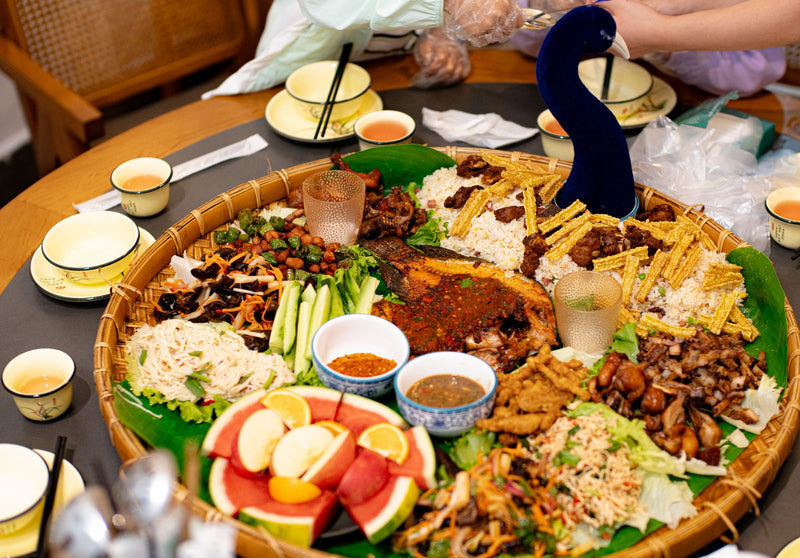
Every Filipino household with an oven or a steamer knows the ritual. Someone hands you a plate wrapped in banana leaf, still warm from the pot, and the smell hits before the sugar does. That leaf is doing work. It is not a decoration or a nod to tradition. It scents the rice cake, catches the coconut oil, and makes the whole spread easier to serve when the tita brigade arrives. This guide walks through how to lay out kakanin on banana leaves at home, from sourcing the leaves through the actual table geometry, so the presentation feels like family kitchen, not a hotel buffet.
Why banana leaves belong under kakanin
Before the leaf is a serving surface, it is a cooking tool. Bibingka baked in the traditional clay pot sits directly on a banana leaf lining. Suman is wrapped, tied, and steamed inside its leaf. Even puto is often piled onto a leaf-lined bilao so the steam has somewhere to condense that is not the rice cake itself. When you carry that leaf from stove to table, you are keeping the food inside its own environment. Nothing about it is styling.
The leaf as plate, wrapper, and aroma
Warm banana leaf releases a faint grassy sweetness that reads as coconut-adjacent. Set a slice of bibingka on a fresh leaf and the top glaze picks up that scent within seconds. The leaf also absorbs the small pool of latik oil that always escapes from good kakanin, keeping the wood or ceramic beneath it clean. And because the leaf is broad and pliable, it lets you serve pieces that would otherwise stick to the plate, suman especially, without a butter knife or a fight.
Regional cues worth respecting
Pampanga bibingka is often served on the same round leaf it baked on, edges scorched, sitting inside a shallow basket or on a wide wooden round. Bicol suman gets a longer, folded leaf that mirrors the wrapped shape of the rice cake itself. Visayan puto tends to sit on a rectangular leaf cut to fit a long tray or a bilao, with the salted egg and cheese pre-portioned next to each piece. If your family cooks a specific way, let the leaf follow the recipe. If you are mixing traditions, choose one region to anchor the table and add others as accents.
What banana leaves are not
They are not a garnish. They should not peek out from under a rim like parsley. They are not a prop for photos, and they are not a substitute for a plate when the food itself is dry or crumbly. If the kakanin is not benefiting from the leaf, either through moisture, scent, or handling, skip it. Overusing banana leaf turns a real practice into a costume.
Preparing banana leaves the right way
Most cooks outside the Philippines are working with frozen leaves from an Asian grocery. That is fine. The freezer already does part of the softening for you by breaking down the cell structure. What you cannot skip is the heat step. A stiff leaf tears the moment you try to fold it, and torn leaves shed dark fragments into pale rice cake.
Sourcing your leaves
- Frozen (Asian grocery). Look for whole leaves rolled and vacuum-sealed, not pre-cut squares. Whole leaves give you more control over shape.
- Fresh from a Filipino market. These come in long strips, often still with a rib. Best flavor, shortest shelf life. Use within two days or freeze.
- Grown at home. If you live somewhere a banana or plantain plant survives, harvest the outer leaves and let the inner ones grow. Wash well.
Softening the leaf
- Wipe both sides with a damp cloth to remove any wax or dust.
- Pass the leaf over a low open flame, about four to six inches above the burner, for three to five seconds per section. The dull green turns glossy and deepens. That color change is your cue.
- If you do not have a gas burner, dip the leaf briefly in hot water instead. Ten seconds is enough. Pat dry immediately.
- Trim out the tough central rib with kitchen shears. It will not fold and it will crack your presentation.
Cutting to size
For a round platter or wood plate, cut the leaf to overlap the edge by about an inch, then tuck the excess under. For a rectangular board holding bibingka or suman, cut a strip the length of the board and a hand-width wider, so the leaf shows a soft green border on either side. For individual portions, cut leaves into six-inch squares. You want the leaf to look like a placemat for the rice cake, not a shroud.

Individual puto and suman portions
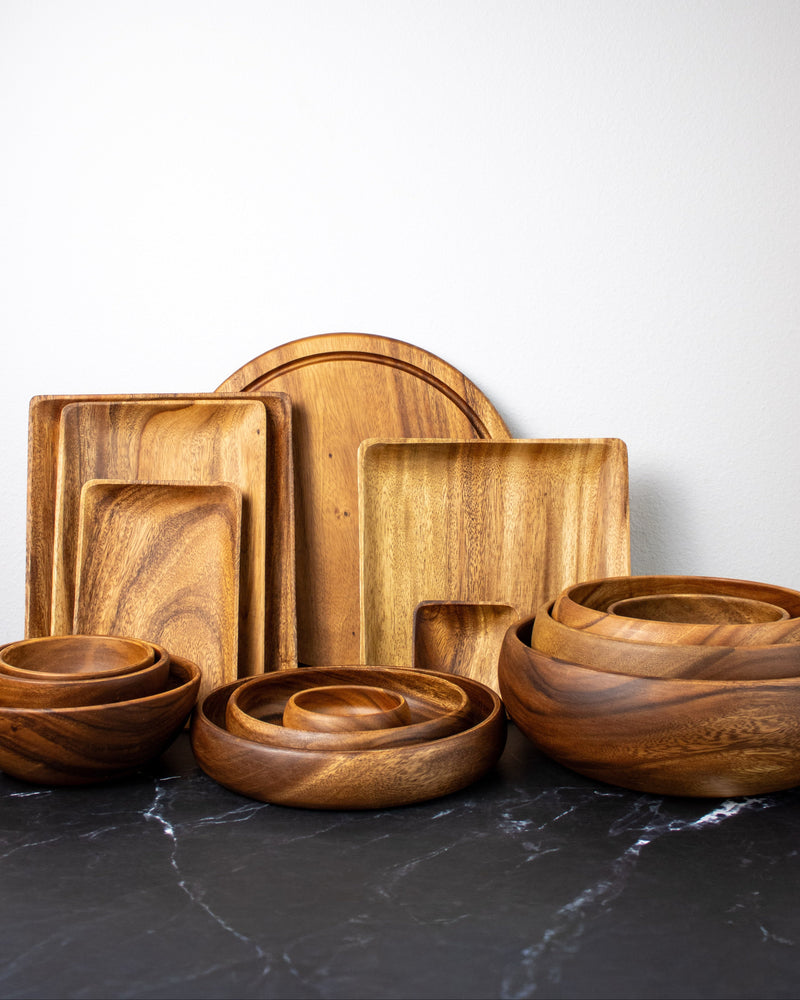
Small acacia plates that hold a leaf-wrapped suman or two pieces of puto without crowding the table.
Shop the Anak plate set →Cleaning and food safety
Banana leaves are food-safe when heat-treated. The USDA and FDA both classify banana leaf as an acceptable food contact surface for the short duration of a meal. Do not reuse a leaf that has held warm, oily kakanin. Compost it. If you are worried about pesticide residue on non-organic imported leaves, a quick vinegar-water rinse before the flame pass handles it.
Building the kakanin spread
The classic kakanin four are bibingka, puto, suman, and kutsinta. Each has a different shape, moisture level, and temperature preference, which is why lining them all up on identical round plates flattens the table. Give each one what it actually needs.
Bibingka: warm and central
Bibingka is the anchor. It should be the last thing to arrive at the table, still warm from the oven, sitting on a leaf-lined board wide enough to hold the whole round with the salted egg and grated coconut alongside. If you baked it in the clay pot, bring the pot to the table intact and slice at the table so people see the leaf edges char slightly against the crust. If you baked it in a modern pan, transfer to a wood board with a fresh leaf underneath.
Puto and suman: stacked and bundled
Puto is happiest stacked. Two or three tiers of small white cakes on a leaf-lined plate reads as generous without needing more square footage. Suman, because it is already leaf-wrapped, does not need a second leaf underneath, but a shallow bundle in a lined bowl or a small stack on a leaf-lined tray keeps the presentation cohesive. Both are fine at room temperature, which is why they go on the table first.
Kutsinta and the sweet-and-sour anchors
Kutsinta needs a shallow bowl, not a plate, because its brown-sugar chewiness pairs with grated coconut and a spoonful of latik oil that pools if it has anywhere to go. A small wood bowl beside the puto stack signals that the two are meant to be eaten together.
The accompaniments
- Grated fresh coconut. A small bowl or a leaf-lined ramekin. Keep it dry.
- Salted egg quarters. Portion onto the bibingka board, four to six pieces around the round.
- Latik. A tiny wood bowl with a spoon. Coconut milk curds go on everything.
- Cheese. Grated queso de bola or a hard white cheese in a small bowl beside the bibingka.
Portioning for the crowd
For merienda with six to eight guests, one whole bibingka, twelve pieces of puto, eight suman, and a bowl of kutsinta is generous without waste. For a fiesta with twelve to sixteen, double the bibingka to two rounds set on separate boards at either end of the table, and increase puto and suman by half. Always assume someone will ask to take home pasalubong, and set aside a small extra portion in the kitchen before service.

Small bowls for latik, syrup, and salted egg
A trio of acacia bowls that give each accompaniment its own home, so nothing drowns the kakanin next to it.
Shop the Ama bowl set →Wood, leaf, and the layered table
The reason acacia works underneath a kakanin spread is contrast. Dark, warm grain reads against the fresh green of a softened banana leaf, and both read against the near-white of puto and the golden crust of bibingka. Three tones, three textures, and none of them are competing.
Round versus rectangular pieces
Round wood plates and platters echo the shape of bibingka and puto naturally. They also make the leaf easy to cut and tuck. Rectangular boards suit suman, which is long and cylindrical, and pair well with a bibingka round set at one end. If you are working with a single serving surface, choose the shape that matches your dominant kakanin. If you are laying out three or four pieces together, mix shapes so the eye moves across the table.
Height and rhythm
A flat table of identical plates is visually monotonous. Introduce height with a small footed bowl for the latik, a stacked puto plate, and a longer bibingka board that sits low. The banana leaves link everything visually because the green repeats. You do not need a runner or a centerpiece. The leaves are the centerpiece.
Starting from a hosting set
If you are building your kakanin service from scratch, a coordinated set makes the table easier to compose. Our family hosting set is designed exactly for this kind of layered spread, with pieces sized for round bibingka, stacked puto, and small-bowl accompaniments in the same acacia grain. Once the base pieces match, the leaves and food do the rest of the work.

A center platter for the bibingka
The larger acacia round that anchors the table, wide enough for a whole bibingka, banana leaf, salted egg, and grated coconut in one composition.
Shop the Chenoweth plate set →Serving moments across the year
Kakanin is not a single occasion. It is a marker for the Filipino year. What you serve, and how the leaf underneath is arranged, shifts with the season and the reason.
Simbang Gabi and the December bibingka table
The nine dawn masses of Simbang Gabi end at the church door, where vendors sell bibingka wrapped in banana leaf, still steaming. At home, the after-mass table is warmer and slower. Salabat in ceramic mugs, bibingka on a wide wood round with the leaf edges showing, puto in a stack for anyone who did not get to the vendor in time. For a longer treatment of the December meal rhythm, see our guide to Pasko 13-day novena meals.
Summer merienda and pamamasyal
Summer merienda leans room-temperature. Puto, suman, kutsinta, and a pitcher of sago at gulaman on the table by three in the afternoon, ready for anyone who wanders in from a pamamasyal walk. The leaves here can be less generous, cut smaller, more casual. Our companion piece on the summer merienda pamamasyal table walks through the full afternoon layout.
Fiestas, baptisms, and wakes
At a fiesta, kakanin is the gesture of abundance. Two bibingka rounds, three flavors of suman, puto in colors, kutsinta pooled with latik. The banana leaves scale up too, covering broader boards and stretching down long tables. At a baptism, kakanin traditionally follows the church ceremony as a soft, sweet welcome. At a wake, it is quieter, served alongside coffee, but the leaf remains, a small green formality that says this food matters.
Regional variations to try
Beyond the Luzon default, Visayan puto often comes in a broader range of colors and includes puto maya with mango. Mindanao traditions include tinagtag and dodol, both of which sit on leaves for the same practical reasons. If you are hosting a Filipino gathering that reaches across regions, one anchor kakanin from your family tradition plus one guest kakanin from another region tells guests you paid attention.
Caring for wood after a kakanin spread
Kakanin is sweet, oily, and often sticky. The banana leaf catches most of it. Your wood serving pieces catch the rest.
What to wipe off first
- Coconut milk and latik oil. Wipe within an hour with a warm damp cloth. Coconut oil is stable but coconut milk can leave a faint dulling if it sits.
- Muscovado syrup. The stickiest offender. Warm water and a soft sponge, dry immediately.
- Salted egg juice. Rare but salty enough to draw moisture out of unsealed wood. Wipe promptly.
When the leaf protects, and when it does not
A whole, unbroken banana leaf shields the wood beneath from almost everything. But once the leaf tears, or once a slice of bibingka is lifted off and the leaf under it lifts with it, the wood is exposed. Keep an extra softened leaf in the kitchen so you can slide it under a serving piece mid-meal if the first one gives up.
Quick reset between rounds
If guests come in waves, as they often do at a fiesta, reset the board between rounds rather than piling new kakanin on old leaf. Slide the old leaf and any crumbs into the compost, wipe the wood dry, place a fresh leaf, and refresh the food. The whole reset takes under a minute.
Longer care
Once the guests have gone and the wood is wiped, the piece goes back into its normal rotation. For a deeper look at how Filipino dishes and their oils interact with acacia over time, our guide to Filipino dishes for wooden tableware covers the full care rhythm, from adobo to kakanin to boodle fight cleanup.
Frequently Asked Questions
Do banana leaves need to be cooked before serving on them?
They need to be softened with heat, not fully cooked. A quick pass over a low flame or a brief hot water dip is enough. This makes the leaf pliable, brings out the aroma, and prevents tearing when you fold or plate on it.
Can I use banana leaves straight from the freezer?
Thaw them first, either overnight in the fridge or for thirty minutes at room temperature. Then still do the flame or hot water pass. Frozen leaves are already partly broken down by the cold, but they are stiff until warmed and will crack if you fold them cold.
How do I keep bibingka warm on a wood platter?
Bring the bibingka to the table just before serving, on a leaf-lined wood board that has been sitting at room temperature. Wood holds ambient warmth well and will not draw heat out the way cold ceramic can. If your gathering runs long, keep the second half of the bibingka warm in a low oven and swap the boards halfway through.
What kakanin can I stack, and what needs its own space?
Puto stacks happily in two or three tiers. Suman, since it is already wrapped, can be bundled together in a shallow pile. Bibingka should not be stacked because the top glaze will smear. Kutsinta needs a bowl to itself because of the syrup and latik pooling.
Are banana leaves safe to eat off of?
Yes, when they have been washed and heat-treated. Banana leaves are recognized as a safe food contact surface for the duration of a meal. Do not reuse a leaf that has held warm oily food. One meal per leaf, then compost.
How far ahead can I prep the banana leaf layer before guests arrive?
Soften and cut the leaves up to four hours ahead. Stack them between damp paper towels in a covered container at room temperature. Any longer and they start to dry at the edges. Do not lay the leaves onto the wood pieces until thirty minutes before service, so the wood does not sit under damp leaf longer than needed.