A Filipino host on their birthday is in an unusual position. They are the celebrant, but they are also still hosting. The food, the music, the kids running around the living room, the tito who wants more San Mig Light, the tita who needs a chair near the electric fan. None of that pauses just because it is the host's name on the cake. The gift you bring should understand this. It should fit the table they will be setting again next weekend, and the one after that.
This guide is for anyone trying to choose a birthday gift for someone who hosts. The aunt who runs every family handaan. The barkada friend whose condo is the default Friday night address. The lola whose dining table has fed three generations. Below are eight gift ideas built around the way Filipino hosts actually use their homes, plus the customs, presentation, and budget logic that sit underneath the choice.
Why Birthday Gifts for a Filipino Host Need a Different Lens
Most birthday gift guides assume the celebrant is being celebrated and nothing else. In Filipino households, the host's birthday usually means the host is also cooking, or directing the cooking, or feeding the relatives who arrived early. The gift sits inside that reality. A scented candle is fine. A bowl that holds the kanin for the next salu-salo is doing something else entirely.
The host is the celebrant and the cook at the same time
Even when the family insists "wala nang gagawin si birthday celebrant," the host usually still ends up checking the rice, refilling the sawsawan, and asking who wants more sabaw. That is not a complaint. It is the role, and most Filipino hosts genuinely enjoy it. A thoughtful gift respects that the host is going to keep hosting after the cake is cut.
Why kitchen and table pieces outperform decor
Decor lives on a shelf. Kitchen and table pieces enter rotation. In a Filipino home that hosts even once a month, a serving bowl or a board will be used dozens of times in the first year. The gift attaches itself to meals, to gatherings, to memories. By year three, the family no longer remembers the candle but they still call the platter "yung galing kay Tita Marisol."
The "next salu-salo" test
A simple way to evaluate any birthday gift for a Filipino host. Ask: will this be used at the next salu-salo. If yes, the gift belongs at the celebration. If no, you are buying a decoration, which is not wrong but is a different category. Most hosts secretly prefer the first.
Read the Host Before You Choose the Gift
The best birthday gifts come from observation, not browsing. Spend five minutes thinking about the host's actual table before you spend an hour scrolling. The clues are usually obvious if you have eaten there even once.
What they cook tells you what they need
A host whose freezer is stocked with pre-marinated inihaw needs a long serving board, not another bowl. A host known for their kare-kare needs deep bowls that can handle saucy ulam without staining. A host who throws boodle fights needs a long flat platter. Match the gift to the dishes that come out of their kitchen most often.
How often they gather people and at what scale
A host who has eight to twelve people over every Sunday needs working hosting pieces, not statement decor. A host whose salu-salo means twenty-five relatives at Christmas needs platters and bowls that scale. A host whose hosting is mostly intimate, four close friends over wine and ulam, needs smaller, more refined pieces. The number on the guest list is one of the most useful clues a giver has.
What their current setup is quietly missing
Walk through their kitchen and dining area in your head. Is the rice always in a mismatched plastic bowl. Is the sawsawan in a ceramic cup that nobody likes. Are the serving plates the ones from the wedding fifteen years ago, chipped at the edges. Filipino hosts rarely complain about these things, but they notice them every time. A gift that quietly fixes a gap is felt for years.

For the host whose plates have done their tour
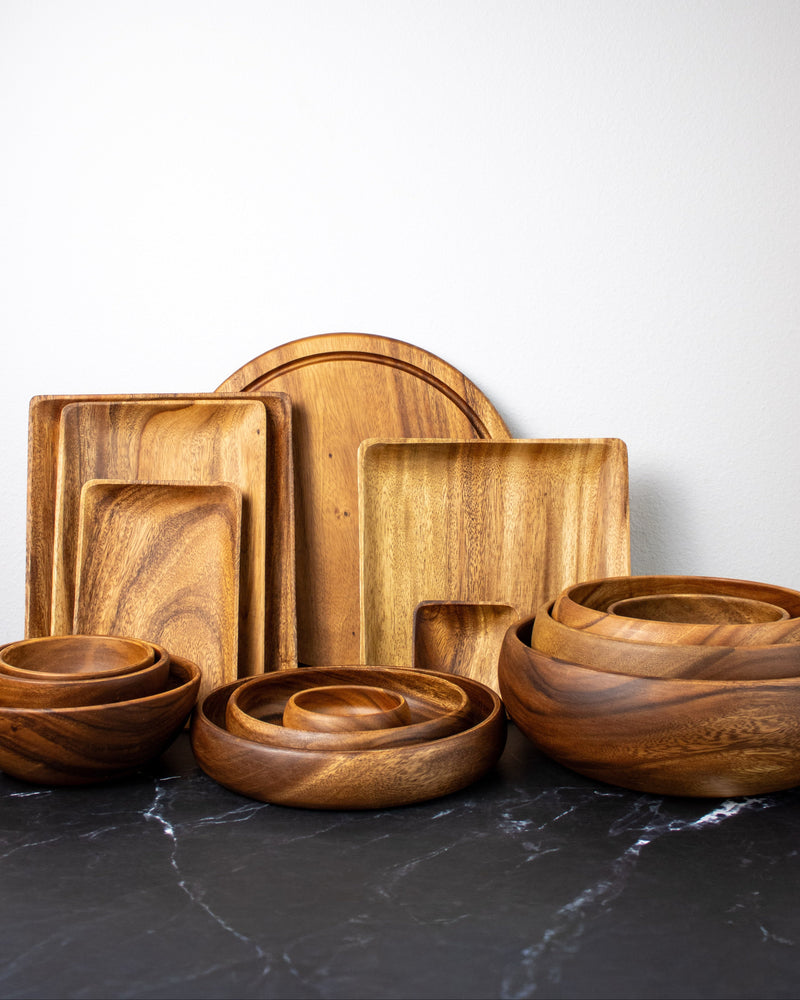
A coordinated set of acacia plates that handles saucy ulam, hot kanin, and weekend salu-salo without flinching.
Shop the Chenoweth Plate Set →Eight Birthday Gift Ideas for the Filipino Host
These are arranged from the most universally useful to the more specialized. None of them are decorations. All of them get used at the next gathering, which for a Filipino host is usually next weekend.
1. A statement acacia bowl for the kanin or palabok
The rice bowl is the center of the Filipino table. If the host is still serving from the pot or a thin plastic bowl, a single large acacia bowl with visible grain becomes the bowl that holds the kanin from this birthday forward. It also doubles for palabok, pancit, or any pasta-style dish meant to be passed around. One well-chosen statement bowl outperforms a set of small matching ones for a host who already has plates.
2. A long platter built for kamayan and lechon
Sooner or later, the host will set up a banana leaf kamayan or a slab of lechon kawali for a Friday inuman. A long, flat acacia platter handles both without warping or staining. If the host has hinted at wanting to throw a proper kamayan, the platter solves the missing piece. For staging guidance you can share with them, our piece on how to host a boodle fight walks through the layout step by step.
3. A serving board for pulutan and inihaw
Pulutan is its own category in Filipino hosting. Chicharon, longganisa, kesong puti, sliced mangga with bagoong, inihaw na liempo cut into thirds. A defined-edge serving board holds these neatly and survives being passed between hands over the course of an evening. Boards also tend to travel: someone always borrows them, and the borrowing is part of how a gift gets embedded in a host's social life.
4. A nesting bowl set for sawsawan
Sawsawan is not optional. Suka with crushed siling labuyo. Toyomansi with garlic. Bagoong with calamansi. Patis with a slice of red onion. A set of small nesting bowls in matching wood gives the host a clean way to set up four or five sawsawan at once, which is the actual reality of a Filipino table. The host stops scavenging mismatched ceramic dishes from the back of the cabinet.
5. A hand-engraved piece with the host's name or a meaningful word
An engraved piece sits in a different category. A bowl with the host's name. A board with the family name or a single word like "Salamat" or "Pamilya" burned discreetly into the underside. Engraving turns a working piece into a personal one. The host knows it was chosen for them specifically, and the engraving guarantees the piece stays in the family rather than being absorbed into the general rotation.
6. A mortar and pestle for fresh sawsawan and adobo paste
Most Filipino hosts have one, but most of them are too small or too light. A heavier mortar and pestle in stone or dense hardwood handles bagoong, garlic, ginger, and siling labuyo properly. It gets used at almost every meal that involves grilling or frying, which is most of them. A practical gift the host did not realize they wanted.
7. A complete hosting set for the next handaan
For a host whose Sunday salu-salo is a fixture, a coordinated hosting set in one wood and finish solves the table-staging problem in one gift. Bowls, platters, and serving pieces that match each other create an instant tablescape without the host needing to think about it. For help sizing the right set to the household, our guide on choosing the right Filipino hosting set walks through the trade-offs.
8. A pair of premium plates for the host's own quiet meals
Filipino hosts spend so much time feeding others that they often eat their own meals on whatever plate is closest. A pair of beautiful acacia plates, reserved for the host's own use, is a small but pointed gift. It says: the person who feeds everyone else deserves to eat well too. For a birthday gift, this gesture lands.

A statement bowl for the rice and the room
A single large acacia bowl, carved from one piece, finished by hand. The bowl that becomes the bowl.
Shop the Gorosin Bowl Set →
Pairing the Gift With the Birthday Itself
A birthday gift is presented inside a specific moment. Filipino birthday celebrations have their own rhythms, and the gift lands better when it is timed and framed to fit them.
Gifts that join the spread versus gifts opened after
Some gifts can quietly join the table from the start. A serving board with the pulutan already on it. A bowl holding the kanin. The host notices the gift not when they unwrap it, but when they realize the piece they have been using all afternoon is the one you brought. Other gifts, engraved pieces especially, are better opened after the meal, in the kind of small ceremony that Filipino families enjoy. Match the gift to the moment.
When the birthday doubles as a handaan
Filipino birthdays often blur into full handaan, with extended family, godparents, and neighbors arriving in waves. If you know the celebration is a proper handaan, a hosting-scale gift makes sense. If it is a quieter dinner with the immediate family, a single piece is more appropriate. Our piece on handaan birthday feast Filipino style covers the gradient between casual birthday dinner and full-blown family event.
Coordinating with other gift givers
If you are part of a barkada or a group of cousins, coordinate. Three people buying matching bowls is wasted. One bowl, one board, and one set of small dishes split across the group covers the host's table in a way that no single gift can. Group chats are quietly the best gift-planning tool a Filipino host has working in their favor.
Adding a card in Tagalog or the host's mother tongue
A handwritten card that names the piece in Tagalog, Cebuano, Ilocano, or Hiligaynon grounds the gift in the host's language. "Para sa kanin tuwing Linggo." "Para sa unang lechon sa bagong taon." The card costs nothing and adds permanence. Many hosts keep the cards with the pieces, taped to the underside or tucked inside a drawer where the bowl is stored.
Budget Tiers and What Each One Actually Buys
Filipino hosts come in every income bracket, and so do gift budgets. The honest principle holds at any tier: one well-made piece beats three forgettable ones. Below is what each range actually delivers in 2026.
Under PHP 1,500 or USD 30
A single small bowl, a sawsawan dish set, or a compact serving board from a trusted maker. At this tier, focus on a piece the host will use weekly, not a stretched-thin set that feels thin in the hand. A single beautiful sawsawan dish is a stronger gift than four mediocre ones.
PHP 1,500 to 4,000 or USD 30 to 80
A mid-size statement bowl, a serving board with a defined edge, or a small set of matching plates. This tier comfortably covers a working gift that gets used at every weekend salu-salo. A pair of plates the host can keep for their own meals also sits in this range.
PHP 4,000 to 10,000 or USD 80 to 200
A full hosting set, an engraved heirloom piece, or a large statement bowl carved from a single piece of acacia. This is the tier for ninongs, ninangs, siblings, and close friends marking a milestone birthday. The gift becomes a fixture in the home.
Above PHP 10,000 or USD 200
Custom commissioned pieces, full sets with engraving, or a multi-piece gift that anchors the host's table for the next decade. Often a group gift from the barkada or the extended family. At this tier, the gift is being chosen for permanence, and the choice of maker matters as much as the price.
Presenting the Gift With Filipino Grace
The unwrapping is part of the gift. Filipino families have specific small rituals around how gifts are received, and matching the presentation to the culture extends the gesture.
Why the wrapping matters less than the framing
Filipino hosts rarely care about elaborate wrapping. They care about how the gift is framed when it is handed over. A short line about why you chose this piece for them specifically lands harder than a fabric ribbon. "I noticed your rice bowl was getting too small for the family. This one should fit." That sentence is worth more than the box.
The role of pakikisalo when the gift is a serving piece
When the gift is a bowl, a board, or a platter, ask the host if you can put it on the table that night. The act of using the gift immediately, with the host's permission, is itself a form of pakikisalo. The piece enters service in front of the people who will associate it with the giver. Our piece on filipino hospitality, salu-salo and pakikisalo covers the deeper logic behind this kind of communal eating.
Engraving and the role of personal marks
An engraved piece carries the host's name or a chosen word into the family record. Engraving is also a way to make a gift impossible to regift, which Filipino hosts who receive many duplicates quietly appreciate. The piece is theirs, marked, and the next time it appears at a salu-salo a cousin will ask about the name on the bowl. The story attaches.
When to skip the card and just hand over the piece
Not every gift needs ceremony. For close family and longtime barkada, sometimes the best presentation is to walk in, set the bowl on the kitchen counter, and say "ito, gamitin mo na." The lack of ceremony is itself a sign of closeness. Read the room. If the host is mid-cooking and the kitchen is loud, save the framed moment for after the meal.

Engrave it and it stays in the family
Add the host's name, the family name, or a single Tagalog word to any acacia piece. Permanent, discreet, and impossible to regift.
Shop Custom Engraving →For gift-giving in adjacent contexts, our companion piece on filipino housewarming gifts applies similar logic to the bahay blessing, where the gift is offered to the home as much as to the family inside it.
Frequently Asked Questions
What is a good birthday gift for a Filipino host who already has everything?
A host who "has everything" usually has a lot of duplicates and very few personal pieces. An engraved bowl or board with their name, or a single statement piece chosen for their cooking style, lands well. The personalization makes the gift theirs in a way no off-the-shelf duplicate can match.
How much should I spend on a birthday gift for a Filipino host?
A reasonable range is PHP 1,500 to 8,000, or roughly USD 30 to 160, depending on your closeness to the host and the scale of the celebration. Close family, ninongs and ninangs, and barkada marking milestone birthdays often spend more. One well-made piece at any tier outperforms several forgettable ones.
Is it okay to give a Filipino host kitchen or serving pieces as a birthday gift?
Yes, and it is often the strongest category. Filipino hosts who feed people regularly genuinely want pieces that work on their table. Far from feeling like "work gifts," good serving pieces are read as a sign that you understand what the host actually does on their birthday and every weekend.
Should the gift match the host's existing tableware?
Not exactly. Matching too closely can feel like you copied the catalog. A gift in a complementary wood and finish, or a single statement piece in a different tone, often integrates better than a strict match. If you are unsure, ask a close family member what is currently in rotation.
What gift works for a Filipino host who lives abroad?
Pieces that carry the home country with them. A wooden bowl from a Filipino maker, an engraved piece in Tagalog, a sawsawan set sized for the dishes they cook to remember home. For hosts in the diaspora, the cultural weight of the gift often matters more than its practical scale.
Can I give the same kind of gift every year?
You can, and many Filipino givers do. A bowl one year, a matching board the next, a platter the year after. The accumulated set becomes "the gifts from Tita Eden" and earns a recognized place on the family table. Repetition with intention is a feature, not a problem.