The Filipino street food night lives in a very specific memory. You are standing near a stall on a warm evening, the ihawan glowing, the smoke thick with fat, someone handing you a stick of isaw and a small plastic cup of sarsa. You eat with your hands. You do not sit down. You talk to whoever is next to you. When you try to bring that home, most people default to a "party platter" and lose the whole thing. This guide is about staging street food indoors so the mood survives the trip.
Why Street Food Belongs at the Filipino Home Table
Filipino street food is not primarily about the food. It is about the format. Someone else is cooking, you are standing, the light is bad, the sarsa is in a repurposed cup, and the whole thing is negotiated in real time. Bring that home and the mistake most hosts make is fixing all the things that were features. They light the room too well. They plate everything. They sit everyone down. Then they wonder why it feels like they served appetizers instead of a night.
The ihawan is a social format, not just a menu
The ihawan corner in your neighborhood is a room. It has a shape. The grill is the center, the sarsa station is a few steps away, guests orbit both. Conversations happen because people are close and their hands are busy. That geometry is what you are actually trying to import. If you get the layout right, the food does its job.
What gets lost when you plate isaw like a main course
Isaw on a rectangular white plate with garnish is a mistake in tone. It reads as fine dining doing a costume. The stick is a serving vessel. It is meant to be held, dipped, and eaten standing. Once you put it on a plate with cutlery next to it, the guest becomes a diner instead of a participant. The joke stops working.
The mood you are actually trying to bring inside
Warm ambient light, low music, no seating chart, food that keeps arriving in small waves. That is the mood. Not "themed party." Not "Filipino night." Just a house that happens to be doing what a sidewalk does, which is feeding people who came over to talk.

Anchor the ihawan corner with a proper board set
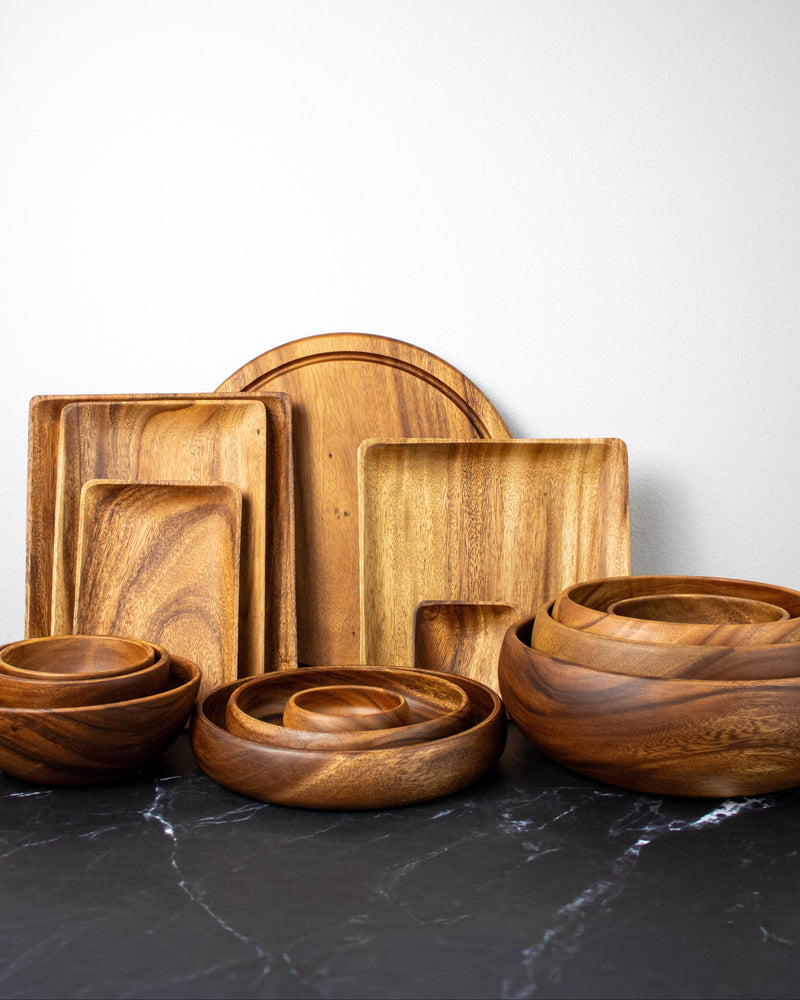
A trio of boards holds skewers, fried items, and sarsa without turning your night into a plating exercise.
Shop the Pamilya Board Set →
The Street Food Menu That Travels Home
The menu is not the point, but you still need one. What travels well from the sidewalk to the living room is anything that can be eaten with hands, does not need cutting, and holds its temperature for at least ten minutes without collapsing. That rules in almost the entire ihawan lineup and most of the fried cart. It rules out the delicate stuff that only works when it hits the stick two minutes ago.
The grilled core: isaw, betamax, adidas, IUD, hotdog, pork barbecue
Isaw (chicken or pork intestines), betamax (cubed pork or chicken blood), adidas (chicken feet), IUD (the trimmed inner cut you already know if you grew up on this), red hotdogs, and the sweet-soy pork barbecue you know from every corner in Manila. Pick four, not all six. You are not proving a point. You are feeding a room. If you are cooking indoors on a grill pan or an air fryer, hotdog and pork barbecue behave the best. Isaw and betamax want real fire and a little smoke to make sense, so grill those outdoors or on a small tabletop grill if you have one.
The fried anchors: kwek-kwek, tokneneng, fishballs, kikiam
Kwek-kwek (quail eggs in orange batter) and tokneneng (chicken eggs, same treatment) hold up in a bowl for a good half hour without going sad. Fishballs and kikiam are the same story. These are your workhorses. They fill the gap while the grill is between rounds. They are also the pieces that most look like themselves in a communal bowl. Do not try to plate them individually.
The dips that do the heavy lifting (spiced vinegar, sweet-sour-chili, Mang Tomas)
Sarsa is the whole personality. Spiced vinegar with siling labuyo, garlic, and onion for isaw and grilled meats. The sweet-sour-chili sarsa (dark, thick, a little garlicky) for fishballs and kwek-kwek. Mang Tomas for the pork barbecue and hotdogs, or for anyone who grew up dipping everything in it. Do not offer one all-purpose sauce. Three is the minimum, four is generous. Give each one its own bowl.
The sides that keep it a meal (puso rice, atchara, sliced cucumber)
Puso rice (rice wrapped in coconut leaves) is the honest street food carb, but a rice cooker of plain white rice hidden in the kitchen works too. Atchara cuts the grease. Sliced cucumber, salted, does the same job for less effort. If you are trying to feed people rather than just snack them, these are what turn the night from merienda into dinner. For the wider casual-eating context, our merienda spread ideas piece has more on how these sides read across different Filipino eating occasions.
Setting Up the Ihawan Corner Indoors
Staging is where most home street food nights fall apart. People treat it like a buffet. A buffet has a line. A sidewalk stall has a huddle. You want the huddle. That means the food area needs to be reachable from three sides, not backed against a wall, and the sarsa needs to be one step from the food, not in a different room.
Where the "grill station" goes when there is no grill
If your actual cooking is happening in the kitchen (grill pan, air fryer, oven finish), your indoor "ihawan" is the surface where the cooked food lands. Put it in the center of the room, not against the counter. A dining table pulled slightly away from the wall works. A kitchen island works if guests can walk around it. What does not work is a long console table where guests can only approach from the front. That is a buffet, not an ihawan.
The board-and-bowl layout that mimics sidewalk staging
Two or three large boards for skewers and grilled pieces. One or two deep communal bowls for the fried stuff. Small bowls for each sarsa. Nothing on individual plates. The visual weight of raw wood and heaped food is what tells guests this is not a plated dinner. If the surface looks like a restaurant, they will behave like they are at a restaurant.
Skewer management: cups, jars, and the vertical trick
Used skewers pile up fast. Have a tall glass or a mason jar at one end of the board specifically for spent sticks. This is a small thing, but it is the difference between the board looking active and the board looking like a mess. Cooked skewers ready to eat can be laid flat, or stood upright in a shorter, wider vessel if you want to signal "grab one." The vertical presentation is a straight lift from the sidewalk stall and it works because it is honest.
Sarsa station: small bowls, one dip each, never combined
Every dip gets its own bowl. Do not use a divided condiment tray. Do not mix vinegar with Mang Tomas because "it saves space." Space is not the issue. Each sarsa has a specific job. Combining them is a food memory violation and the guests who grew up on this will notice.

One large board as the ihawan surface
A single wide board carries skewers, spent sticks, and a scatter of fried pieces like the counter of a working stall.
Shop the Greg Board →
Serving Pieces That Make Street Food Read as Street Food
The reason acacia and mango wood work so hard for this format is that they carry the visual language of the sidewalk without pretending to. Wood at a Filipino table is not new. It is what pancitan counters and roadside carinderias have always used. The material is doing quiet work: it tells the room what kind of eating is about to happen.
Why wooden boards work better than platters here
Ceramic platters are shiny, cold, and reflective. Under warm indoor light they look staged. Wooden boards absorb light, carry a little grease without protest, and do not read as "we set this up for photos." Boards also let you overlap items, pile skewers casually, and leave the puso rice sitting next to the isaw without a garnish. That casual staging is what you cannot fake on porcelain. Our roundup of Filipino dishes that suit wooden tableware covers the broader logic behind this pairing.
Communal bowls for the fried stuff (never individual plates)
Kwek-kwek, fishballs, kikiam, and squid balls all belong in a single deep bowl, heaped, warm, with a slotted spoon or a pair of tongs sitting alongside. The moment you portion them onto individual plates, you have made the guest ask "how many am I allowed." That question does not exist at the sidewalk. Do not introduce it at home.
The "no cutlery" cue: how the surface tells guests to use their hands
If there is no fork and no knife at the setup, guests will not ask for one. The absence is the instruction. Toothpicks for fishballs, hands for everything else. This reads awkward to newer guests for about ninety seconds and then it clicks. Do not undermine it by leaving a stack of forks on the side "just in case."
Napkins, toothpicks, and the small things guests actually reach for
Cheap paper napkins, lots of them, in a stack. Toothpicks in a small glass. A stack of small plates for people who want to carry a mixed handful somewhere. Wet wipes if you are going to be honest about the grease. These small provisions are what keep the standing-around format sustainable for two hours instead of forty minutes.
The Flow of a Street Food Night at Home
A street food night at home has a rhythm that is closer to a house party than to a dinner. Nothing lands at once. There is no "we are seated now." Food arrives, gets eaten, more food arrives, drinks appear somewhere in the middle, and eventually somebody asks about rice. That progression is the whole thing.
Staggered grilling: why everything should not land at once
Cook in waves. First wave: hotdogs and pork barbecue, the crowd-pleasers, plus the first round of fishballs and kwek-kwek from the fryer. Ten minutes later: isaw and betamax if you have them. Another ten minutes: refills of whatever went first. Waves keep the food warm at the point of eating, and they give guests a reason to hover near the board instead of drifting off with a paper plate.
Standing vs sitting: reading the room
Some guests will stand for two hours. Others will look for a chair after fifteen minutes. Leave a few chairs around the perimeter, not at a table. The center stays open. The food stays central. Reading the room is knowing when to pull a chair closer for a lola who does not want to stand, without turning the whole thing into a seated meal.
The merienda-to-inuman shift (drinks arrive, food keeps coming)
Around forty-five minutes to an hour in, the beers come out. San Miguel Pale Pilsen, Red Horse for the ones who want more punch, or whatever your household drinks. The shift from merienda to inuman is the moment the night decides how long it is going to be. If the food stops arriving here, guests leave inside an hour. If it keeps trickling in, the night stretches to three hours easily.
When to bring out puso or rice (later than you think)
Rice comes out late. Not first, not with the initial wave. Once guests have been standing and dipping for an hour, someone will start looking for a carb. That is the moment. Puso rice, or plain rice in small bowls, appears then and turns the merienda into an actual meal. Bring it out too early and everyone plates a meal and sits down, which ends the format. For a fuller shared-eating format that sits alongside this one, our guide on how to host a boodle fight is the closest neighbor to a street food night.

Communal bowls for the fried anchors
Deep wooden bowls hold kwek-kwek, fishballs, and kikiam heaped and warm, the way the cart does it.
Shop the Ama Bowl Set →Cleanup, Storage, and Making It a Repeatable Thing
The first street food night at home takes effort. The second and third take a fraction. That is because the setup is a kit, and once you have built the kit you are just refilling it. Cleanup is fast if you handle the wood correctly and do not let sauces sit.
Handling grease and sarsa on wooden boards (quick wipe, no soak)
Wipe boards down while they are still warm. A damp cloth clears sarsa and grease in seconds. Do not soak wooden boards in the sink. Do not put them in the dishwasher. If a board looks dry after a couple of uses, rub a thin coat of food-safe mineral oil into it and leave it overnight. Vinegar-based sarsa in particular will pull moisture from wood if it sits, so the quick wipe matters most for those bowls.
What to prep the day before vs day of
Day before: mix the spiced vinegar so the aromatics have time to bloom, portion the fried batter dry ingredients, thaw whatever needs thawing. Day of: skewer the meats in the morning, cook in waves in the evening. The dips get better overnight. The grill items do not.
Building your street food "kit" so the next one takes half the effort
Your kit is: three or four boards, four to six small dip bowls, two large communal bowls, a stack of paper napkins, toothpicks, a tall jar for spent skewers, and a set of tongs. Store it together. Once the kit is assembled, hosting a street food night is a matter of shopping and cooking, not staging. That is when it becomes a repeatable thing rather than a project.
Frequently Asked Questions
Do I need an actual grill to host a street food night at home?
No. A stovetop grill pan, a small tabletop charcoal grill on a balcony, or an air fryer will cover most of the menu. Isaw and betamax genuinely want fire and smoke to taste right, so those two items push you toward an outdoor grill or an open flame if you can manage it. Hotdogs, pork barbecue, and the fried anchors work fine indoors.
What are the essential dips for a Filipino street food spread?
Three at minimum. Spiced vinegar with siling labuyo, garlic, and onion for the grilled items. A sweet-sour-chili sarsa (dark, thick, a little garlicky) for fishballs and kwek-kwek. Mang Tomas for pork barbecue and hotdogs. Add a plain soy-calamansi if you want a fourth. Each dip goes in its own bowl, never combined.
How do I serve isaw indoors without the whole house smelling like grill smoke?
Grill the smoky items on a balcony, outside the door, or under a strong range hood, then bring them inside on a warm board. The smell that lingers overnight comes from the actual grilling smoke, not from the finished skewers. If you have no outdoor access, an air fryer finishes isaw well enough for a home night, though purists will notice.
Can I use wooden boards for greasy fried street food?
Yes, and they handle it better than ceramic. Wipe the board down while it is still warm to keep grease from sitting. Do not soak the board or run it through a dishwasher. A rub of food-safe mineral oil after every few uses keeps the surface protected. The USDA and FDA both recognize properly maintained hardwood as safe for food contact.
How much food per person for a street food night?
Plan for four to six skewers per adult across the grilled items combined, plus a handful of fried anchors (six to eight pieces of kwek-kwek, fishballs, or kikiam total), plus a small portion of rice at the end. Guests will eat more than at a plated dinner because the format encourages grazing. Round up on the fried items, which hold up in the bowl longer than the grilled ones.