Seven mistakes show up at almost every Filipino table I visit, even at houses where the lola has hosted for decades. They are not failures of taste. They are the residue of Western templates pressing against a way of eating that was built on different principles. Filipino dining was never designed around plated courses or matched flatware. It was built around shared access, generous rice, sawsawan in arm's reach, and the slow rhythm of a meal that lasts hours. Once you can name the mistakes, you can fix them in an afternoon.
Why Filipino Table Setting Is Different
Most table setting advice you find online was written for a Western template: a host plate, a salad fork to the left, a dessert spoon above. None of that translates to a salu-salo. The Filipino table is not a sequence of courses arriving in order. It is a single landscape of dishes that all hit the table around the same time and stay there. Guests build their own plates and rebuild them. Understanding this shift is the difference between a setup that flows and a setup that fights itself all afternoon.
It is not about courses, it is about access
In a Filipino meal, no one waits to be served the next thing. The ulam, the rice, the sabaw, and the sawsawan are all out at once. A guest seated at the far end of the table should be able to reach (or be reached by) every dish without standing. When you read older accounts of Filipino dining traditions, access is the through-line. The table is not a stage. It is a shared workspace.
The table is built for sharing, not plating
Serving vessels matter more than dinnerware in this system. A boodle fight makes this literal, banana leaf instead of plates, but the principle holds for every salu-salo: the communal vessel is the center of gravity. Individual plates exist to support what the communal vessels are offering, not the other way around. This is why a beautiful set of matching dinner plates can still feel wrong on a Filipino table. The serveware was an afterthought.
How these mistakes creep in
The mistakes have three common origins. First, Pinterest and home-design feeds that default to Western place settings. Second, restaurant habits, where a server controls the flow and one plate arrives at a time. Third, the diaspora reflex of trying to make a Filipino table look "presentable" by Western standards, often at the cost of how the food is actually meant to be eaten. None of these are character flaws. They are templates absorbed without anyone naming them. Once you name them, you can set them down.
Mistakes 1 and 2: The Layout Errors
The two layout mistakes are the easiest to spot and the easiest to fix. They both come from treating the Filipino table like a Western one, where the center is decorative and the rice is a polite supporting role.
Mistake 1: Crowding ulam in the center instead of distributing along the table
Walk into most salu-salo and you will see every ulam clustered in the middle of the table like a centerpiece. It looks abundant. It also means the guests at either end cannot reach half the dishes. The fix is to distribute. Adobo at one end, kare-kare at the other, sinigang in the middle. Sawsawan repeated in two or three places along the length of the table, not just one. Every seat should have at least one ulam within arm's reach and a sawsawan they can grab without asking someone to pass it.
Mistake 2: Treating rice as a side dish (one small bowl per person)
Rice is the meal. Ulam is what makes the rice interesting. When you set out one small rice bowl per person and call it done, you have already told your guests to ration. They will. They will eat less ulam too, because there is no rice to carry it. Plan for a generous serving of kanin per person and have a refill bowl or rice cooker within reach. The amount of rice on the table is the single strongest signal of how the meal is meant to go.
Quick fix: the kanin-ulam ratio rule
- Rice volume on the table should equal at least the volume of all ulam combined.
- Plan for one and a half cups of cooked rice per adult guest, more if sabaw dishes are heavy.
- Keep a refill source (a covered bowl, a kawali, a rice cooker) within walking distance, not buried in the kitchen.
- Serve rice in shallow, wide bowls when possible. They scoop faster and pair better with ulam-on-rice eating.

The host set that solves the layout problem
Built around shared serving pieces and individual plates that play well together, this set covers the access and rice-ratio issues in one go.
Shop the Family Hosting Set →Mistakes 3 and 4: The Serveware Errors
Serveware mistakes are quieter than layout mistakes, but they shape the meal more than people realize. The wrong vessel makes food behave wrong. Sabaw cools too fast, sawsawan goes stagnant, ulam stops circulating.
Mistake 3: Using deep soup bowls for sabaw dishes meant to be ladled over rice
Sinigang, tinola, and nilaga are not soups in the Western sense. They are sabaw dishes that get ladled over rice. When you put them in deep individual soup bowls, you have signaled to guests that this is a course to be eaten on its own, with a spoon, separate from the rice. They will treat it that way. The sabaw will cool by the time they get to it. Use a wide, shallow communal vessel with a ladle, set near the rice. Let guests pour as much sabaw as they want directly over their plate.
Mistake 4: Plating sawsawan in tiny ramekins guests cannot reach
Sawsawan, suka with chilies, patis with calamansi, toyomansi, bagoong, is the seasoning layer of a Filipino meal. Each guest should be adjusting their plate as they go. When you serve it in a single tiny ramekin in the middle of the table, only the three people closest to it ever use it. The rest eat under-seasoned. Either set out multiple small dishes, one for every two or three seats, or use a slightly larger communal vessel that travels easily.
What to use instead
- Shallow communal bowls for sabaw, with a ladle resting in the bowl, not on the table.
- Mid-size dipping vessels (think small bowl, not ramekin) for sawsawan, repeated along the table.
- Wide-rim plates for guests, so rice, sabaw, and ulam can share a surface without merging into a single puddle.
- Wooden serving boards for grilled and dry ulam, which keep them visually anchored without trapping moisture.

Shallow plates for ulam-over-rice eating
Wide-rim acacia plates give rice, sabaw, and ulam room to coexist on a single plate, the way a Filipino meal actually wants to be built.
Shop the Chenoweth Plate Set →
Mistakes 5 and 6: The Flow Errors
Flow mistakes are the ones seasoned hosts make most often, because they look like efficiency. Putting everything out at once feels generous. It is actually a missed chance to give the meal shape.
Mistake 5: Setting dessert and savory at the same time, no reset moment
If the leche flan, the bibingka, and the fresh mango are sitting on the table while people are still eating adobo, the meal has no arc. Dessert gets warm, savory gets cold, and the moment when the table should slow down (the moment when conversations get longer and the kids start moving around) never arrives. Hold dessert until the savory plates are cleared. The reset is what makes the meal feel like a meal, not a buffet line.
Mistake 6: Forgetting the merienda buffer between lunch and the next round
A Filipino kainan that starts at noon does not end at two. It rolls into three, four, sometimes five. Lolas know this and build in a merienda buffer: a small pause where the savory clears, coffee or tsokolate comes out, and the kakanin (puto, bibingka, suman) appears. This is not a second meal. It is the bridge that keeps people at the table without overfeeding them. Without it, guests either eat too much at lunch or leave before the relatives have finished catching up.
How experienced lolas pace a 4-hour kainan
- Noon to 1:30: savory ulam on the table, rice constantly refilled, sawsawan adjusted as needed.
- 1:30 to 2:00: clear the savory, wipe the table, bring out coffee or tsokolate. This is the reset.
- 2:00 to 3:00: merienda buffer. Kakanin, fruit, light sweet things. People graze and talk.
- 3:00 to 4:00: dessert proper. Leche flan, halo-halo, or whatever the centerpiece sweet is. Guests start drifting toward goodbyes.
The four-hour kainan is not a marathon. It is a sequence with built-in breath. Once you see the pattern, you stop trying to do everything at once.
Mistake 7: The Hospitality Error
The last mistake is the one most worth naming, because it is the one most easily corrected and the one most easily missed. It has nothing to do with serveware or layout. It is about where the host stands in the meal.
Mistake 7: Serving yourself first, or eating before guests have rice on their plate
In a Western dining frame, the host eats when the food is ready. In a Filipino frame, the host eats when the guests are eating. If you have rice on your plate before your titos and titas do, you have signaled that the table is yours, not theirs. The fix is small: serve guests rice first, even if just a spoonful, then sit down with them. Do not stand and supervise. The food does not need supervision. The conversation needs you in it.
The pakikisalo principle: you eat with them, not before them
Pakikisalo is the practice of eating alongside others as a sign of belonging, not just serving them. There is a fuller treatment of this in our piece on salu-salo and pakikisalo, but the short version is this: the host is not a server. The host is the first guest. Filipino hospitality assumes the meal is a shared event, not a service delivered. The minute you opt out of the eating, you have opted out of the hospitality.
Small gestures that signal a guest is welcome
- Pour the first scoop of rice into a guest's plate yourself, even if they protest.
- Reach for the sawsawan and offer it before they ask.
- Sit at the corner closest to the kitchen so you can step away without disrupting the table.
- Do not clear plates while people are still eating. It rushes them.
- Refill rice before it runs out, not after.
None of these are performance. They are how a guest knows the host wants them there.
Building a Filipino-Ready Table That Forgives Mistakes
You do not need a complete reset to fix these mistakes. Most Filipino tables already have most of what they need. What they lack is a small layer of flexible serveware that can carry communal dishes, sawsawan, and rice without having to borrow from the everyday plates. The right three or four pieces, chosen well, will carry a household through boodle fights, salu-salo, weekday dinners, and seasonal occasions like Noche Buena without ever feeling stretched.
Pieces that flex across boodle, salu-salo, and weekday family meals
The pieces that earn their keep on a Filipino table are the ones that do not declare a single use. A wide acacia board can be a kamayan platter on Saturday and a cheese board on Wednesday. A medium wooden bowl can hold rice for ten or fruit for two. Look for pieces that can shift register depending on what you put in them. Single-purpose serveware is what fills cabinets and never comes out.
Why wood, ceramic, and woven mix better than matched sets
A fully matched dinner set reads formal in a way that fights the Filipino table. Wood softens it. Ceramic anchors it. Woven pieces (banig placemats, abaca trays) add the texture that signals home rather than restaurant. The mix is not a compromise. It is the look. A table where every surface matches looks like a hotel buffet. A table where the textures vary looks like someone lives there and has been feeding people for a long time.
A starter setup most homes can build in three pieces
- One large communal bowl for rice, sabaw, or salad. Wide enough that a ladle does not feel cramped.
- One long serving board or platter for grilled ulam, lechon, or kamayan-style spreads. Wood that has been finished with food-safe oil.
- A set of medium dipping vessels for sawsawan, repeated along the table rather than centralized.
That is the spine. Everything else (individual plates, glasses, utensils) can stay whatever you already own. Mix unmatched ceramics with wooden serving pieces and you have a table that reads Filipino without anyone having to explain why.

Communal bowls for sabaw and sawsawan
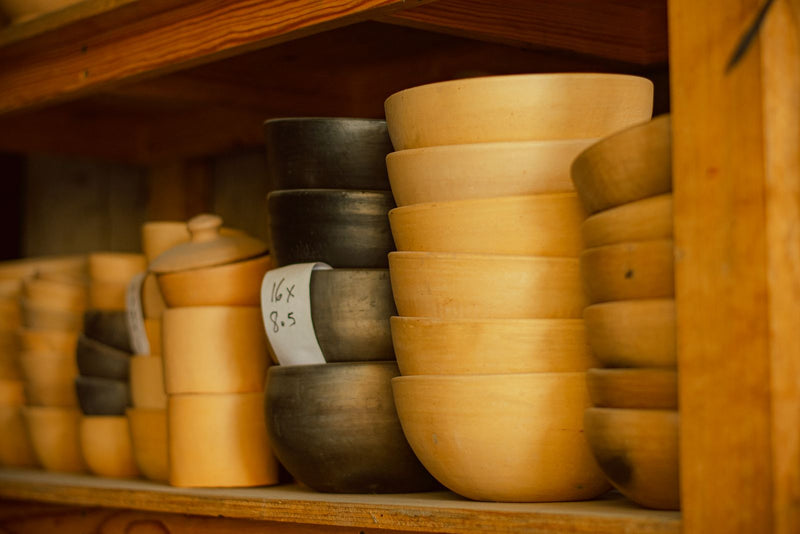
The Gorosin bowls are sized for the two jobs Filipino tables ask serveware to do most: holding sabaw within ladle's reach and keeping sawsawan circulating.
Shop the Gorosin Bowl Set →Frequently Asked Questions
What is the biggest difference between a Filipino table setting and a Western one?
Western settings sequence courses and assign each guest a fixed place. Filipino settings put everything on the table at once and let guests build their own plates from shared vessels. The Western table is plated. The Filipino table is shared.
Do I need matching plates for a Filipino dinner?
No. A mix of wood, ceramic, and woven pieces actually reads more Filipino than a matched set. The texture mix is what signals home rather than formal restaurant. Focus on serveware first, individual plates second.
How much rice should I plan per guest?
Plan for at least one and a half cups of cooked rice per adult, more if your menu leans heavy on sabaw dishes. Keep a refill source within reach. Running out of rice is the one shortfall a Filipino host should never let happen.
Where should sawsawan go on the table?
Distribute it. One sawsawan bowl per two or three seats, repeated along the length of the table. A single ramekin in the middle only ever gets used by the people closest to it. Sawsawan that no one can reach might as well not be there.
Is it rude to eat before all the food is out?
The bigger rudeness is for the host to eat before the guests have rice on their plates. Once every guest has been served at least a starting portion, the host sits and eats with them. Pakikisalo is the principle: you eat alongside, not after or before.
Can I mix wood, ceramic, and woven pieces on the same table?
Yes, and you should. Mixed textures read more authentically Filipino than a uniform set. Use wood for serving boards and bowls, ceramic for individual plates, and woven pieces (banig, abaca trays) for placemats or under-platters.