The gift sits by the door for three days before Tita brings it into the kitchen. Not because she does not want it. Because she wants to remember it. This is what a Filipino thank-you looks like when it is done well. The object waits. The gratitude arrives slowly, holds, and then keeps holding.
If you are shopping for a salamat po gift, you are probably already sensing that a store-bought hamper or a rushed card will not carry the weight you owe. Maybe you are thanking a ninang who watched your kids for a week. A kasambahay who stayed through a family emergency. A coworker who covered your shifts when your mother was sick. A tito who walked you through visa paperwork. In each of these, the debt is not a debt in the transactional sense. It is utang na loob, and it wants to be honored with an object that itself shows respect.
This guide walks through nine Filipino thank-you gifts, ranked by weight of gratitude. Light salamat at the top. Utang na loob at the bottom. Along the way we cover the wrapping, what to say when you hand it over, and why you never mention the price.
Why "Thank You" in Filipino Culture Isn't a Transaction
Filipinos do not really say thank you the way English does. Salamat po carries something the English "thanks" does not, which is why we say it in Tagalog even when the rest of the conversation is in English. Po marks respect. Salamat carries the acknowledgment. Together they say: I see what you did for me, and I hold it.
Utang na loob, the debt that isn't a debt
Utang na loob translates poorly. Literally, "a debt of the inside." Not a financial debt. Not a favor owed. It is the internal bond that forms when someone helps you in a way that touches the shape of your life. When your ninang paid your first semester tuition. When your neighbor drove your lola to dialysis for six months. When a friend flew home for your father's wake.
You do not repay utang na loob. You honor it. The distinction matters because it changes what the gift is for. A transactional gift settles the ledger. A utang na loob gift says the ledger is not the point. The bond is the point.
Paggalang and why the gift itself must show respect
Paggalang is respect made visible. It is the reason you put the po in salamat po. It is why you hand a gift with two hands, not one. It is why the object itself has to carry weight.
A rushed gift card fails paggalang not because it is cheap, but because it is hurried. It says you fit the thanks into your day rather than making a day for the thanks. A hand-carved acacia board fails when it is dropped off without a note. The object is right. The offering is thin.
This is why we lean toward objects that have their own presence. Wood that shows its grain. Pieces that will be used at a table. Gifts that will still be in the receiver's kitchen five years from now, doing the work of feeding the people they love. That kind of longevity is paggalang made permanent. For deeper context on why Filipino gifts so often center on food and the shared table, see our piece on salu-salo and pakikisalo, which explains why food-centered giving lands the way it does.
What gets it wrong (cash in an envelope, a rushed gift card)
Cash is not rude in Filipino culture. It is what you give at binyag, at kasal, at graduations. But cash has a specific job, which is to help pay for the occasion. As a thank-you, it changes the register. It moves the gesture into the market, and the market is exactly where utang na loob does not want to live.
The other common miss is the last-minute grocery hamper. A tin of biscuits, a bottle of wine, a card. It is not wrong. It is just proportional to a small favor. If your ninang stepped in when your marriage broke down, a hamper says you did not know how to weight it. The object should tell the receiver: I understand what you did for me.
The Nine Filipino Thank-You Gifts, Ranked by Weight of Gratitude
The list below moves from light salamat to lifelong utang na loob. This is not a ranking of quality. It is a ranking of match. A light salamat gift given for a life-shaping kindness looks stingy. An heirloom piece given for a small favor looks confusing. Read your relationship. Read the kindness. Then pick from the tier that fits.
How this list is organized
The three tiers roughly correspond to how long the kindness will stay with you. Light salamat covers help you will remember for a season. Meaningful salamat covers help that will stay in the family stories. Utang na loob covers help that changed a life direction, yours or someone you love.
A note on presentation and pasabit
Pasabit, in Ilocano and adjacent Tagalog usage, refers to sending something along with a small handwritten tag or note. It is a habit worth adopting for every tier. A brief line in Tagalog does more than an eloquent paragraph in English. "Salamat po sa lahat, Ninang" on a piece of kraft paper is enough. We come back to what to write in the closing chapter.
Light Salamat: For Small Kindnesses (Coworkers, Neighbors, One-Time Favors)
Light salamat is not a lesser gift. It is a gift correctly sized. A coworker who covered one shift. A neighbor who signed for a parcel. A friend who dropped off adobo when you were sick. These kindnesses want to be acknowledged, but they do not want to be inflated. If you go too big, you burden the receiver with the sense that they now owe you something back. Correct sizing keeps the relationship easy.
1. A hand-carved acacia serving board with a handwritten note
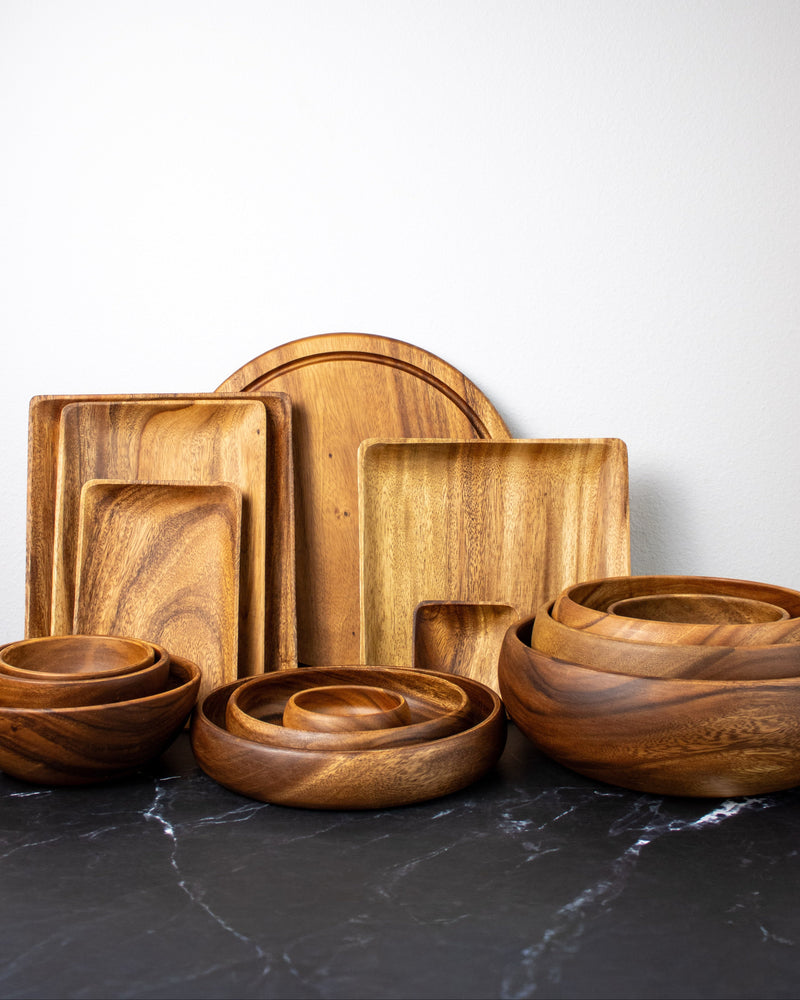
An acacia board sits somewhere between a functional object and a small piece of the house. Sturdy enough for cheese, bread, or pandesal on a Sunday morning. Warm enough to hold on the counter as decor when it is not in use. The note is what does the work. Three lines on kraft paper. What they did, what it meant, and salamat po at the end.
For coworkers you like but do not know deeply, a mid-sized board is safer than a hosting set. It reads as thoughtful without reading as intimate. The receiver can leave it out without feeling that a stranger has moved into their kitchen.
2. Suka and patis pairing on a small acacia tray
A small acacia tray with a bottle of native suka (coconut vinegar) and a good patis (fish sauce) is a gift that says: I know your kitchen. It works especially well for neighbors who cook, or for a friend who has been asking about that adobo recipe you brought over last month. The tray is the anchor. The condiments are the invitation to keep cooking.
If they are not a heavy Filipino cook, swap the patis for calamansi juice or a jar of bagoong they can dip green mango into. The tray becomes the permanent object. The pairing rotates with the season.
3. A single ama bowl filled with heirloom rice or pastillas
A single acacia ama bowl, small size, filled with heirloom rice, pastillas de leche, or polvoron and wrapped in katsa cloth. This is the classic pasalubong-shaped thank-you. The bowl stays. The contents do not. What the receiver keeps is the object that fed them once, which becomes the object that feeds their family many times.
For office coworkers, this reads as elegant without being over the top. For neighbors, it reads as neighborly in the deepest sense of the word: I brought you something to eat, and I brought you something to eat from.

The mini hosting set for a considered salamat
A pared-back trio of acacia pieces that says thank-you without inflating the occasion. Right for the meaningful salamat tier, ninongs and ninangs included.
Shop the mini hosting set →
Meaningful Salamat: For Sustained Help (Ninongs, Ninangs, Long Favors)
Meaningful salamat is what you give when the kindness lasted. When someone was there across weeks, months, or a hard season. Ninongs and ninangs live in this tier by default, because their role is sustained care, not a single act. So do the family friends who cooked for your household while your mother was hospitalized, and the tito who kept showing up to help with paperwork.
4. The mini hosting set as a "you fed me, now I feed you" gesture
A mini hosting set (a serving board, a bowl, and small dishes) turns a thank-you into an invitation to keep hosting. It is especially powerful for a ninang who taught you what a Filipino table looks like. You are saying, in wood: what you gave me, I now want you to keep giving to the people at your table.
This gift lands hardest when paired with a follow-up meal at their house, using the set. Bring the food. Let them host with the pieces you gave them. Close the circle.
5. Engraved acacia board with the receiver's family name
A serving board engraved with the family surname turns an already good gift into an heirloom. It says: this is not just for you. This is for the people who will sit at your table after you, and after them. Filipino gift-giving has always thought across generations. Engraving names the intention out loud.
A single line, sans-serif or block, along the underside or one edge. "Familia Reyes." "Bahay Santos." "Ang Hapag ng mga Cruz." Simple is more paggalang than ornate.
6. A rose bud set for a ninang who taught you to host
A rose bud set (small acacia dishes arranged like petals, for dipping sauces, condiments, or slices of fruit) is a specifically feminine framing that suits a ninang who is remembered for her table. She is the one who taught you that a proper salu-salo has a suka dish next to the lumpia, a calamansi next to the pancit, a bagoong for the mango. The rose bud set makes that lesson visible on her own table.
If you are also considering a birthday gift for a ninang who fits this description, our guide on birthday gifts for a Filipino host walks through adjacent options that layer with a thank-you.

The ama bowl set, for utang na loob weight
A full acacia bowl set passed with two hands is a gift that reads as heirloom on arrival. Right for the kindness that changed a season of your life.
Shop the ama bowl set →Utang Na Loob Gifts: For Life-Shaping Kindness
Utang na loob is for the person who changed your line of life. The tita who paid the deposit on your first Sydney apartment. The kasambahay who essentially co-raised you. The ninang who mortgaged something to help pay for your surgery. These are not thank-you gifts in the ordinary sense. They are an object placed into the bond, a way of saying: I know I cannot repay this. I want to give something that will sit in your kitchen and remind us both that we are tied.
7. The full ama bowl set, passed with two hands
The full ama bowl set (large, medium, and small acacia bowls, sometimes with matching serving pieces) is the closest a modern gift gets to an heirloom on arrival. Handed with two hands. Not wrapped in glossy paper. Wrapped in katsa or banana leaf, the way people used to wrap food when they walked it to a neighbor.
The two-handed handover is not decorative. It is paggalang made physical. The gift becomes heavier the moment it is given. That weight is the point.
8. Custom-engraved heirloom piece with a date and a Tagalog phrase
Engraving is what pushes a very good gift into a lifelong one. A date they will remember. A phrase they will read out loud years later. Some phrases that land well:
- "Salamat sa lahat" (Thanks for everything)
- "Utang na loob ko sa'yo" (My utang na loob is with you)
- "Para sa iyong hapag" (For your table)
- "Mahal ka namin" (We love you)
The phrase should be short. Two to five words. Long enough to feel considered. Short enough that it lives on the wood without crowding it. Pair with the year, or the year and month of the kindness, if there is a specific one to anchor to.
9. A hosting set gifted so they can host their own salu-salo
A full hosting set (boards, bowls, serving dishes) given specifically so the receiver can host again is a very Filipino way to thank someone. You are not just handing them wood. You are handing them the equipment to keep being who they are in the community. It is especially meaningful for a ninang whose home has thinned out (children moved abroad, husband passed) and who has quietly stopped hosting because she does not have the pieces.
This is also the register we use for corporate thank-yous that need to carry real weight. Our piece on corporate Filipino heritage gifts covers how to gift at scale without losing the paggalang, particularly for Filipino-Australian professionals thanking a mentor, a longtime employee, or a community elder on behalf of a company.

Custom engraving, the last step to heirloom
A date, a Tagalog phrase, a family name. Engraving is what turns a thoughtful piece into an object your ninang will still be handing around at eighty.
Shop custom engraving →How to Give the Gift: The Filipino Way
The gift is half of it. The handover is the other half. You can spend well on the object and still fumble the moment. And you can give a very small gift and land the moment perfectly, because you knew how to give it.
The wrapping (banana leaf, katsa cloth, or simple kraft)
Banana leaf is the traditional wrapper for food-shaped gifts, especially in the provinces. It carries a rural intimacy that reads well for older receivers and for gifts that reference a hometown. If you are gifting outside of a Filipino kitchen (Australian coworker, non-Filipino neighbor), it may read as too esoteric.
Katsa cloth (unbleached muslin) is the middle path. Rustic, tactile, forgiving. A square of katsa tied with abaca string is the safest premium wrap for a Filipino thank-you. It works across generations, across regions, and it does not compete with the wood inside.
Kraft paper works for lighter salamat gifts. Wrap once. Tie with twine. Slip the handwritten note under the string, do not seal it into an envelope. The receiver should see the note before they see the object.
Avoid glossy Western-style gift wrap and stick-on bows. They clash with the material of the gift itself and pull the gesture toward the mall.
What to say when handing it over (and what not to say)
Say less than you think. Filipinos over-explain when they are nervous, which is exactly when a thank-you is happening. The words that work:
- "Salamat po sa lahat." (Thank you for everything.)
- "Para po sa inyo. Sana magamit ninyo." (This is for you. I hope you will use it.)
- "Alam ko po hindi ito sapat, pero salamat po talaga." (I know this is not enough, but thank you truly.)
What not to say. Do not explain the price. Do not explain how long you shopped. Do not say "this is nothing, it is small." That last one is common and it is a mistake. It reads as self-effacing to English speakers, but it can read to the receiver as: I did not think you were worth much. Instead, let the object speak. If they say it is too much, respond, "hindi po, ito lang po ang naisip ko" (it is not, this is just what came to my mind).
Why you never mention the price
Naming the price collapses the gift back into transaction. It puts a number on utang na loob, which cannot have a number. If the receiver asks (some titas will), a warm redirect works: "hindi po importante, ang importante po, salamat po sa inyo" (it is not important, what matters is thank you).
Remove the price tag before wrapping. Remove any store sticker on the base of the wood. Remove the receipt from anywhere in the package. If a piece is engraved, that becomes the identifying mark. There is no need for the shop's logo to appear anywhere the receiver can see.
The follow-up meal, closing the circle of gratitude
The gift is not finished at the handover. It is finished at the follow-up meal. A week later, a month later, whenever it is right, invite the receiver to eat with you. Or, if it is a ninong or ninang, ask them to host you, using the piece you gave them. The gift becomes a hinge between two meals: the memory of the kindness they gave you, and a fresh gathering where you are together again.
This is why so many Filipino thank-you gifts are tableware. The gift is not the object. The gift is the meals it will host, for years, with the receiver at the head of the table. If you are thinking about extending this logic to a new home rather than a thank-you, our Filipino housewarming gifts guide covers the adjacent occasion using much of the same paggalang framework.
Frequently Asked Questions
What is a traditional Filipino thank-you gift?
Traditionally, a Filipino thank-you gift is food-adjacent: heirloom rice, pastillas, a jar of something homemade, or the tools to host a meal. Modern versions include acacia serving pieces, engraved boards, and full hosting sets. The through line is that the gift supports the receiver's ability to feed their people. It is rarely a purely decorative object.
Is it rude to give cash as a thank-you gift in Filipino culture?
Cash is not rude, but it changes the register. Cash belongs at baptisms, weddings, graduations, and funerals, where it helps pay for the occasion. As a thank-you for a personal kindness, cash reads as transactional. It settles the ledger, when utang na loob does not want to be settled. A chosen object shows more paggalang and lasts longer in the receiver's memory.
What does "salamat po" mean, and how does it differ from "salamat"?
Salamat is the basic Tagalog word for thanks. The po turns it into a respectful form used with elders, in-laws, ninongs, ninangs, or anyone deserving deference. Salamat po literally means "thank you" with the honorific attached. In practice, it carries a weight that "thanks" in English does not: it acknowledges the person and their standing in the same breath.
What's a good thank-you gift for a ninong or ninang?
Ninongs and ninangs sit in the meaningful salamat tier by default. A mini hosting set, an engraved acacia board, or a rose bud set (for a ninang known for her table) all read correctly. If they helped through a life-shaping season, move up to the full ama bowl set or a custom-engraved heirloom piece. Wrap in katsa cloth, hand with two hands, and follow up with a shared meal.
Should I include a note with a Filipino thank-you gift?
Yes, always. A short handwritten note in Tagalog is better than a long note in English. Two or three lines is enough. Kraft paper or plain card. Slip it into the wrapping so the receiver sees it before they open the object. This is the pasabit detail that turns a good gift into a proper one.
What is utang na loob and how does it shape gift-giving?
Utang na loob literally translates to "a debt of the inside." It is the internal bond formed when someone helps you in a way that touches the shape of your life. You do not repay it, you honor it. In gift-giving, this means matching the object to the depth of the bond. A small favor calls for a small gift. Life-shaping kindness calls for something heirloom, given slowly, with the receiver's future meals in mind.