The Honest Answer: They Do Different Jobs
If you are reading this, you have probably seen the version of the argument that picks a winner. Acacia is warm and natural, so wood wins. Ceramic is classic and dishwasher safe, so ceramic wins. Neither answer holds up at an actual Filipino table, because both are doing different work. A plate that handles sinigang well is not the same plate that handles a long pulutan night with lumpia, chicharon, and sliced mangoes with bagoong.
Why "which is better" is the wrong question
"Better" only makes sense once you name the meal. A bowl of mainit na tinola served straight off the stove is a heat and liquid problem. A platter of inihaw na liempo with atchara and kanin is a grease, grain, and presentation problem. These are not the same problem, and the plate that solves one will frustrate you at the other. The faster you stop asking which material is superior, the sooner you can build a table that handles real Filipino meals without compromise.
Quick decision frame
When you are unsure which plate to reach for, check four things in order: heat, liquid, occasion, and weight. Hot and wet pushes you toward ceramic. Dry and shared pushes you toward acacia. Formal sit-down meals lean ceramic. Outdoor kainan, handaan, and long grazing tables lean wood. If a meal is mixed, which most are, you will end up reaching for both. That is the point.
What this guide will and will not tell you
This is not a verdict. It is a working frame for deciding what each plate is for in a Filipino home, what each one fails at, and how households who own both actually use them across a week. We will name specific dishes, not abstract categories. We will not tell you to throw out your ceramic, and we will not pretend acacia is a universal upgrade. Both are tools. The skill is knowing the job.
What Ceramic Plates Do Best
Ceramic earns its place in every Filipino home for reasons that have nothing to do with style. It tolerates direct heat, it handles long contact with acidic liquids, and it cleans up in a dishwasher. For weeknight dinners built around sabaw and sauce, ceramic is the workhorse. Treat this section as the case for keeping every ceramic plate you already own.
High-heat dishes and freshly poured sauces
Sinigang straight from the pot, tinola ladled hot, nilaga with the broth still steaming. These are ceramic situations. A glazed ceramic plate or shallow bowl accepts boiling-hot liquid without flinching, and it does not transfer heat to the table fast enough to scorch a runner or a child's hand. Ceramic also holds heat longer than wood, which matters when the second person at the table sits down five minutes after the first. For broth-heavy mains, ceramic is the answer.
Acidic foods sitting long
Kinilaw with vinegar working through the fish for fifteen minutes at the table. Adobo where the soy and suka pool around the rice. Pickled atchara on a side dish. Glazed ceramic is non-porous and chemically inert, which is exactly what you want when acid sits in contact with the surface for a long time. Wood is also food safe when finished properly, and you can read the full case for that in our explainer on whether acacia wood is food safe, but ceramic is the safer default for anything wet and acidic that will sit on the plate for half an hour or more.
Formal place settings and dishwasher convenience
For weddings, baptisms, and any meal where every place setting needs to match exactly, ceramic is easier to source in volume. It also goes in the dishwasher without a second thought. If you host twenty people on a regular Sunday and the kitchen has to reset for breakfast the next morning, ceramic is the plate that gets you there.
Where ceramic struggles
Ceramic is heavy. A stack of twelve dinner plates in a small kitchen cupboard is a real shelf load. It chips when it taps the sink, and a chipped rim is a plate you should retire because it now harbors bacteria in the crack. It rings sharply when stacked, which is not what you want at the end of a long meal when the kids are sleeping. And it feels cold to the hand on a December merienda, which sounds trivial until you notice how much warmth a wooden plate adds to the same gesture.
What Acacia Plates Do Best
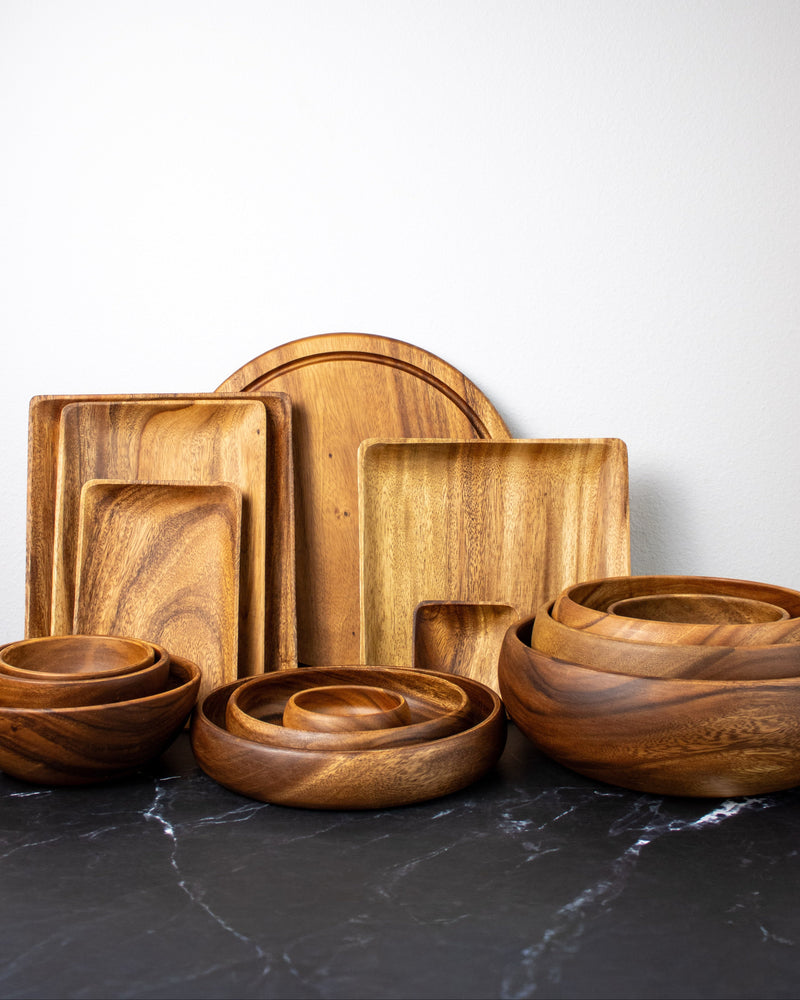
Acacia is not a ceramic replacement. It is a category expansion. The dishes it serves better are the ones ceramic was never designed for: grilled, dry, finger-foods, and platters meant to be shared. Wood also changes the social temperature of a meal, which is not a marketing claim, it is something you notice the first time you put a plate of grilled liempo on a dense, grained acacia board instead of a white ceramic plate.
Grilled, dry, and finger-food dishes
Inihaw na liempo, inihaw na bangus, lechon kawali, crispy pata. Lumpiang Shanghai with a small bowl of sweet chili. Ulam platters meant for kamayan. These are the dishes acacia was made for. Wood does not pool grease the way ceramic does, the grain reads beautifully under the brown of grilled meat, and the slight give of the surface means a knife will not screech against the plate. For any dish where the eater might pick something up with their hands, acacia is the more honest plate.
Pasalubong-style spreads and pulutan boards
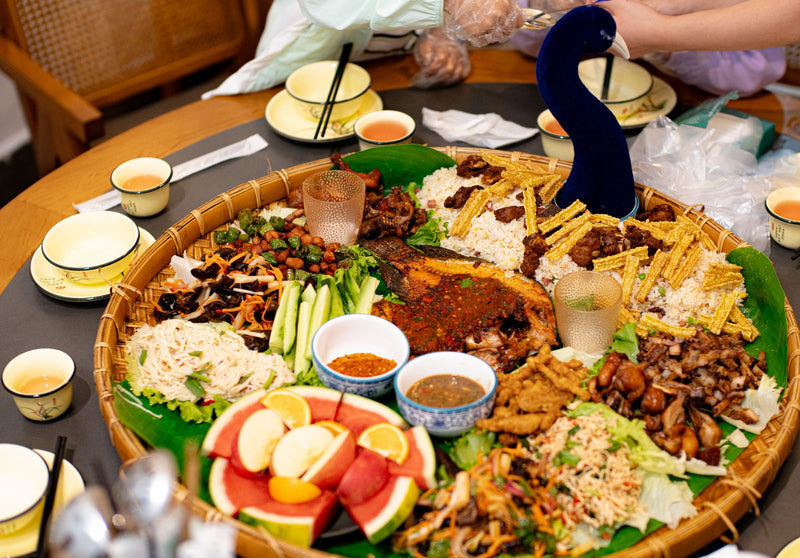
A pulutan night does not work on individual ceramic plates. It works on shared surfaces, where six small things sit together and people graze. Acacia plates and boards are the natural home for this kind of meal: sliced chorizo, kesong puti, salted egg, peanuts, sliced cucumber, chicharon. A single wooden plate in the middle of the table changes how people eat. They lean in, they take less at a time, they stay longer.
Outdoor kainan, kids' tables, and pakikisalo gatherings
Wood does not break when a four-year-old drops it. That alone makes acacia the default for kids' tables and for any meal that happens outdoors. It also does not chip when it knocks against another plate, which matters at a handaan where plates are stacking, sliding, and getting passed around. Pakikisalo, the act of joining a meal in progress, is easier when the plates can take the chaos.
Visual warmth: how grain reads under everyday light
This is not a small thing. Ceramic reflects light flatly. Acacia absorbs it, and the grain pattern shifts as the day moves. At a window-lit weekend lunch, a wooden plate looks like part of the meal, not a backdrop to it. White ceramic, by contrast, can feel hospital-bright at noon. If you are someone who notices the light at the table, you will notice this difference within a week of using both.

A starter set built for grilled and shared meals
If you are adding acacia for the first time, a four-piece plate set covers most of the dishes ceramic struggles with.
Shop the Chenoweth Plate Set →Side-by-Side: Six Real Decision Points
Marketing comparisons usually stop at "natural vs durable." Real kitchens care about six specific things. Here is how acacia and ceramic actually stack up at each one, with the trade-offs named honestly.
Heat tolerance and what "hot food" actually means at home
Ceramic handles food off the stove directly. Acacia can hold hot food, but not boiling-hot liquid sitting on it for a long time. In practice, that means inihaw straight from the grill is fine on wood, the meat surface is hot but not wet. Sinigang ladled boiling from a pot is a ceramic job. If you are unsure, ask whether the food is still steaming liquid. Steaming liquid points to ceramic. Hot solids point to either.
Weight, stack height, and storage in small Filipino kitchens
Acacia is roughly half the weight of equivalent ceramic per plate. In a small kitchen with a single overhead cabinet, a stack of twelve wooden plates fits where eight ceramic ones would crowd the shelf. Wood also does not require the same protective spacing between plates, because there is nothing to chip. If your kitchen is tight, weight and storage are real considerations, not aesthetic ones.
Care load: handwash vs dishwasher, oiling vs none
Ceramic goes in the dishwasher. Acacia is hand-wash with warm soapy water, dried promptly, and oiled occasionally with food-grade mineral oil to keep the grain from drying out. That sounds like more work, and it is, but the actual time cost is small: thirty seconds per plate at the sink, ten minutes once every couple of months for oiling. The full routine is in our guide to how to care for acacia wood plates. If you cannot or will not hand-wash, do not buy acacia. If you can, the care load is not the obstacle people imagine.
Lifespan and what "damage" looks like for each
Ceramic chips and cracks. Once chipped at the rim, a plate is done, because the chip becomes a place for bacteria to lodge. Acacia does not chip. It can dry out, lose its surface oil, or warp if left wet overnight. All three are recoverable. Sand lightly, re-oil, and the plate is back in service. In practical terms, a well-cared-for acacia plate outlasts most ceramic by years, because the failure modes are reversible rather than terminal.
Cost per use over five years
A mid-range ceramic dinner plate runs roughly the same per piece as a comparable acacia plate. If you use a ceramic plate twice a week for five years and never break it, that is 520 uses. Acacia at the same cadence costs the same per use. The variable is breakage. Households with small kids, frequent guests, or cramped kitchens break ceramic faster than they wear out wood. For those households, acacia is the cheaper plate over time.
Sound and feel during a long meal
Stack three ceramic plates and you hear it across the room. Stack three wooden ones and you barely hear anything. At a three-hour Sunday lunch with twelve people, this matters more than it sounds like it should. Wood absorbs sound. Cutlery against a wooden plate is quieter than cutlery against ceramic. None of this is decisive on its own. All of it adds up across a long meal.

For salad, dessert, and merienda portions
Smaller acacia plates handle the dishes a full dinner plate is too big for, from halo-halo bowls of sliced fruit to single-serving lumpia plates.
Shop the Anak Plate Set →How Filipino Households Actually Mix Both
The households that have figured this out do not pick a side. They run both, and the pattern is consistent enough across Filipino kitchens that it is worth naming directly. Here is how the mix actually works in practice.
The "wood for ulam, ceramic for sabaw" pattern
The shorthand most homes settle on is simple: anything with broth goes on ceramic, anything dry or grilled goes on wood, and rice sits on whichever is closer. This is not a rule, it is a habit that emerges naturally after a few months of owning both. The plate you reach for matches the food's physical state. Liquid finds ceramic. Solid finds wood. Mixed plates split the difference depending on what dominates.
Setting a hybrid table without it looking mismatched
The trick is not to alternate plates around the table. That looks accidental. Instead, dedicate the wood to the shared center: a long acacia board with the lechon, a wooden plate of inihaw between guests, a wooden bowl of kanin if you are kamayan-style. Keep ceramic for the individual place settings: each guest gets a ceramic bowl for their sabaw, and a small ceramic plate for their rice if you are plating individually. The table reads intentional because the materials are zoned by function, not scattered randomly.
When to bring out acacia: handaan, pulutan night, weekend lunch
Acacia gets the special occasions and the slow meals. A handaan with a long lechon platter. A pulutan night with friends and three small wooden plates of sides. A Saturday lunch that goes for two hours because nobody is in a hurry. The plates are not the reason the meal lasts longer, but they signal to everyone at the table that this is a meal worth lingering at.
When ceramic stays the default: weekday dinners with broth-heavy mains
Tuesday night sinigang for four. Wednesday tinola. Thursday nilaga. These are ceramic dinners, full stop. The food is hot and wet, the meal is short, the plates need to go in the dishwasher because tomorrow is another work day. Save the acacia for Saturday.
Building Your Plate Collection the Practical Way
If you are deciding what to buy first, or what to add to an existing collection, here is the practical sequence most Filipino homes end up at. None of this is a marketing answer. It is what people actually own after a few years of cooking and hosting.
If you already have ceramic, what to add first
Add one large acacia platter or board for shared dishes, and a set of four smaller acacia plates for sides, dessert, and merienda. That is it. You do not need to match your ceramic count. The acacia is doing different work, so it does not need to scale the same way. One large platter covers handaan and pulutan. Four small plates cover everything from sliced mango to lumpia to a single ensaymada at three in the afternoon.
If you are starting fresh, the 60/40 split most homes settle on
For a household of four that hosts occasionally, a workable starting kit is roughly 60 percent ceramic and 40 percent acacia. That looks like eight ceramic dinner plates, eight ceramic bowls for sabaw, four to six acacia dinner plates, four small acacia plates, and one or two acacia platters or boards for shared dishes. This is enough for daily life plus a Saturday meal for ten without anything plastic appearing on the table.
Sizes that matter
You need fewer sizes than the catalog suggests. A standard dinner plate handles most ulam. A smaller plate handles salad, dessert, merienda, and side dishes. A bowl handles sabaw and kanin. A platter or board handles shared dishes. Skip the specialty shapes until you know you actually need them. Most households use four sizes and ignore the rest of the catalog.
A note on care so acacia outlives the trend cycle
Wooden tableware has cycled in and out of style for decades. The pieces that survive are the ones that get cared for. Hand-wash, dry promptly, oil occasionally, do not soak. That is the whole routine. The full deep-dive on materials, sourcing, and long-term care is in our complete acacia wood guide, which is worth reading once if you are committing to wood for the long term. Done right, an acacia plate is a thirty-year object. Done casually, it is a five-year object that ends up in the kids' picnic kit. Both are fine outcomes. The difference is how you treat it in year one.

The full plate collection for a hybrid table
If you are building the acacia side of a 60/40 split in one go, a complete plate set is the simplest way in.
Shop the Ina Plate Set →Frequently Asked Questions
Can I use acacia plates for sinigang or other soupy dishes?
For a quick bowl of sabaw, ceramic is the safer default. Wood handles hot food fine, but boiling liquid sitting on the plate for a long time will dry out the surface oil faster than it should. Use ceramic for sinigang, tinola, and nilaga, and save the acacia for the dry ulam beside the bowl.
Do acacia plates stain from patis, suka, or toyo?
Properly finished acacia resists short contact with patis, suka, and toyo without staining. Long contact, more than thirty minutes, can leave a faint mark on lighter pieces. Wipe spills promptly and the plate stays clean. Darker plates hide marks better if you cook a lot with toyo.
Are wooden plates safe for hot food straight from the pan?
Hot solid food straight off the grill or pan is fine on acacia. Boiling liquid is not. Inihaw na liempo at 80 degrees Celsius lands on wood without issue. Sabaw that is still bubbling needs ceramic. The rule of thumb is whether you can comfortably touch the food for a second. If yes, wood is fine.
How long do acacia plates last compared to ceramic?
A cared-for acacia plate often outlasts ceramic, because its failure modes are reversible. Wood can be sanded and re-oiled if it dries out. Ceramic that chips at the rim is finished. In households with frequent guests or small kids, acacia tends to be the longer-lived investment by a wide margin.
Can I put acacia plates in the dishwasher to save time?
No. The dishwasher's heat and prolonged water exposure will warp, crack, or dry out the wood. Acacia is hand-wash only, with warm soapy water and a prompt towel-dry. If dishwasher-safe is non-negotiable for your household, stick with ceramic and use acacia as accent pieces for occasions.
Do I need to choose between acacia and ceramic, or can I use both?
Almost no Filipino household ends up choosing one. The realistic outcome is owning both and reaching for whichever fits the meal. Ceramic for weekday sabaw, acacia for shared and grilled dishes. The two materials are complementary, not competing, once you stop treating them as substitutes.