A family tree engraved into wood is not a document. It is an object your niece can hold, that survives a power outage, that ends up on a table during noche buena and starts a conversation between three generations who otherwise would not have talked. The shift back to physical heirlooms is not nostalgia. It is a response to how easily digital records vanish and how little weight they carry when you want to hand your surname to someone.
Why families are turning back to physical heirlooms
Every Filipino family has a shared drive somewhere with scanned baptism certificates, phone photos of a lola's handwritten notes, and half-finished family tree apps that stopped syncing three years ago. The information is there. It is also fragile. Accounts get closed, phones die, subscription platforms shut down, and the person who knew the password passes on. A physical piece with names carved into it does not require anyone's login.
What digital records cannot hold
Digital genealogy is efficient at storing data and terrible at conveying weight. A spreadsheet cell reading "Gorosin, Emilio, 1902 to 1968" carries the same visual weight as the row above and the row below. But a name burned into wood, sized appropriately, placed on a physical object that gets passed around a table, carries the weight it deserves. This is not sentimentality. It is how objects work in memory. The Smithsonian's research on family heirlooms has long noted that tactile items are retained across more generations than paper records, largely because they participate in daily life.
The heirloom question in Filipino households
Filipino families already understand heirloom logic. The santo passed down through generations, the abuela's earrings that get worn only at weddings, the boodle fight platter that has been at every reunion for twenty years. What changed recently is that fewer families have those objects still intact. Migration, house fires, typhoons, and the simple attrition of decades have thinned out physical inheritance. Commissioning a new heirloom is a way to restart the line without pretending the old objects are still there.
Gathering the names
Before anything gets drawn or engraved, the names have to be right. This sounds obvious until you sit down and try to write out four generations from memory. Names are the part that families get wrong most often, and the part that cannot be corrected once wood is burned.
Deciding the scope
The first question is whose names go on the piece. There are three common shapes:
- Paternal apelyido only. Traces one surname through the male line. Compact, historically common, and the format used in most printed genealogies. Leaves out roughly half the family by design.
- Bilateral. Includes both maternal and paternal lines. Truer to how Filipino families actually operate, especially given that many households center around the mother's side and the lola's cooking. Takes more space and requires more layout thought.
- Chosen family. Includes ninongs, ninangs, adopted siblings, and long-standing household members who are not blood but are family in every functional sense. Common in Filipino diaspora families where the household of origin was never strictly biological.
None of these is more correct than another. The choice reflects what the family wants the piece to say. A paternal-only piece tells one story. A bilateral piece tells a different one. Decide before layout.
Living celebration or memorial
The second question is what the piece is for. A memorial piece foregrounds those who have passed and often uses year ranges (1934 to 2019) beneath each name. A living-celebration piece foregrounds the current generation and treats the older names as the roots feeding it. Both are valid. Mixing them without care produces a piece that reads as neither, so pick a lean and commit to it.
Spellings, nicknames, and dates
Spelling matters more than families expect. "Delos Santos" versus "de los Santos" is not the same name on a legal document, and a lola who spelled it one way on her marriage certificate may have spelled it another way on her children's baptism records. Ask two elders separately, in writing. Do the same for maiden names, which are often lost within a single generation.
Decide early whether nicknames appear. "Tita Baby" is what the family calls her. "Concepcion" is her legal name. Some families want both. Some want only the formal name. Some want only the name the family actually uses. Any of these works. The mistake is deciding at the layout stage and having to redo the arrangement.
Planning the layout on wood
Layout is where most engraved family pieces succeed or fail. A beautiful tree design on paper does not automatically translate to a physical object with its own grain, edge shape, and functional purpose. The wood pushes back.
Reading the grain first
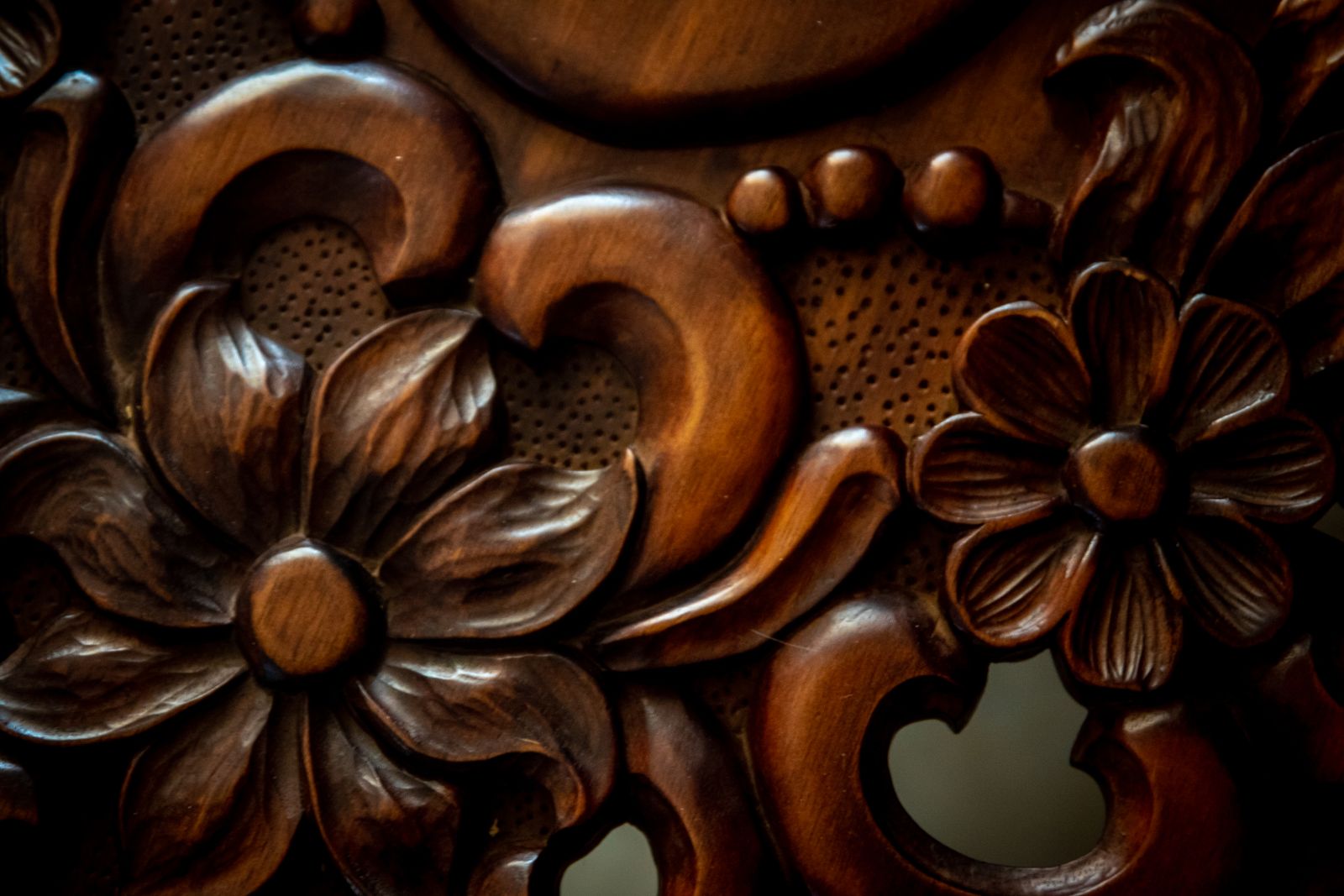
Acacia has strong figure. The dark streaks and lighter fields are not decoration; they are the tree's growth history, and they run in a direction the engraving has to respect. Names placed across a strong dark band become harder to read. Names running against the grain look off-balance. Before any layout is drawn, the specific piece being engraved should be photographed and the grain traced. This is why generic templates rarely work for wood engraving. Each board has its own map.
Tree diagrams versus name arrangements
Two dominant layouts exist for family pieces:
- Tree diagram. Literal branches with names attached at nodes. Beautiful when done well, cluttered when done poorly. Works best when generations are roughly balanced. Fails when one branch has twelve children and another has one.
- Name arrangement. No branches drawn. Names are grouped by generation in bands or concentric rings, with typography doing the hierarchical work instead of graphic lines. Ages better than tree diagrams because adding a name later does not require redrawing the whole structure.
For families that expect to add names over time (most families), the name arrangement is usually the wiser choice. It looks less immediately impressive than a full tree diagram, but it survives the passage of years without becoming visually broken.
Leaving room for future names
A family tree engraved today should have physical space for names that do not yet exist. Grandchildren will be born. Marriages will happen. Someone will convert, adopt, or return to the family after years away. Reserve at least 20 percent of the usable engraving surface as blank. Not visually blank, but literally unengraved wood ready to receive additions. Reengraving over existing burn marks is possible but rarely as clean as fresh engraving on fresh wood.

Start with the engraving service
If you are ready to commission a family tree piece, this is where the conversation about names, scope, and layout begins.
Shop the Custom Engraving →Why acacia holds the detail
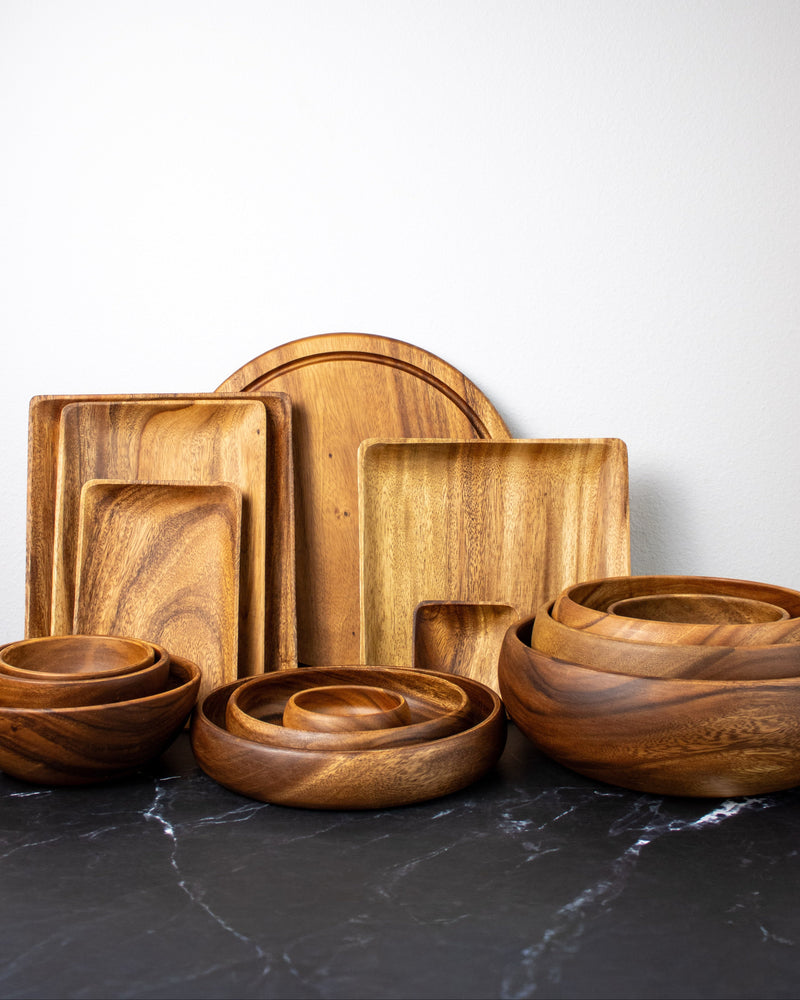
Not every wood engraves well. Softwoods burn too hot and blur. Very dense hardwoods resist the laser and produce shallow, gray lines instead of clean dark ones. Acacia sits in the middle of the density range, which is one of the reasons it has become the default wood for engraved heirloom pieces in the Philippines.
Grain density and legibility
Acacia's Janka hardness rating is around 1750 lbf, which puts it above oak but below ebony. That density gives the engraving crisp edges. Characters as small as 4mm remain legible on a well-prepared surface, which matters when you are fitting thirty to fifty names on a single piece. Softer woods like pine would smear at that size, and bamboo, which is technically a grass, does not hold fine detail at all because its structure is hollow-fibered.
How color contrast works with laser burning
Laser engraving on acacia produces a dark brown to near-black burn against the wood's natural warm brown. The contrast is legible without being harsh. This is different from engraving on lighter woods like maple, where the contrast is stark and can feel clinical, or on very dark woods like walnut, where the burn nearly matches the surface and details disappear at distance. Acacia's mid-tone is what makes the names readable from across a room.
What the finish does to engraving
Oiled finishes deepen the wood's color and slightly increase contrast with engraved lines. Waxed finishes give a softer surface and slightly muted contrast. Fully sealed pieces (polyurethane or lacquer) preserve engraving indefinitely but change the tactile feel of the wood and prevent future engraving. For a piece expected to receive additions over decades, an oil-and-wax finish is the more practical choice.
Functional piece or display piece
The single most important decision after scope is whether the piece will be used or displayed. Everything else, layout, size, wood thickness, finish, follows from this.
What survives daily kainan
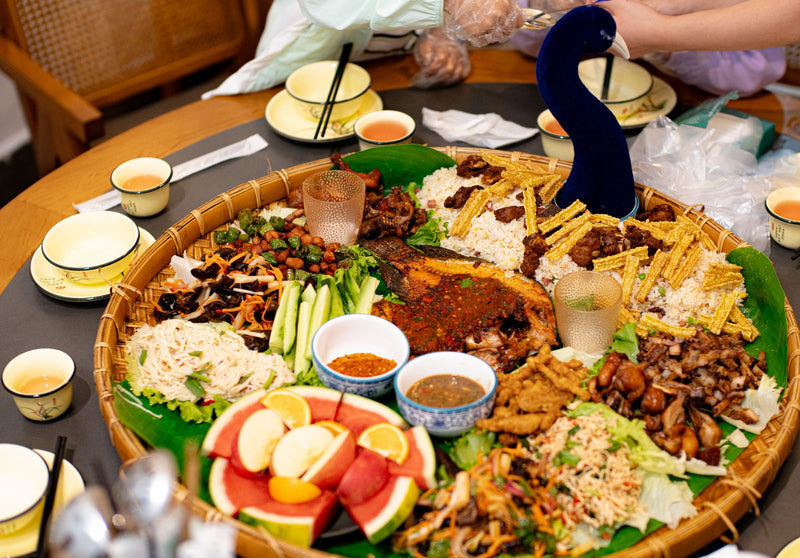
A functional piece is a bowl, platter, or board that goes on the table at meals and holds food. This is not a compromise. Filipino families historically embedded meaning into the objects that fed them, from the palayok to the boodle fight banana leaf. An engraved serving platter that appears at every fiesta and pasalubong dinner is doing more heirloom work than a framed piece on a wall no one looks at.
Functional pieces need thicker wood (18mm minimum for platters, 25mm for boards), food-safe finishes (mineral oil and beeswax, not polyurethane), and engraving depth of at least 0.5mm so the burn survives decades of washing. Names on the underside are common for functional pieces so the top remains available for food service.

A serving bowl set that carries an engraving well
The Gorosin bowl set offers the surface area and grain consistency families look for when the tree is going onto a piece that will also see suka, patis, and rice.
Shop the Gorosin Bowl Set →Display pieces and their conventions
A display piece is meant to be looked at rather than used. Wall-mounted boards, standing plaques, and shelf pieces fall in this category. They allow more elaborate layouts, denser engraving, and finer detail because they do not have to survive washing and food contact. They also permit sealed finishes that lock the engraving in permanently.
The tradeoff is participation. A display piece is seen by whoever enters the room where it hangs. A functional piece is touched by everyone at the table. Both matter. Neither is inherently better. Some families commission both, a functional serving piece for meals and a smaller display piece for the sala or altar.
A hybrid approach
Some families choose a plate set where each individual piece carries part of the tree, distributing the engraving across the table during meals. This is not for everyone. It requires the plates to be used carefully and stored together. But it produces an experience during kainan that no single piece can match: the family literally surrounds the food. If you are considering this, see how the arrangement works on a set of matched plates before committing.

A plate set that distributes the tree across the table
The Ina plate set gives each seated family member a physical piece of the arrangement, so the tree lives in the meal, not above it.
Shop the Ina Plate Set →The reveal and the handoff
Engraved family pieces are often commissioned for a specific moment: a lola's 80th birthday, a wedding, a baptism, a first family reunion after years abroad. The moment matters, and it deserves the same thought as the piece itself.
Choosing the moment
Give the piece during a meal. Not before. Not after. During. The reason is practical: the piece will spend the rest of its life at meals. Introducing it in that context sets its purpose. Handing it over in a hotel lobby or a driveway does not root the object in what it is for. If the moment is a birthday, bring it out with the pancit. If it is a baptism, place it on the table before the litson arrives. The piece belongs at kainan, so its first appearance should be at kainan. For more on how Filipino table objects earn their place through use, see the broader collection of hosting pieces we assemble for reunions and long meals.
Explaining the piece
The person handing over the piece should be able to explain three things without hesitation: whose names are on it, why those names and not others, and where the space for future names is. This is where the earlier decisions about scope pay off. If the paternal-only choice was made deliberately, say so. If certain nicknames were included because that is what the family actually uses, say so. Do not apologize for choices. Explain them.
Older relatives will read their own names first, then look for people they knew. Younger relatives will look for themselves. Both responses are correct. The piece is doing what it should. If a family piece from a previous generation exists, this is also the moment to bring it out and place the new one beside it. Continuity is easier to feel when you can see both objects at once.
Care after the handoff
The person receiving the piece needs to know how to keep it. Not in a long lecture, but in enough detail that they will not damage it in the first month. Two sentences usually suffice: wipe it with a damp cloth after use, and re-oil it with food-safe mineral oil twice a year. The FDA classifies mineral oil as food-safe for direct wood contact, and it is what nearly every professional woodworker recommends for maintaining acacia. Written care instructions can go with the piece. Verbal instructions during the handoff carry more weight.
Families that want a fuller hosting set to build around the engraved piece often start with a matched arrangement so the tree piece has visual siblings on the table rather than sitting alone with mismatched ceramics. See the Royal Hosting Set for how a coordinated grouping reads next to an engraved piece.
Frequently Asked Questions
How long does a family tree engraving take from commission to delivery?
Most engraved heirloom pieces take four to eight weeks from the moment names and layout are finalized. The engraving itself is a matter of hours. The time goes into layout drafting, family review, revisions, and the wood-preparation stage. Rush timelines are possible for specific dates but reduce revision windows.
Can names be added later, after the piece is delivered?
Yes, if the piece was designed with future additions in mind and left unengraved surface area is available. The piece must be brought back for the addition; engraving cannot be done at home. Pieces that were sealed with polyurethane or lacquer cannot receive additions because the sealed surface must be sanded away first, which alters the original engraving.
What if there is a spelling error we only notice after delivery?
Small errors can sometimes be corrected by sanding the affected area and reengraving, though the repaired zone may show slightly different grain color afterward. Large errors usually mean commissioning a new piece. This is why written verification of every name with two family members before engraving is standard practice.
Is it appropriate to engrave names of family members who have passed away?
Yes, and this is one of the most common uses of engraved family pieces in the Philippines. Many families use year ranges (birth to death) for deceased members and birth years only for the living, which visually distinguishes the two without requiring separate sections. The convention is a family choice, not a fixed rule.
How much does a custom family tree engraving cost?
Cost varies significantly with piece size, complexity of the layout, number of names, and choice of functional or display use. A small display piece with ten to fifteen names sits at one price point; a large functional serving platter with fifty names sits at another. Pricing is provided after the initial scope conversation, because generic quotes for engraving rarely match the actual work involved.
Should the piece be paternal-only or include both parents' lines?
This is a family decision, not a rule. Filipino household life often centers around bilateral relationships, so many contemporary families choose to include both maternal and paternal lines. Older-style pieces often trace paternal apelyido only. Neither approach is more traditional in a strict sense; both have long histories in different regions.